QLDVICSATASNTACT
Building
Certificate IV in Building and Construction
CPC40120 - CPC40120 - Nationally recognised building and construction training for builders, site supervisors and construction managers.

Three licence classes, each with a named qualification, an experience requirement and financial requirements. Everything you need to get your QBCC builder's licence in Queensland — from choosing the right class to submitting your application.
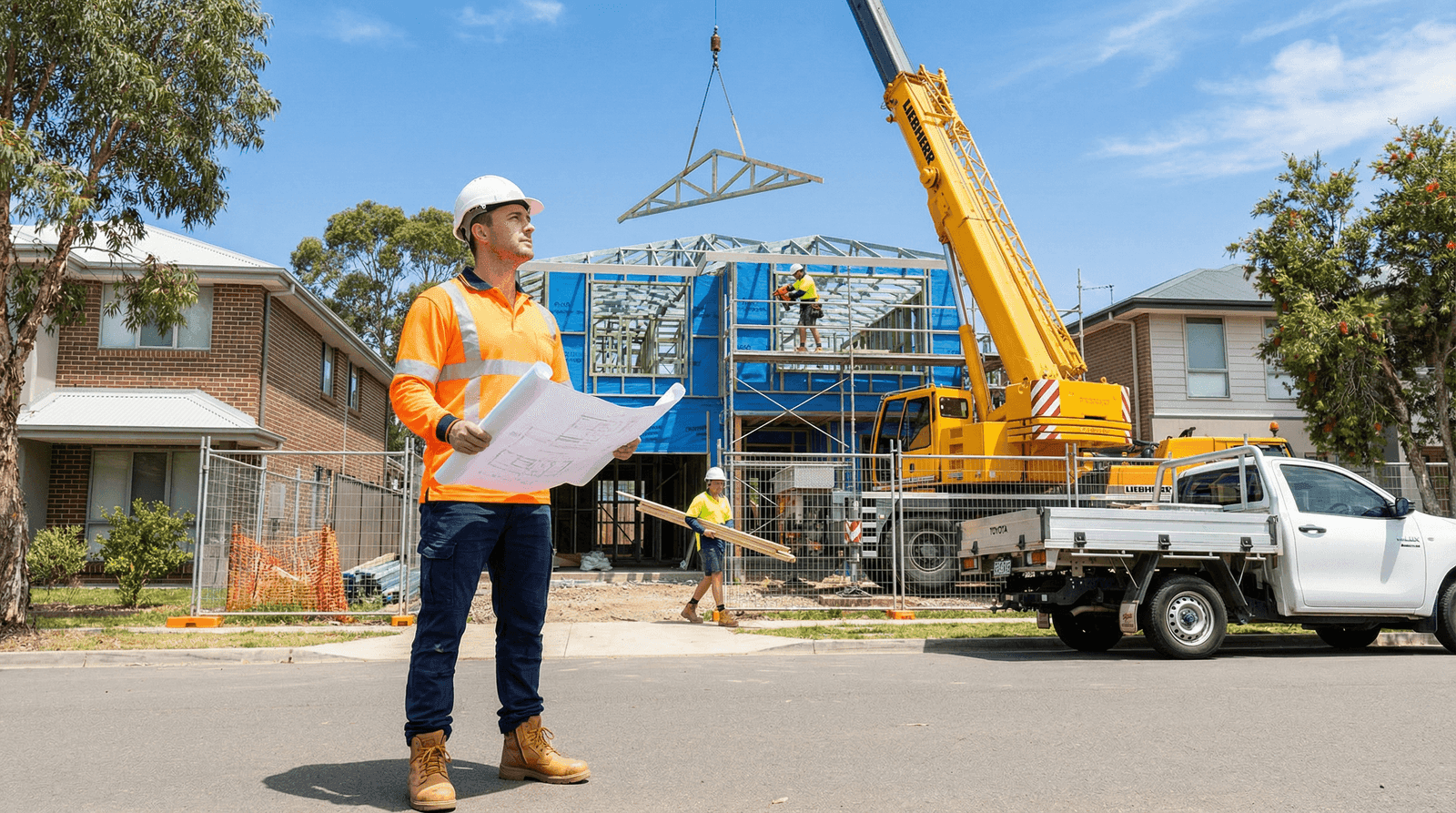
A QBCC builder's licence is the legal authority to carry out building work in Queensland. Issued by the Queensland Building and Construction Commission under the Queensland Building and Construction Commission Act 1991 (the QBCC Act) and the Queensland Building and Construction Commission Regulation 2018, it confirms you have the qualifications, experience, and financial capacity to operate as a licensed builder.
Unless an exemption applies, you must not carry out, or undertake to carry out, building work without a contractor's licence of the right class. That covers quoting, tendering and contracting as well as doing the work. Work valued at $3,300 or less is generally not building work under the QBCC Regulation, but some work needs a licence at any value, such as plumbing, gasfitting and fire protection work. Employees of a licensed contractor are covered by their employer's licence, but building work must be personally supervised by someone who holds a licence of the relevant class, such as a contractor, nominee supervisor or site supervisor licence. The scope of work you can perform, and the financial backing you need, scale with your licence class.
Source: Queensland Building and Construction Commission Act 1991, sections 42 and 43 and schedule 1A; Queensland Building and Construction Commission Regulation 2018, schedule 1, section 2 (both accessed October 2026 on legislation.qld.gov.au).
At the end of 2024-25 there were 28,845 active builder licensees in Queensland, and QBCC granted licences to 8,175 people and businesses not previously licensed, across all QBCC Act licence classes (QBCC Annual Report 2024-25). The Queensland construction pipeline is forecast to reach $77 billion by 2026–27 — and licensed builders are at the centre of it.
Building without a licence is a serious offence. Under section 42 of the QBCC Act, the maximum penalty is 250 penalty units for a first offence (up to $43,175 at the penalty unit value of $172.70 from 1 July 2026), 300 penalty units for a second offence, and 350 penalty units or 1 year's imprisonment for a third or later offence. An infringement notice for a first offence is 20 penalty units ($3,454). A court can fine a company up to 5 times the maximum for an individual.
Source: QBCC Act section 42; State Penalties Enforcement Regulation 2014, schedule 1; Penalties and Sentences Act 1992, section 181B; penalty unit value from the Queensland Government (accessed October 2026).
QBCC names a nationally recognised qualification for each licence class and also accepts equivalent courses. Choose the class that matches the scale of work you want to perform.
Building work on class 1 and class 10 buildings, including homes, granny flats, sheds and carports. Class 2 to 9 buildings with a gross floor area of up to 2,000m², but not Type A or Type B construction. Also non-structural work on any building.
Builders focused on residential construction — new homes, renovations, extensions, and smaller commercial projects.
CPC40120
Certificate IV in Building and Construction
10 Units
Site Supervisor Unit Route
2–4 Yrs
Contractor Experience
Source: QBCC Builder (low rise, medium rise and open) licence class pages and Queensland Building and Construction Commission Regulation 2018, schedule 2, parts 4 to 6 (accessed October 2026). Unit counts are the site supervisor unit routes in the Technical qualifications for licensing (version 9, December 2022). Experience applies to contractor and nominee supervisor licences, not site supervisor licences.
QBCC names a nationally recognised qualification for each builder class and accepts equivalent courses. For the site supervisor licence in each class it also lists a shorter set of units.
The Department of Housing and Public Works sets the technical qualifications for QBCC licences in its Technical qualifications for licensing document, and the QBCC assesses applications against them. For a contractor or nominee supervisor licence in each builder class, the document accepts any one of: the qualification named for the class, a course QBCC considers at least equivalent, a recognition certificate as a builder for the class, or a qualification or statement of attainment of the required competency. The named qualification is one recognised pathway. You can complete it through formal study at a Registered Training Organisation, or through Recognition of Prior Learning (RPL) if you already have industry experience.
QBCC compares the content of other courses with the named qualification when it assesses equivalence, so a higher qualification is not automatically accepted. Its application guides say a degree in engineering or architecture would not be considered at least equivalent to the Certificate IV or the Diploma of Building and Construction.
Source: Department of Housing and Public Works, Technical qualifications for licensing (version 9, 12 December 2022), parts 4 to 6, via Business Queensland; QBCC Builder low rise and medium rise application guides (effective March 2026) (accessed October 2026).

| Unit Code | Unit Title | Type |
|---|---|---|
CPCCBC4001 | Apply building codes and standards to the construction process for Class 1 and 10 buildings | Site supervisor |
CPCCBC4053 | Apply building codes and standards to the construction process for Class 2 to 9 Type C buildings | Site supervisor |
CPCCBC4002 | Manage work health and safety in the building and construction workplace | Site supervisor |
CPCCBC4007 | Plan building and construction work | Site supervisor |
CPCCBC4008 | Supervise site communication and administration processes for building and construction projects | Site supervisor |
CPCCBC4009 | Apply legal requirements to building and construction projects | Site supervisor |
CPCCBC4010 | Apply structural principles to residential and commercial constructions | Site supervisor |
CPCCBC4012 | Read and interpret plans and specifications | Site supervisor |
CPCCBC4018 | Apply site surveys and set-out procedures to building and construction projects | Site supervisor |
BSBLDR414 | Lead team effectiveness | Site supervisor |
| Unit Code | Unit Title | Type |
|---|---|---|
CPCCBC5001 | Apply building codes and standards to the construction process for Type B construction projects | Site supervisor |
CPCCBC5004 | Supervise and apply quality standards to the selection of building and construction materials | Site supervisor |
CPCCBC5005 | Select and manage building and construction contractors | Site supervisor |
CPCCBC5006 | Apply site surveys and set-out procedures to building projects up to three storeys | Site supervisor |
CPCCBC5018 | Apply structural principles to the construction of buildings up to three storeys | Site supervisor |
CPCCBC5009 | Identify services layout and connection methods for Type B and C constructions | Site supervisor |
CPCCBC5010 | Manage construction work | Site supervisor |
| Unit Code | Unit Title | Type |
|---|---|---|
CPCCBC6001 | Apply building codes and standards to the construction process for large building projects | Site supervisor |
CPCCBC6018 | Manage processes for complying with legal obligations of a building or construction contractor | Site supervisor |
CPCCBC6014 | Apply structural principles to the construction of large, high rise and complex buildings | Site supervisor |
CPCCBC6016 | Assess construction faults in large building projects | Site supervisor |
Degrees: A degree in architecture, construction management, engineering or quantity surveying is listed for the separate builder (project management services) class, not for Builder Open. For Builder Open, QBCC assesses other courses for equivalence with the CPC60220.
You do not need a trade apprenticeship to get a QBCC builder's licence. For a contractor or nominee supervisor licence you need experience in the scope of work for the class, or work QBCC is satisfied is at least equivalent. QBCC expects your primary role to have been supervising the whole build, through every stage and subtrade, and to show supervisory, administration and management work, not only tool-based trade work. Experience as a leading hand or supervising a single trade is generally not enough. A site supervisor licence has no experience requirement.
Source: Queensland Building and Construction Commission Regulation 2018, schedule 2, parts 4 to 6 and section 14; QBCC Builder low rise and medium rise application guides (effective March 2026) and Builder open licence page (accessed October 2026).
| Your Background | Experience Required | Notes |
|---|---|---|
| Carpentry, or bricklaying and blocklaying trade qualification | 2 years | Only these two trades reduce the period under the legislation |
| Other trade or no trade background | 4 years | Must demonstrate supervisory, administration and management experience |

Generally does not count: Trade-only work or supervising a single trade, work as or under an owner-builder, unpaid work, and experience gained as part of a training course. For medium rise and open, QBCC also excludes work done before you obtained the technical qualification, unless you did it as an employee of a builder with the appropriate class of licence.
Ideally, each referee holds a licence or qualification at the same or a higher level than the class you are applying for, was the licensed builder on the project, and can sign the referee declaration in your experience record. If they don't, QBCC may consider a referee employed in a supervisory or managerial role with the company, but you carry the onus of proving your experience. For each project, give the address, start and finish dates, your role and the stages and trades you supervised.
Source: QBCC Builder licence class pages (Referees) and Builder low rise application guide (effective March 2026) (accessed October 2026).
If QBCC is not satisfied you meet the requirements, it asks for more information, usually by email or phone, and an application it still can't verify is refused. Getting your documentation right the first time is the single biggest thing you can do to speed up the process.
Hold the qualification QBCC names for your target class (CPC40120 for Low Rise, CPC50220 for Medium Rise or CPC60220 for Open) or one QBCC accepts as equivalent. Prepare Training delivers all three 100% online.
Download the experience declaration from qbcc.qld.gov.au. Record each project with its address, dates, your supervisory role and the stages and trades you supervised. Referees, ideally the licensed builder on each project, verify and sign each entry.
SC2: complete an MFR declaration showing you meet the $46,000 net tangible assets threshold. Category 1 and above: an accountant prepares your MFR report, which must be signed no more than 30 days before QBCC receives it.
Provide photo ID and show you can work in Queensland. If you have any convictions, provide a National Police Certificate no older than 30 days when QBCC receives it. If applying as a company, provide evidence of your business structure and your nominee.
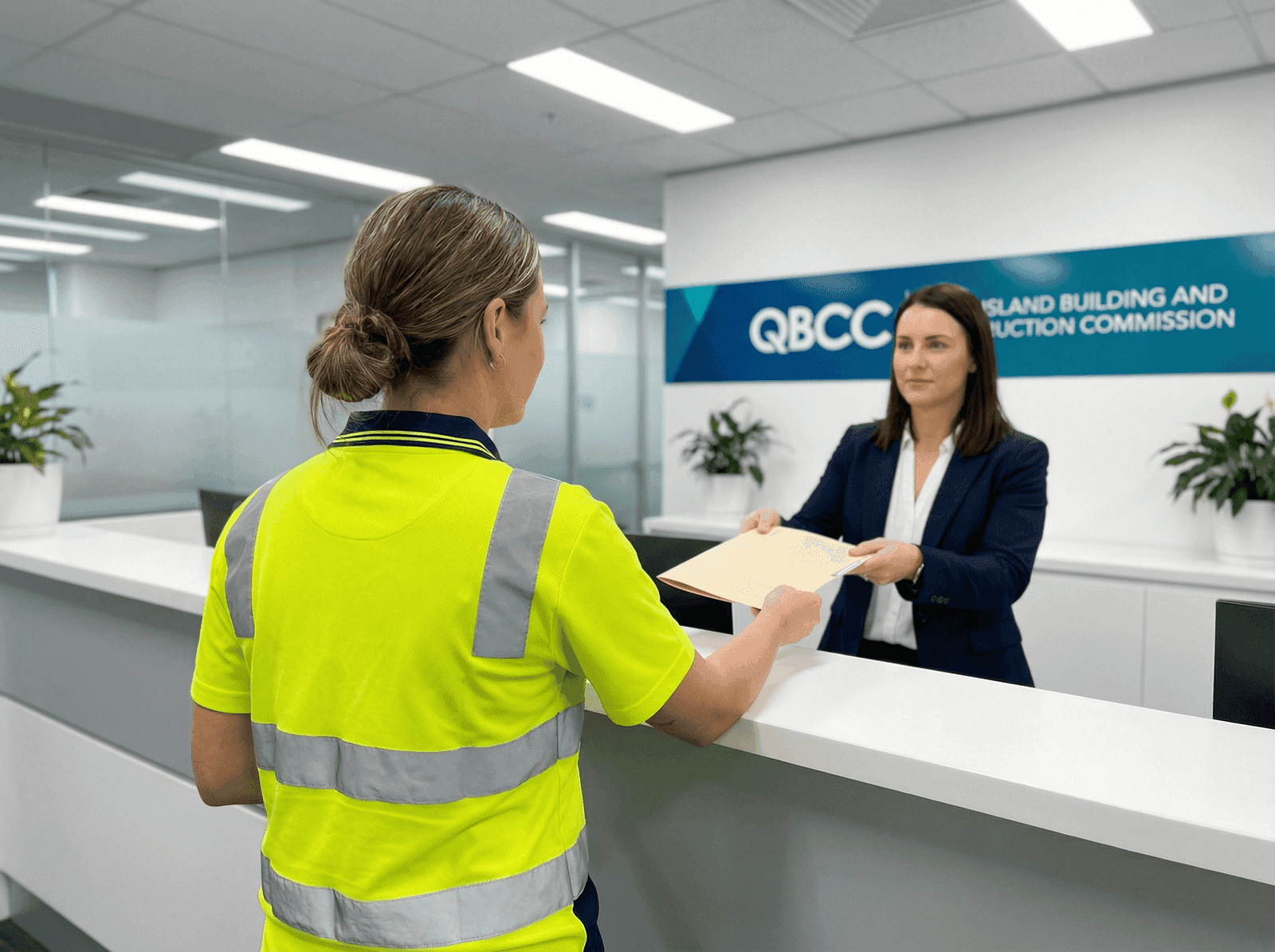
Lodge via email, post, or in person at a QBCC service centre. Pay the application fee. QBCC will contact you for payment if lodging by email or post.
QBCC reported an average of 25 business days to process licence applications in 2025-26. Applications that need more information take longer. If approved, you receive your licence number and licence card.
Source: QBCC Builder low rise licence page (How to apply), QBCC Fit and proper page, QBCC MFR report or declaration page and QBCC Annual Report 2025-26, Table 3 (accessed October 2026).
QBCC licence fees are determined by your annual turnover category. For Contractor licences, you must also meet Minimum Financial Requirements — a solvency test that protects consumers and subcontractors.
| Category | Max Revenue | New Applicant | 1-Year Renewal | 3-Year Renewal |
|---|---|---|---|---|
| SC2 | Up to $800,000 | $920.68 | $419.21 | $1,068.99 |
| Cat 1-2 | Up to $12 million | $1,180.19 | $501.47 | $1,278.70 |
| Cat 3-7 | Over $12 million | $1,696.50 | $754.35 | $1,923.83 |
Source: QBCC Licence fees (accessed October 2026). The fees are set in fee units in schedule 7 of the QBCC Regulation and rise each 1 July. If you already hold an individual QBCC licence, a lower fee applies. Check QBCC's current fees before you apply.
| Category | Maximum Revenue | Minimum NTA |
|---|---|---|
| SC1 | Up to $200,000 | $12,000 |
| SC2 | Up to $800,000 | $46,000 |
| Cat 1 | $800,001 – $3,000,000 | $46,001 – $156,000 |
| Cat 2 | $3,000,001 – $12,000,000 | $156,001 – $480,000 |
| Cat 3 | $12,000,001 – $30,000,000 | $480,001 – $1,200,000 |
| Cat 4 | $30,000,001 – $60,000,000 | $1,200,001 – $2,400,000 |
| Cat 5–7 | $60,000,001+ | $2,400,001+ |
Source: QBCC Maximum revenue, Net tangible assets and What are minimum financial requirements pages (accessed October 2026).
NTA = Total Assets − Intangible Assets − Disallowed Assets − Total Liabilities
Disallowed assets include recreational vehicles, cryptocurrency, racehorses, collectors' items, and inaccessible superannuation. You must also maintain a current ratio of at least 1:1 (current assets ≥ current liabilities).
The SC1 financial category (up to $200,000 revenue, $12,000 NTA) is available to trade contractors only. Builders must start at SC2 ($800,000 revenue, $46,000 NTA) at minimum. Plan your finances accordingly before applying.
Getting the licence is the first step. Keeping it requires ongoing compliance with financial reporting, insurance, and notification obligations.
Most residential building work valued over $3,300 (including materials, labour, and GST) must be insured under the Queensland Home Warranty Scheme. You must pay the premium to the QBCC before work starts or within 10 business days of signing the contract — whichever comes first.
Due by 31 December each year for categories 1 to 7. Required for all contractor licensees except SC1 and SC2 individual contractors (maximum revenue up to $800,000). Company licensees must report regardless of category. QBCC can take disciplinary action against licensees who don't meet their reporting obligations.
Notify the QBCC within 14 days of any change to your contact details (phone, email, address), as section 109C of the QBCC Act requires. Company licensees must also notify within 14 days of changes to directors or nominees. From February 2026 email is QBCC's preferred way to send notices, and not updating your email address can attract a penalty of up to 10 penalty units.
Unlike NSW, Queensland has not yet legislated compulsory continuing professional development for builder licensees. QBCC says only building certifiers and pool safety inspectors have compulsory training obligations. A pilot programme with 160+ participants has been completed, and a framework is under development — but for now, CPD remains voluntary. Staying current with industry training is still recommended.
Source: QBCC Queensland Home Warranty Scheme pages, Annual financial reporting, Update details on your licence, Deconstructing the Building Reg Reno and Continuing professional development pages; QBCC Act section 109C; Building Commission NSW CPD requirements for the NSW comparison (accessed October 2026).
Queensland's licensing framework is actively evolving. Here are the changes that affect builder licence applicants and holders right now.
Source: Business Queensland, Technical qualifications for building and construction licences; QBCC, Deconstructing the Building Reg Reno and Trust account rollout pages; Queensland Building and Construction Commission Regulation 2018, schedule 2 and schedule 8 (current from 1 September 2026) (accessed October 2026).
These are the gaps QBCC's application guides and licence pages flag. Each one can mean a request for more information, or a refusal.
QBCC looks for referees who held a licence or qualification at the same or a higher level than the class you are applying for, ideally the licensed builder on the project. Weaker referees mean QBCC needs more evidence from you.
Listing trade work ("Installed cabinets") instead of supervisory work ("Coordinated kitchen renovation including plumbing, electrical, and cabinetry trades"). Supervising a single trade is generally not enough. The QBCC needs evidence that you supervised and managed the whole build.
For medium rise and open, QBCC excludes work done before you obtained the technical qualification for the class, unless you did it as an employee of a builder with the appropriate class of licence.
An MFR report must be signed by a qualified accountant no more than 30 days before QBCC receives it. If you need a National Police Certificate, it must be no older than 30 days when QBCC receives it.
Check that your qualification or statement of attainment matches what the technical qualifications document lists for your class and licence type. QBCC assesses older and equivalent qualifications case by case, using your transcript and course outlines.
Work done as an owner-builder, or supervised by one, is generally not accepted toward your experience requirement, however complex the project was.
Source: QBCC Builder low rise and medium rise application guides (effective March 2026), Builder medium rise and open licence pages, Fit and proper page and MFR report or declaration page (accessed October 2026).
These nationally recognised qualifications meet the licensing requirements discussed in this guide.
CPC40120 - CPC40120 - Nationally recognised building and construction training for builders, site supervisors and construction managers.

CPC50220 - CPC50220 - Nationally recognised building and construction training for experienced builders, site managers and construction professionals.

CPC60220 - CPC60220 - Advanced building and construction management for experienced professionals working with large and complex projects.

CPC60220 - CPC60220 - Explore course content, online coursework and assessment requirements. Check any intended licensing pathway with the relevant regulator.
Each regulator sets its own qualification, experience and fee rules. Pick a state to see the full guide.
Not sure where to start? Read the national builders licence guide for a side-by-side summary of every state, or check whether RPL can fast-track your qualification.
Built by Prepare Training (RTO 45384). Use them on the job today, no account needed.
Draft a site-specific Safe Work Method Statement for high risk construction work in minutes. No sign-up.
Open the tool →Work out concrete, brick, timber and plasterboard quantities with waste allowances built in.
Open the tool →Instant per-square-metre build estimates for Sydney, Melbourne, Brisbane, Perth and Adelaide.
Open the tool →The CPC40120, CPC50220 and CPC60220 are the qualifications QBCC names for the three builder classes, and one recognised pathway to a licence. Prepare Training delivers all three 100% online with flexible, self-paced study. Speak to our team about the best pathway for your goals.