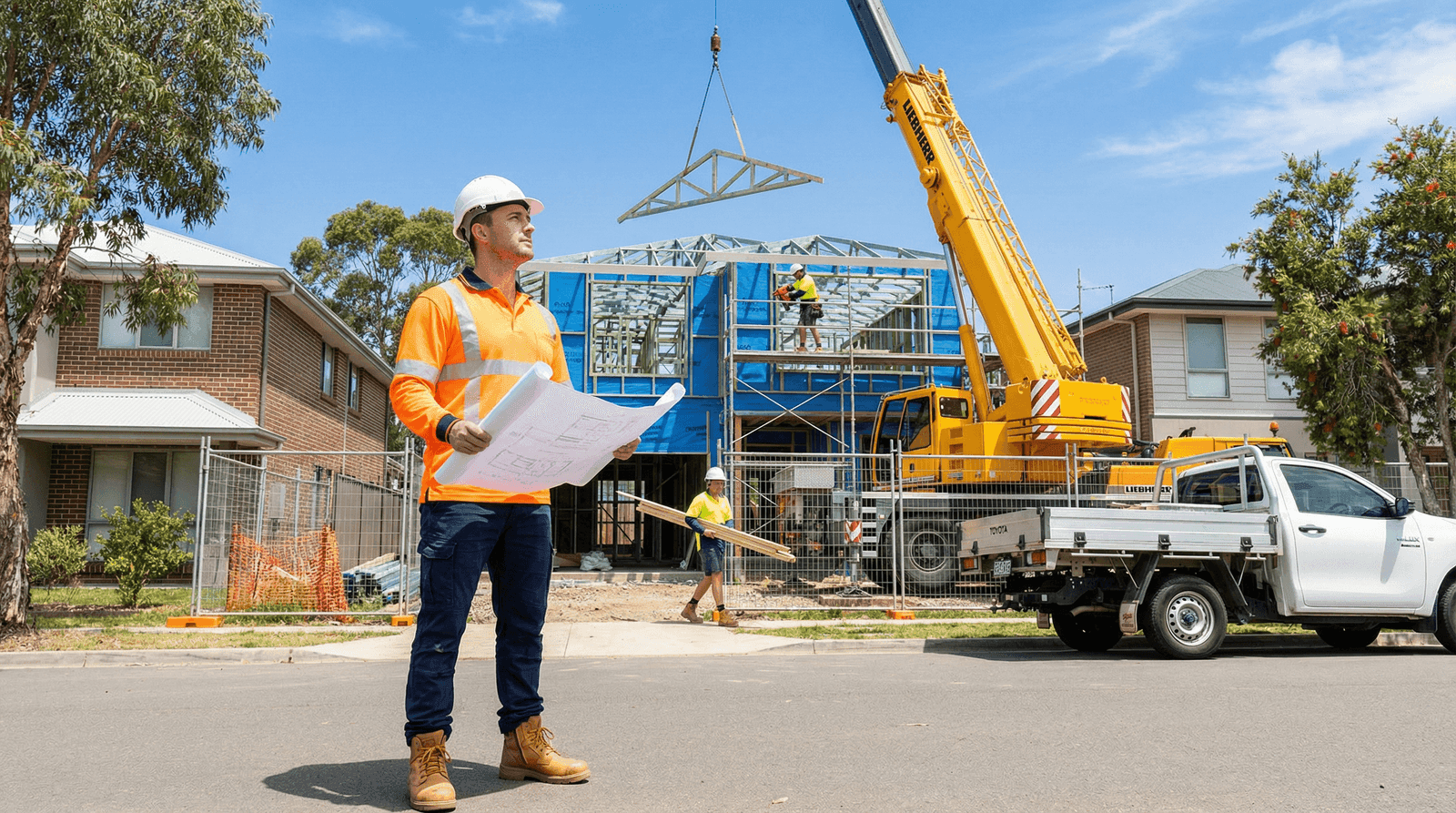
QLDVICSATASNTACT
Building
Certificate IV in Building and Construction
CPC40120 - CPC40120 - Nationally recognised building and construction training for builders, site supervisors and construction managers.

The complete 2026 guide to builder registration in the Northern Territory — Australia's most straightforward pathway. No exam, the same Certificate IV for all four categories, and a booming construction industry driven by a $4.34 billion infrastructure budget.
Understanding the NT's unique registration framework — and why it's the simplest in Australia.
A builder's registration in the Northern Territory authorises the holder to carry out building work within the scope of their registration category, as governed by the Building Act 1993 and administered by the Building Practitioners Board (BPB). The first thing to note: the NT uses the term “registration” rather than “licensing” — though they achieve the same outcome.
Anyone wanting to contract for building work valued at $12,000 or more in the NT must hold the appropriate registration. What makes the NT pathway stand out nationally is its simplicity: no written exam, the same Certificate IV for all four builder categories, and a purely document-based assessment process.
With the NT construction industry booming — building approvals up 69.7% year-on-year and a $4.34 billion infrastructure budget — understanding this pathway has never been more relevant.
The NT calls it “registration” while most other states use “licensing.” The practical outcome is the same — you are legally authorised to contract for building work. Throughout this guide, we use both terms interchangeably since “builder's licence” is how most people search for this topic.
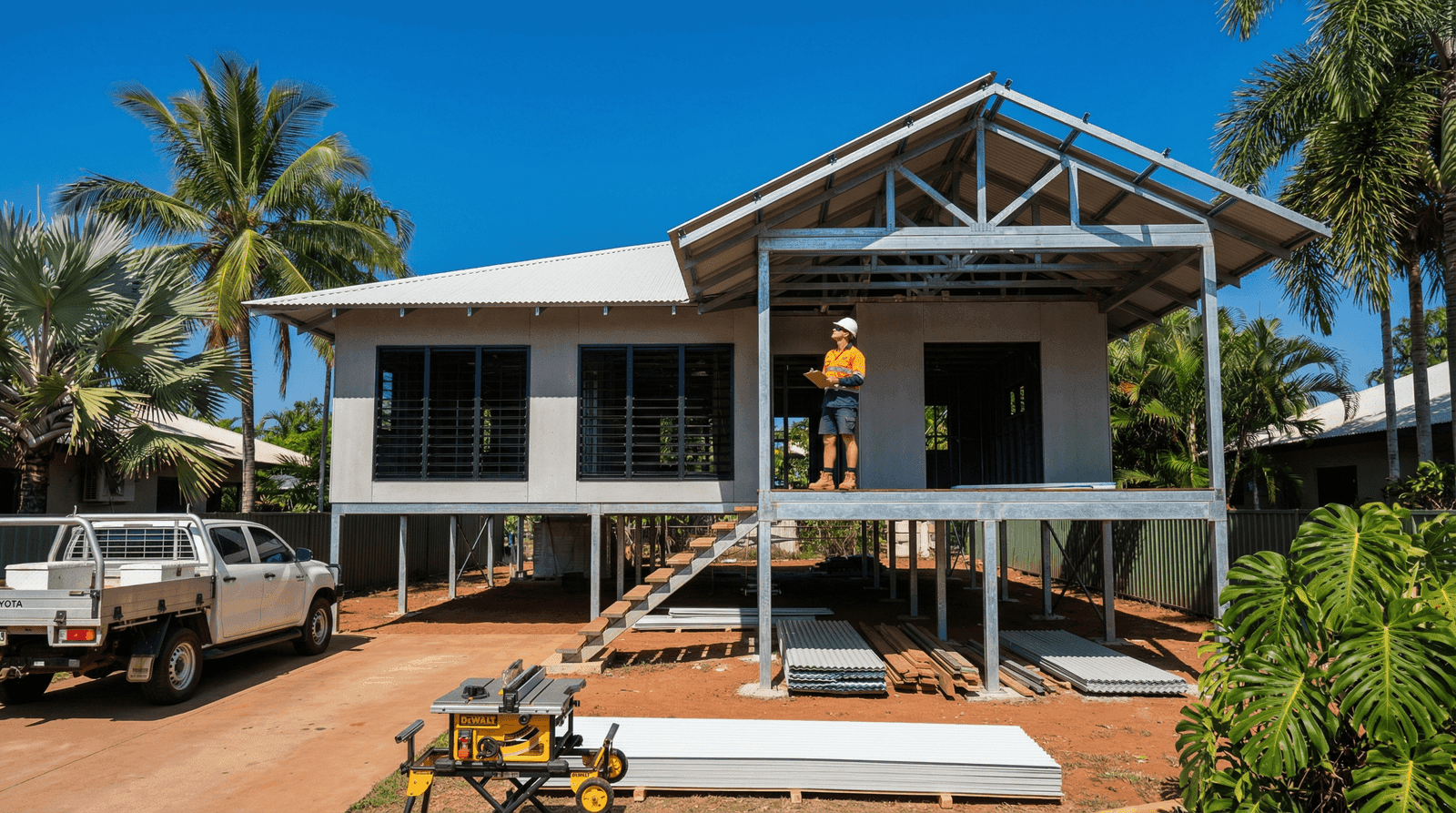
Residential, commercial, restricted, unrestricted — here's what each one covers.
The NT has four builder registration categories defined by the Building Practitioners Board. Two cover residential work and two cover commercial work. Unlike states like Queensland (where different QBCC licence classes require different qualifications) or the ACT (where unrestricted requires a university degree), all four NT categories require the same Certificate IV qualification. The differentiator between categories is the type and scope of your experience.
| Category | Scope of Work | Height Limit | Building Classes |
|---|---|---|---|
| Residential (Restricted) | Detached houses, attached dwellings and Class 2 buildings | Up to 2 storeys | Class 1a, Class 2, Class 10 (attached) |
| Residential (Unrestricted) | Detached houses, attached dwellings and Class 2 buildings | Any height | Class 1a, Class 2, Class 10 (attached) |
| Commercial (Restricted) | Commercial buildings including boarding houses | Up to 3 storeys | Class 1b, Classes 3-9, Class 10 (attached) |
| Commercial (Unrestricted) | Commercial buildings including boarding houses | Any height | Class 1b, Classes 3-9, Class 10 (attached) |
Source: Building Practitioners Board (bpb.nt.gov.au/practitioners). Scope descriptions summarised — refer to the BPB for exact legal definitions. All categories also cover retaining walls on which the integrity of a registered building depends.
The difference between “restricted” and “unrestricted” is height. Residential Restricted covers buildings up to 2 storeys; Unrestricted covers any height. Commercial Restricted covers up to 3 storeys; Unrestricted covers any height. Both require the same Cert IV — the Board assesses whether your experience matches the category you are applying for.
Source: HIA Guide to Builder Registration in NT
There is a misconception that splitting work across multiple contracts under $12,000 avoids registration requirements. The Housing Industry Association warns that builders engaging in contract splitting to deliberately avoid regulatory requirements could face regulatory action from the Building Practitioners Board.
One qualification, four categories. The NT keeps it simple.
This is the NT's biggest differentiator from other Australian states: the same Certificate IV in Building and Construction (Building) — course code CPC40120 — qualifies you for all four builder registration categories. Whether you want to build houses, apartments, commercial offices, or high-rise developments, the qualification requirement is the same.
In contrast, the ACT requires a university degree for unrestricted building, NSW requires a Diploma for higher licence classes, and Queensland's QBCC system has different qualification tiers for each licence class. The NT's approach is notably simpler — your qualification gets you in the door, and your experience determines your category. The Certificate IV is delivered 100% online, so you can study while you work and gain experience simultaneously.
| Category | Qualification Required | Course Code |
|---|---|---|
| Residential (Restricted) | Certificate IV in Building and Construction (Building) or equivalent | CPC40120 / CPC40120 |
| Residential (Unrestricted) | Certificate IV in Building and Construction (Building) or equivalent | CPC40120 / CPC40120 |
| Commercial (Restricted) | Certificate IV in Building and Construction (Building) | CPC40120 / CPC40120 |
| Commercial (Unrestricted) | Certificate IV in Building and Construction (Building) | CPC40120 / CPC40120 |
Source: ABLIS (Australian Business Licence and Information Service), verified across all four category pages. The phrase “or equivalent” on residential categories suggests superseded versions (CPC40110, CPC40108) may also be accepted.

Course code: CPC40120 (or CPC40120)
No. Unlike most other Australian states, the NT does not require a Diploma of Building and Construction for any builder registration category — including unrestricted and commercial categories.
However, holding a Diploma (CPC50220) provides additional knowledge in contract administration, structural principles, and project management that can benefit complex projects. It also satisfies the Cert IV requirement and is valuable if you plan to work in other states where a Diploma is required.
Competitors using the superseded course code CPC40110 are referencing outdated information. CPC40120 is the current nationally recognised code.
If you already have 3+ years of practical building experience, Recognition of Prior Learning (RPL) can significantly reduce your study time. Your existing skills are assessed against the qualification's units of competency, allowing you to gain formal credentials based on what you already know and can do.
Three years on the tools — and the documentation you'll need to prove it.
All four builder registration categories require a minimum of 3 years of practical experience in relevant building work. Your experience must be verified by 3 written references from registered building practitioners who can attest to your competence and the scope of your work.
| Category | Experience Required | Special Conditions |
|---|---|---|
| Residential (Restricted) | 3 years practical experience (min. 1 year in the NT) | The only category requiring NT-specific experience |
| Residential (Unrestricted) | 3 years practical experience or equivalent | Experience in residential building of any height |
| Commercial (Restricted) | 3 years practical experience in Class 3-9 buildings (1-3 storeys) | May receive limitations if experience is not "significant and complex" |
| Commercial (Unrestricted) | 3 years practical experience in Class 3-9 buildings (any height) | Experience must include buildings of any height, not just low-rise |
The $50,000 minimum net tangible assets requirement is not just for application — you must maintain this level throughout your registration period. You will need a Net Assets Certificate from a registered accountant, and the BPB provides a template on their website. This requirement ensures builders have the financial capacity to meet their contractual obligations.
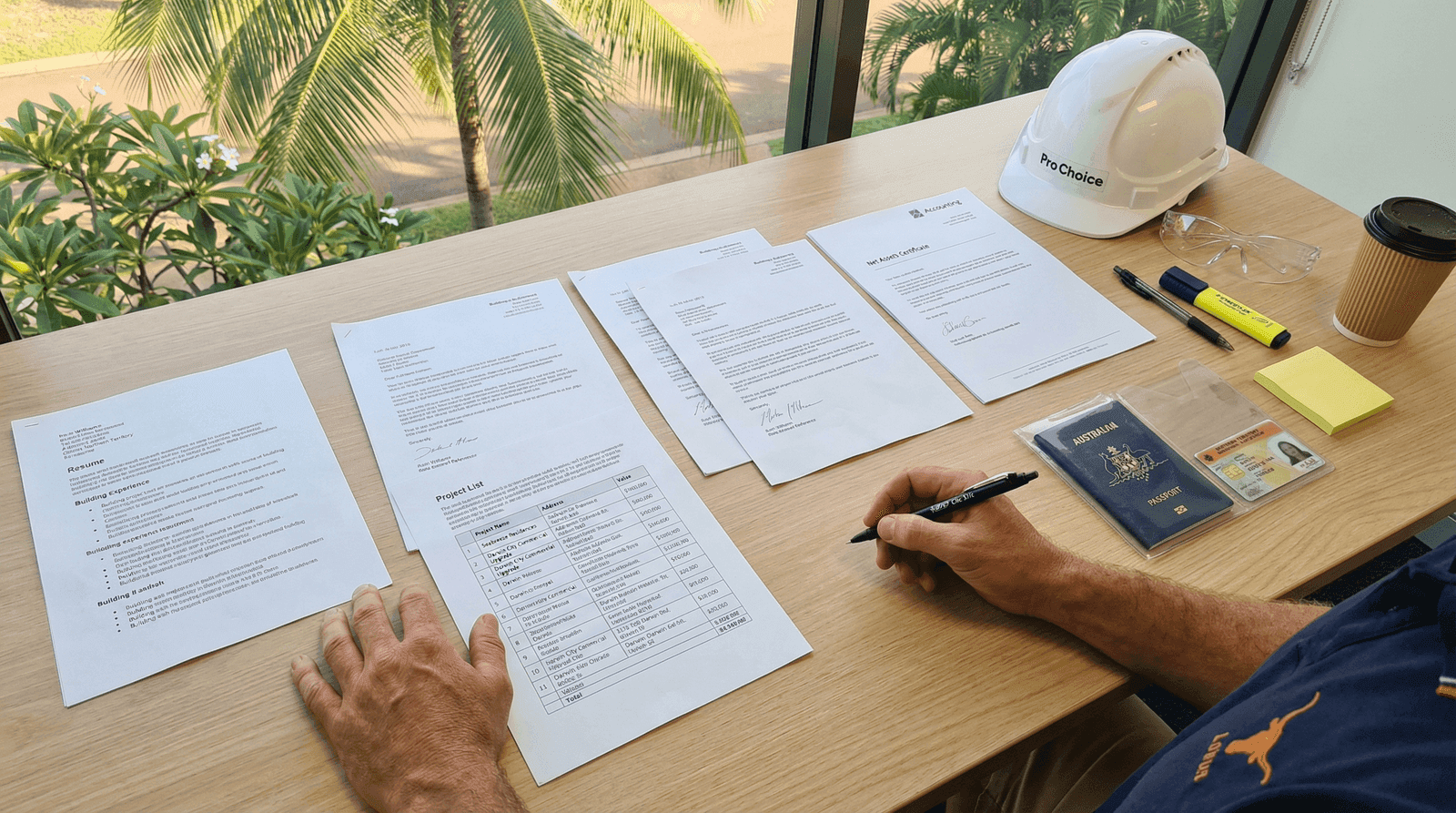
From qualification to registration — the complete NT process with no exam required.
The NT application process is entirely document-based. There is no written exam, no practical assessment, and no interview. The Building Practitioners Board assesses your application against the requirements set out in Ministerial Determination S57 (gazetted 5 September 2025).
Complete the Certificate IV in Building and Construction (Building) — CPC40120. This can be done 100% online through Prepare Training, including while you gain experience.
Accumulate at least 3 years of practical experience in relevant building work. For Residential Restricted, at least 1 year must be completed in the NT.
Prepare your resume, detailed project list, 3 written references from registered practitioners, Net Assets Certificate ($50,000+), and proof of identity.
Download the individual or company application form from the BPB website. Select your target registration category or categories.
Submit your application by mail, email, or in person to the Building Practitioners Board. The $333 application fee is payable on submission.
The BPB assesses your application against all requirements. They must be satisfied you are a "fit and proper person." No exam or interview.
If approved, pay the $1,000 licence fee. Your registration is issued for 2 years and cannot be transferred. Total cost: $1,333.
If registering as a company, you will also need an ASIC full company extract (no more than 28 days old), a copy of your Certificate of Incorporation or Registration of Business Name, and at least one director or nominee must be individually registered in the relevant category. All directors must be fit and proper persons and the company must hold $50,000+ in net tangible assets.
Applications can be submitted to the Building Practitioners Board or at a Territory Business Centre:
Current fees from the ABLIS 2025-26 fee schedule — updated from 1 July 2025.
| Fee Type | 2025-26 Amount | 2024-25 Amount | Notes |
|---|---|---|---|
| Application fee | $333.00 | $324.00 | Payable on submission |
| Licence fee (on approval) | $1,000.00 | $972.00 | Payable when Board approves registration |
| Total (new registration) | $1,333.00 | $1,296.00 | Same for all 4 categories |
| Renewal (every 2 years) | $1,333.00 | $1,296.00 | Lodge at least 2 months before expiry |
| Mutual recognition | $1,333.00 | $1,296.00 | Interstate applicants |
| Owner-builder certificate | ~$324.00 | $324.00 | Check BPB for current amount |
Source: ABLIS (Australian Business Licence and Information Service), 2025-26 fee schedule. Fees are subject to annual review from 1 July each year. Always check bpb.nt.gov.au for current amounts.
Budget realistically for the full pathway from qualification to registration:
RPL may be a cost-effective pathway for experienced builders. Check your RPL eligibility.
Registrations that expire prevent you from legally contracting for building work. The BPB requires renewal applications to be lodged at least 2 months before expiry. Renewal costs $1,333 (2025-26) and requires an updated project list. Do not let your registration lapse.
What homeowners get, what builders must do, and how the $200,000 cover works.
The Fidelity Fund NT is a not-for-profit trust established in 2013 to protect homeowners when builders fail to complete or properly build their homes. It is administered by Master Builders Northern Territory (MBNT). If you undertake prescribed residential building work worth over $12,000 that increases the floor area of a property, you must obtain a Fidelity Fund Certificate before starting work.
$12,000
Work Value Threshold
Residential work over $12,000 that increases floor area requires a certificate
$200,000
Maximum Cover
Combined maximum across non-completion and defective work
6 Years
Structural Defect Cover
Non-structural defects covered for 12 months after completion
| Cover Type | Maximum Amount | Details |
|---|---|---|
| Incomplete homes (non-completion) | Up to $200,000 | Capped at 20% of contract price |
| Defective work | Up to $200,000 | Less any non-completion amount already paid |
| Total maximum cover | $200,000 | Combined maximum across both cover types |
Important: This is a “last resort” scheme. Homeowners can only claim after a trigger event — builder death, disappearance, insolvency, or deregistration. For disputes without a trigger event, homeowners should contact the Commissioner of Residential Building Disputes through Consumer Affairs.
Under the Building Act, deposits for residential building work are limited to 5% of the contract cost. Progress payments can only be claimed for completed work. These provisions protect homeowners and were strengthened through reforms driven by the Fidelity Fund framework.
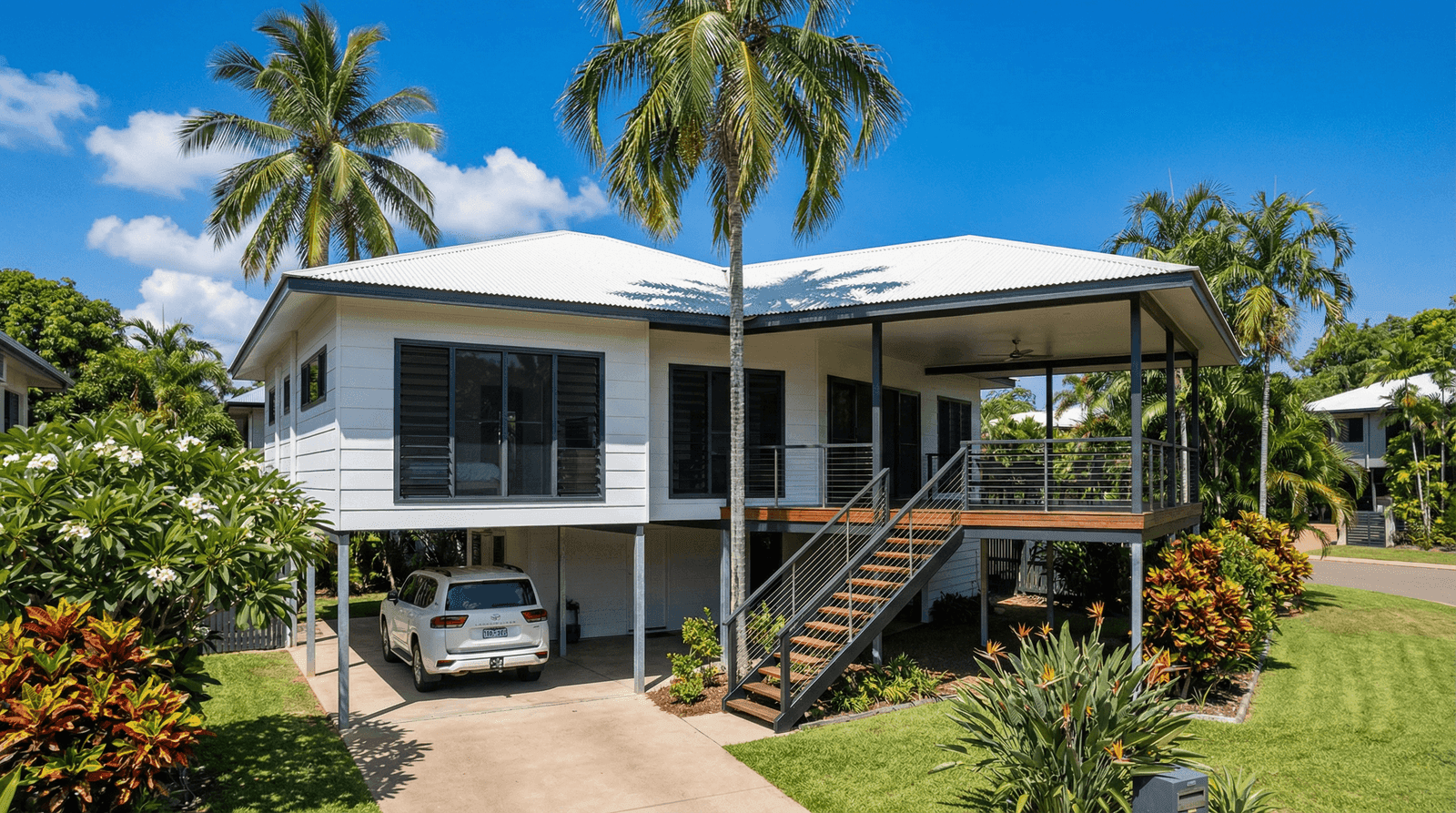
This is the most widely misunderstood aspect of NT builder registration.
Automatic Mutual Recognition (AMR) does NOT apply to builders in the Northern Territory. This is confirmed on both the BPB's AMR page and the NT Government's occupational licences page. If you hold a builder's licence in another state, you cannot simply notify the NT regulator and start working — you must apply through the traditional mutual recognition process.
Traditional mutual recognition involves a separate application with the Building Practitioners Board, including supporting documentation and the full $1,333 registration fee. Your interstate registration must be in an equivalent category.
If AMR applied (which it does NOT for builders), you could work under your home-state licence with just a notification to the BPB.
Because builders are excluded from AMR in the NT, you must follow the traditional mutual recognition process.
Interstate builders who start work in the NT without proper registration are committing an offence under section 22 of the Building Act 1993, carrying a maximum penalty of $7,560 (40 penalty units at $189). Holding a licence in another state does not authorise you to build in the NT without applying through the mutual recognition process.
From $7,560 for individuals to $151,200 for corporations — and real cases that prove it.
Under section 22 of the Building Act 1993, carrying out building work without the required registration is a criminal offence. Disciplinary penalties were significantly increased in August 2022, reflecting the NT Government's commitment to stronger consumer protection.
| Offence Type | Penalty Units | Maximum Fine (Individual) | Maximum Fine (Corporation) |
|---|---|---|---|
| Unregistered building work (s 22) | 40 PU | $7,560 | — |
| Disciplinary civil penalty (individual) | Up to 160 PU | $30,240 | — |
| Disciplinary civil penalty (corporation) | Up to 800 PU | — | $151,200 |
| Obstruction (s 166) | 40 PU | $7,560 | — |
Based on NT penalty unit value of $189 from 1 July 2025 (Penalty Units Act 2009). This value is subject to annual review. Sources: Building Act 1993 (NT) via AustLII; agd.nt.gov.au penalty units page.
$94,200
Fined 600 penalty units in December 2024 — the largest fine ever issued by the BPB. Found to have engaged in “unlawful short cuts” across multiple residential projects over 15+ years, including invoicing for incomplete frame stage work. Registration suspended.
Source: BPB Inquiries (bpb.nt.gov.au)
$62,800
Company fined 400 penalty units in January 2026 for professional misconduct and Building Act breaches. Individual directors were also fined $12,560 and $12,960 respectively — demonstrating that directors can be held personally liable.
Source: BPB Inquiries
$7,040
Fined 40 penalty units in 2025 for making a false declaration under s69(1), failing to enter into a written contract under s48B, and carrying out works not in accordance with the building permit.
Source: BPB Inquiries
The Kassiou Constructions case is instructive: the BPB described the builder's practices as “unlawful short cuts to building practices [that] became the norm,” adding that “this practice flies in the face of what is expected of an experienced and competent building practitioner.” Homeowners were left with abandoned builds and had to wait over 15 months for Fidelity Fund access. Compliance is not optional.
The biggest change to NT building regulation in over a decade.
From 15 April 2025, mandatory registration for commercial building contractors is in full effect. This is a two-stage reform introduced by the Building Legislation Amendment Act 2024, representing the most significant change to NT building regulation in over a decade.
The 12-month grandfathering period — which allowed experienced commercial builders to register without full qualification requirements — ended on 14 April 2025. All new commercial builder applications now require the full Certificate IV qualification, 3 years of relevant commercial experience, and all other standard requirements.
If you are an experienced commercial builder who did not register during the grandfathering period (April 2024 — April 2025), you now need a Certificate IV in Building and Construction (CPC40120) to apply. There is no longer an experience-only pathway. Prepare Training's 100% online Certificate IV can be completed while you continue working.
Builders can hold both commercial and residential registrations simultaneously. If you work across both sectors, you will need to register in the relevant categories for each. The qualification requirement is the same Certificate IV for all categories — your experience documentation simply needs to cover both residential and commercial project types.
When you need one, what it covers, and the legal responsibilities you take on.
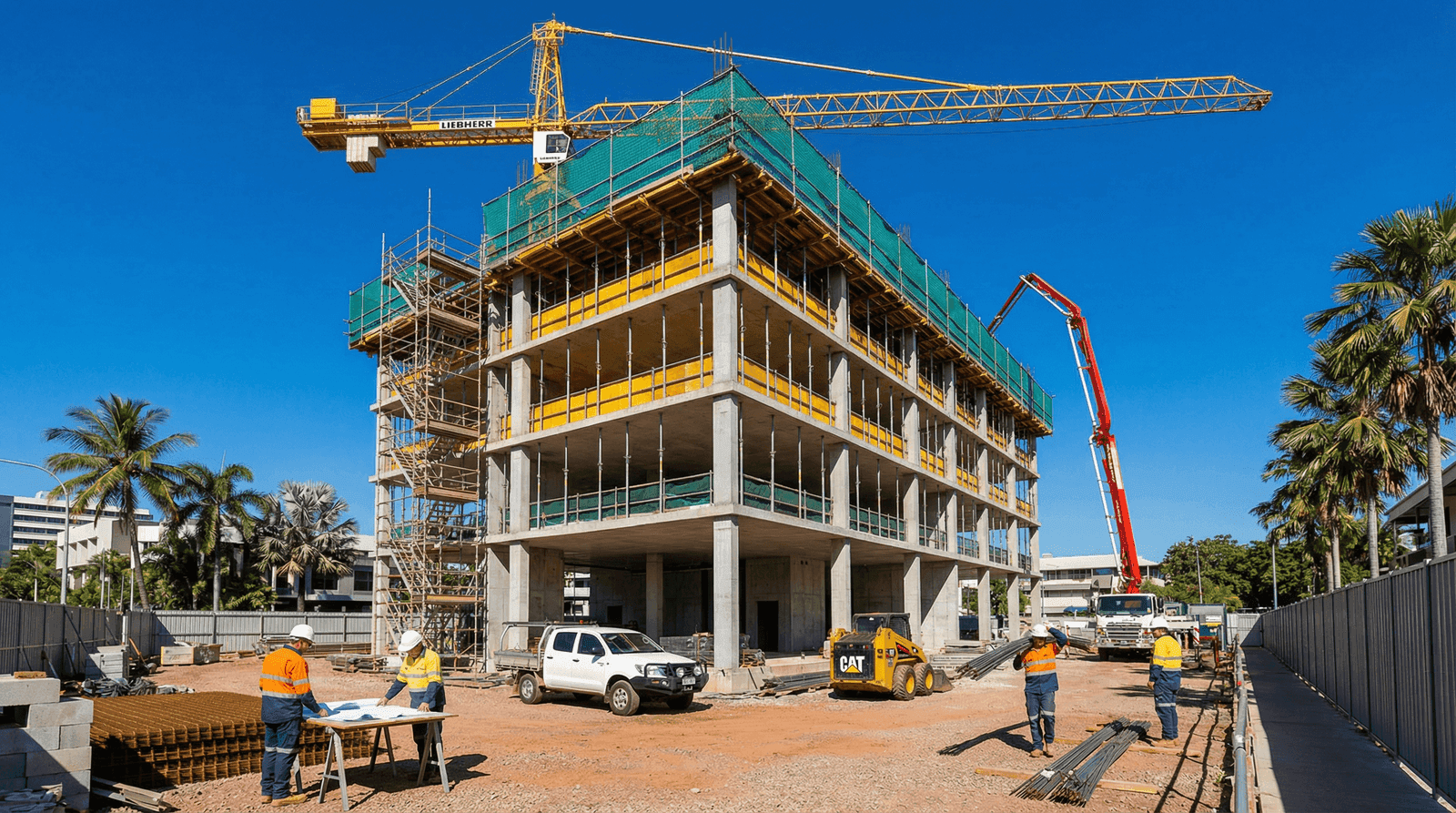
An owner-builder certificate allows individual property owners to build or extend their own home without engaging a registered builder. It is required when the owner wants to carry out building work valued over $12,000 on a single dwelling (Class 1a), an attached garage or shed built at the same time (Class 10), or extensions that increase floor space.
If you are already registered as a residential building contractor, you do not need an owner-builder certificate to build your own home.
As an owner-builder, you assume all legal responsibilities of a builder, including compliance with building certification, site protection, directing workmanship, and work health and safety. Critically, you are responsible for rectifying defective work for up to 6 years if the property is sold. Engaging a project manager does not remove these legal responsibilities. A builder who recommends you become an owner-builder while they act as project manager may be avoiding their own legal obligations — or may be unregistered.
Record building approvals, massive infrastructure investment, and a housing boom.
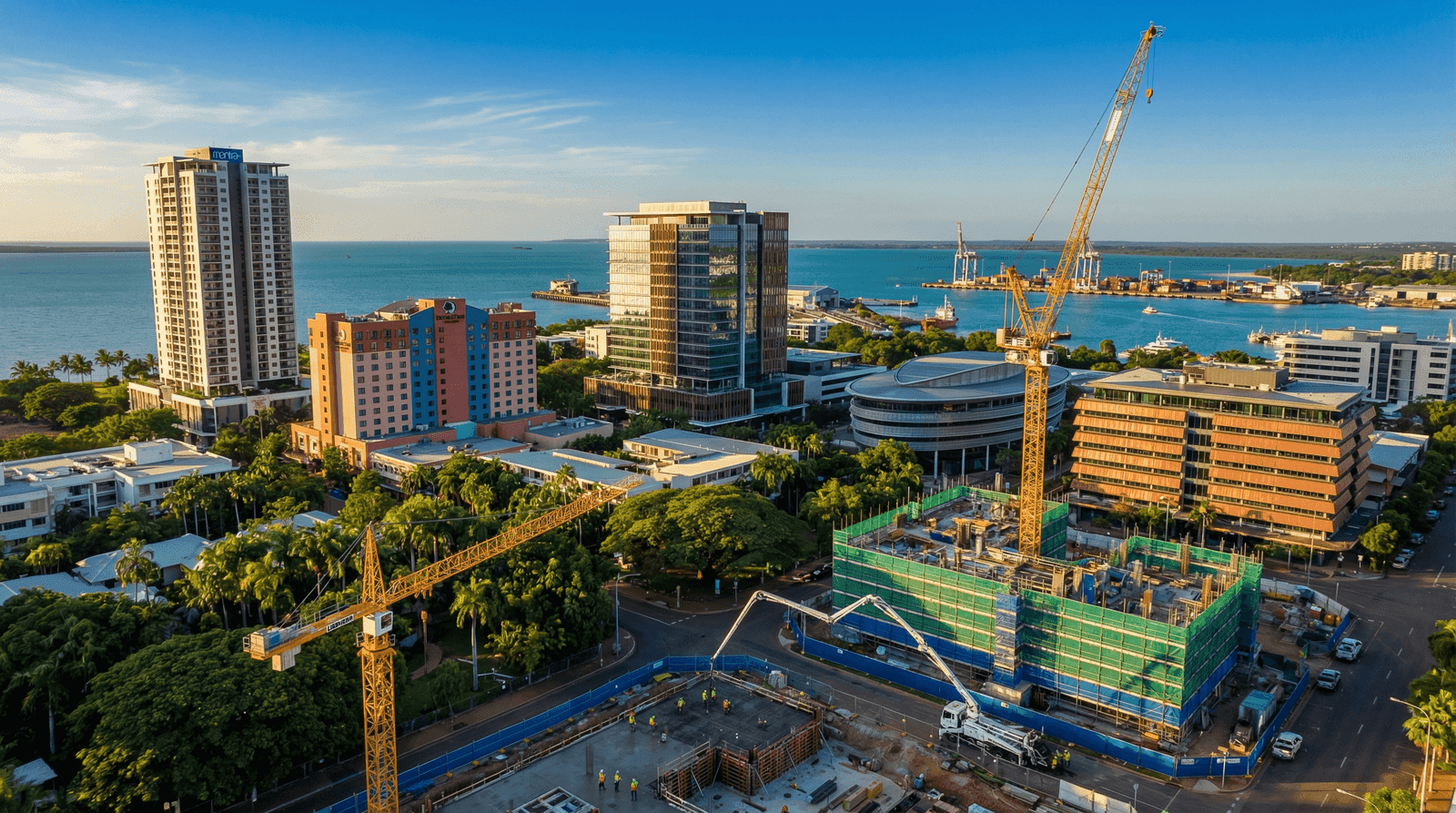
The Northern Territory's construction industry is experiencing a period of significant growth. The NT leads the nation in building approval growth at 69.7% year-on-year — more than 4 times the national average of 16.1%. This surge is driven by the HomeGrown Territory grants programme, a massive infrastructure pipeline, and strong population growth of 1.4% per annum.
Construction accounts for 7.8% of the NT workforce (10,730 workers) and contributes 6.4% of Gross State Product. With Darwin dwelling values growing at 18.9% annually — the highest capital city growth in Australia — the opportunity for registered builders is substantial.
With only approximately 1,210 registered residential builders serving a population of 264,400 — and building approvals surging nearly 70% — there is clear demand for registered builders in the NT. The HomeGrown Territory grants programme has been extended to September 2026, and the $4.34 billion infrastructure budget ensures sustained project pipeline. Getting registered now positions you to capitalise on this growth.
Key developments from 2022 to 2026 that affect builder registration.
While the NT does not currently have a formal Continuing Professional Development (CPD) requirement, reports indicate a scheme is in development. Registered builders should monitor announcements from the Building Practitioners Board for updates that may affect registration renewal requirements.
Why the NT is one of the most accessible registration pathways in Australia.
| Requirement | NT | ACT | QLD | NSW |
|---|---|---|---|---|
| Written Exam | No exam ✓ | Yes — 80% pass mark | Yes — QBCC exam | Yes — knowledge test |
| Qualification for Unrestricted | Certificate IV only ✓ | University degree | Diploma (open licence) | Diploma |
| Qualification for Commercial | Certificate IV only ✓ | Diploma or degree | Varies by class | Diploma |
| AMR Available | No — traditional MR only | No — exempt until Jul 2027 | No — excluded | Limited |
The comparison makes the NT's position clear: it offers one of the most accessible builder registration pathways in Australia. No exam, the same Certificate IV for all categories (including unrestricted and commercial), and a document-based process. For tradies who already have the experience but need the formal qualification, the NT pathway is particularly attractive.
| State | Exam Required? | Pass Mark | Qualification for Full Scope |
|---|---|---|---|
| NT | No | N/A | Certificate IV (CPC40120) |
| ACT | Yes — written exam | 80% | University degree (Class A) |
| NSW | Yes — knowledge test | Not public | Diploma (CPC50220) |
| VIC | No (RPL assessment may apply) | N/A | Diploma (CPC50220) |
| QLD | Yes — QBCC exam | 60% | Diploma (CPC50220 — open) |
| SA | No | N/A | Diploma (CPC50220) |
| WA | No | N/A | Diploma (CPC50220) |
| TAS | No | N/A | Diploma (CPC50220 — Category 1) |
If you plan to work only in the NT, a Certificate IV is sufficient for all four builder registration categories. However, if you may work in other states in the future, a Diploma is often required for unrestricted or commercial categories elsewhere.
These nationally recognised qualifications meet the licensing requirements discussed in this guide.
CPC40120 - CPC40120 - Nationally recognised building and construction training for builders, site supervisors and construction managers.

CPC50220 - CPC50220 - Nationally recognised building and construction training for experienced builders, site managers and construction professionals.
Each regulator sets its own qualification, experience and fee rules. Pick a state to see the full guide.
Not sure where to start? Read the national builders licence guide for a side-by-side summary of every state, or check whether RPL can fast-track your qualification.
Built by Prepare Training (RTO 45384). Use them on the job today, no account needed.
Draft a site-specific Safe Work Method Statement for high risk construction work in minutes. No sign-up.
Open the tool →Work out concrete, brick, timber and plasterboard quantities with waste allowances built in.
Open the tool →Instant per-square-metre build estimates for Sydney, Melbourne, Brisbane, Perth and Adelaide.
Open the tool →You need a Certificate IV in Building and Construction (CPC40120) for ALL four builder registration categories in the NT. Unlike other states, the NT does not require a Diploma for any category. The same qualification works for residential restricted, residential unrestricted, commercial restricted, and commercial unrestricted.
Prepare Training delivers nationally recognised construction qualifications 100% online. The Certificate IV in Building and Construction (CPC40120) is all you need for any of the NT's four builder registration categories — no exam required. Study while you work and take the first step.