NSWWA
Building
Diploma of Building and Construction (NSW/WA)
CPC50220 - CPC50220 - Explore course content, online coursework and assessment requirements. Check any intended licensing pathway with the relevant regulator.
The complete 2026 guide to obtaining your builder's licence in New South Wales. Everything you need to know about qualifications, experience requirements, fees, and the application process — all in one place.
A builder's licence in NSW is the contractor licence you need to carry out, advertise or contract for residential building work valued at more than $5,000 (including GST, labour, and materials). Licences are issued by Building Commission NSW, part of the Department of Customer Service, under the Home Building Act 1989 and the Home Building Regulation 2014.
Without a valid licence, you cannot legally advertise building services or enter into contracts for residential building work above this threshold. Building Commission NSW says unlicensed work can bring a fine of $22,000 for an individual or $110,000 for a company under the Home Building Act 1989. Subcontractors need a licence too when their part belongs to a contract worth more than $5,000.
Source: Building Commission NSW, general building work (accessed October 2026).
Note: Specialist trade work always requires the appropriate trade licence regardless of value.
Before you can apply for a general building licence or qualified supervisor certificate in NSW, you must meet one of three qualification routes listed by Building Commission NSW:
The Certificate IV on its own is not enough. For most people working on the tools, the practical route is the Certificate IV plus either their carpentry or bricklaying trade or the Diploma.
Source: Building Commission NSW, general building work: qualifications and experience needed (accessed October 2026).
Course Overview
The qualification covers structural principles, building codes and standards, legal requirements, and project management for Class 1, 10, and Class 2-9 Type C constructions. Delivered 100% online, you can study while you work and gain your qualification without leaving the tools.
Beyond qualifications, you need at least 2 years of relevant industry experience in a wide range of building construction work, with most of it gained in the 10 years before you apply. The builder you worked for must hold a general building contractor licence, your work must be supervised and directed by someone holding an individual contractor licence or qualified supervisor certificate in general building work, and you must have been paid lawfully for it. If you already have significant hands-on experience, Recognition of Prior Learning (RPL) may help you gain your qualification faster by crediting what you already know.
NSW offers three main credential types depending on what work you want to do. Understanding the differences helps you choose the right pathway.
Allows you to contract for building work, advertise your services, and supervise projects.
Allows you to do and supervise the building work on your certificate, but not contract or advertise.
Lets you work under the general supervision of a licence or certificate holder in some trade and specialist categories. It isn't one of the licence types listed for general building work.
Fees for a new building contractor licence vary with the term and whether you apply as an individual, partnership or company. Each fee includes a processing component that isn't refunded if the application is refused or withdrawn.
| Applicant Type | 1 Year | 3 Years | 5 Years |
|---|---|---|---|
| Individual | $883 | $1,654 | $2,890 |
| Partnership | $1,469 | $2,253 | $3,787 |
| Company | $1,763 | $2,821 | $4,928 |
Source: Building Commission NSW, fees for contractor licences, supervision and tradesperson certificates (fees for July 2026 to June 2027, accessed October 2026). Fees may rise with CPI each financial year. The non-refundable processing component is $382 for individuals, $890 for partnerships and $972 for companies. A building qualified supervisor certificate costs $181 to $547.
Applications are lodged with Service NSW and assessed by Building Commission NSW. Follow these steps to ensure a smooth application.
Meet one of the listed qualification routes, most often the Certificate IV (CPC40120) with the listed units plus a carpentry or bricklaying credential, the Diploma (CPC50220) or a relevant degree.
Get referee's statements from the licence holders who supervised you, covering at least 2 years of relevant experience across a wide range of building work.
Gather a National Police Check no older than 4 months, proof of identity including address, a passport photo, your original qualifications and all experience documentation.
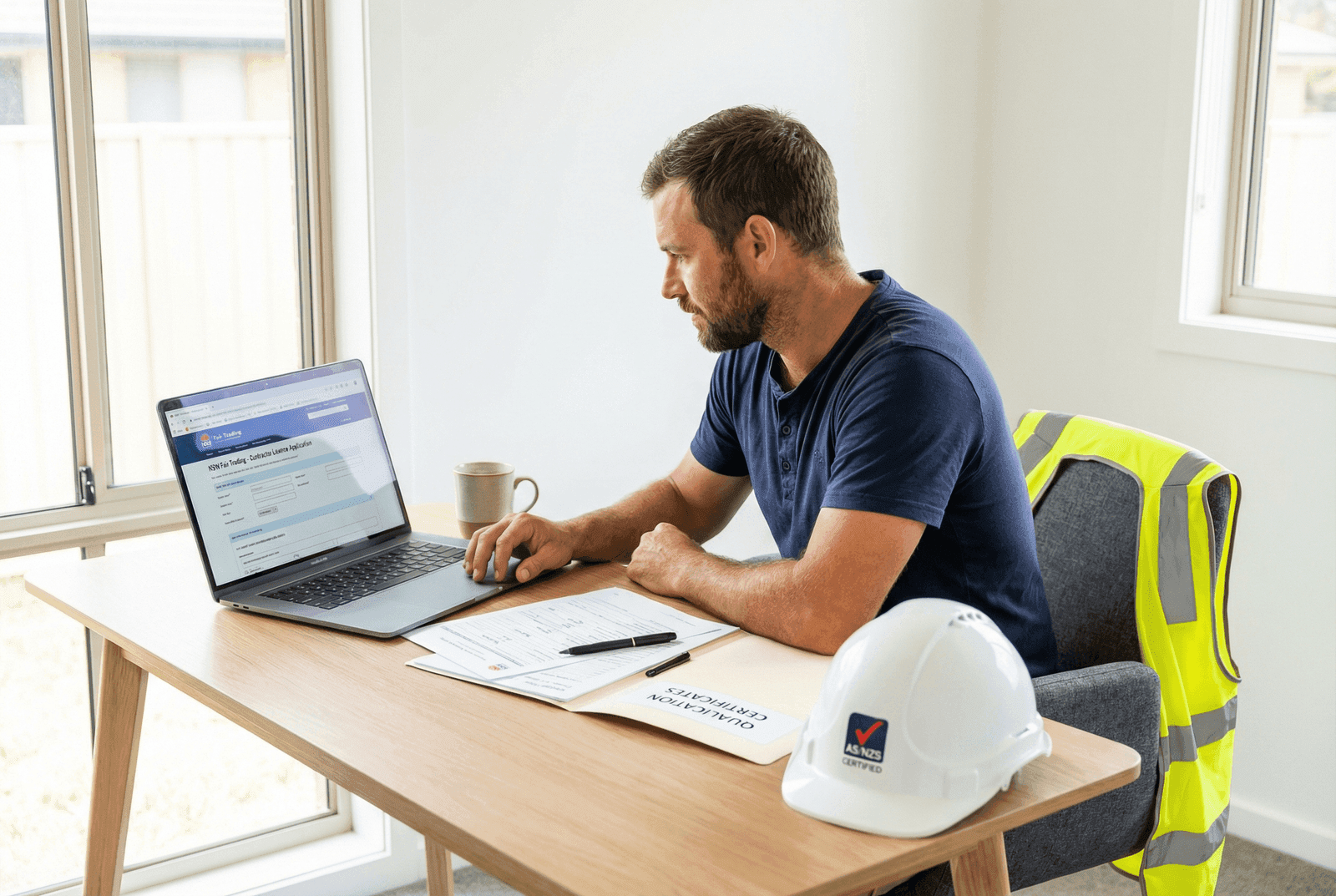
Book an appointment and lodge your application in person at a Service NSW centre. Individual contractor licence and supervisor certificate applications can't be lodged online.
Building Commission NSW estimates about 13 weeks. Respond promptly to any requests for additional information to avoid delays.
Once approved, your licence will be issued for your chosen term (1, 3, or 5 years). You can now legally contract for building work.
Building Commission NSW's estimated processing time for general building licences is13 weeks for individuals and 11 weeks for companies and partnerships (as at 1 October 2026). It can take longer if they need to ask you for more information.
The NSW Government has injected $9.2 million over four years to accelerate building certification and trades licensing approvals. This includes $4.48 million specifically to increase capacity for processing home building licence applications.
Building Commission NSW assessed almost 24,000 home building-related licensing applications in 2024-25 alone.
Understanding why applications fail helps you avoid the same mistakes. Here are the most common reasons for rejection and how to prevent them.
| Mistake | Consequence | Prevention |
|---|---|---|
| Providing false or misleading information | Criminal offence, immediate rejection, potential prosecution | Be truthful in all declarations. If unsure about something, seek clarification before answering. |
| Missing documentation | Delays in processing, potential rejection if not provided | Use a checklist. Gather all documents before starting the application. |
| Insufficient experience evidence | Application refused | Have your referees document all the work they supervised, at every relevant site. |
| Being bankrupt (current or within 3 years) | May be refused, or licensed with conditions such as a $20,000 contract limit. Current bankrupts cannot get a building contractor licence. | Complete the Additional Details Form for bankruptcy and explain the steps you have taken. |
| Unpaid judgement debts from building claims | Application may be refused | Resolve all debts related to building claims before applying. |
| Disqualified in NSW or another state | Application may be refused | Resolve any disqualifications first. |
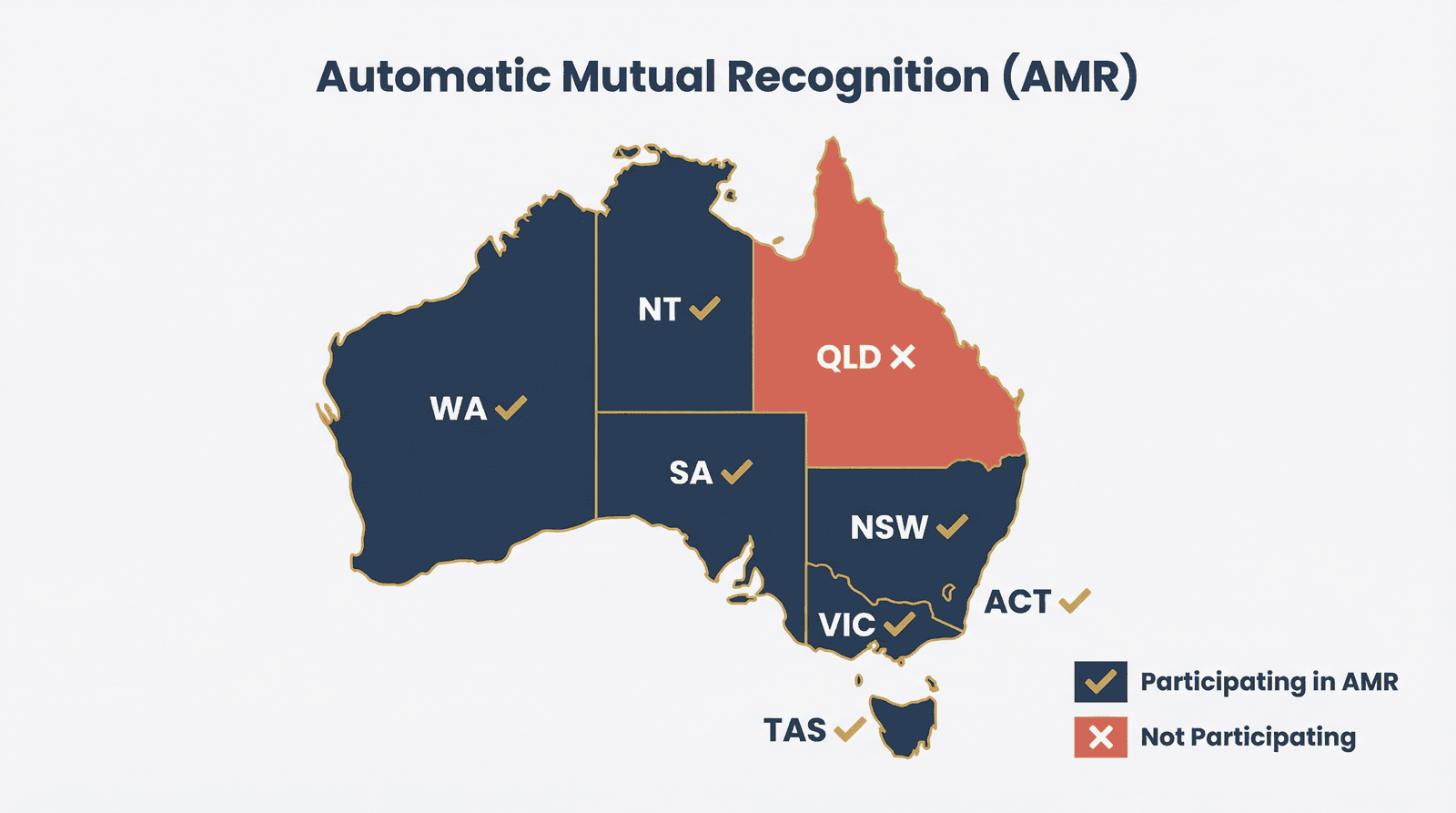
If you hold a builder's licence from another state, you can apply to have it recognised in NSW. General building work is not yet part of the Automatic Mutual Recognition (AMR) scheme in NSW. Building Commission NSW says it is intended to join on 1 October 2027. Until then, interstate builders apply under Mutual Recognition: lodge the Home Building Mutual Recognition form and fee at Service NSW. Once a complete notice is lodged you are deemed registered and can start work, and substantive registration should follow within one month.
How It Works
For occupations included in AMR, you can work in NSW under your home state licence after notifying Building Commission NSW, with no NSW licence fee. Several trade and other building categories are already included. General building work is intended to join on 1 October 2027.
Participating States
These are two distinct credentials serving different purposes. Understanding the difference is important before deciding which pathway suits your needs.
| Feature | Builder's Licence | Owner-Builder Permit |
|---|---|---|
| Purpose | Contract for building work for others | Supervise work on your own property only |
| Work Threshold | Required for work over $5,000 | Required for work over $10,000 |
| Qualifications | A listed qualification route plus 2 years of supervised experience | White card, plus the owner-builder education requirement for work over $20,000 |
| Frequency | Renewable for 1, 3 or 5 years | Generally one permit in any 5-year period |
| Commercial Use | Yes - run a building business | No - your own home only |
| Insurance and responsibility | Home building compensation cover for each job over $20,000 | Just as responsible for the work as a licensed builder |
Choose a builder's licence if: You want to work as a builder professionally, contract for work on other people's properties, or run a building business.
Choose an owner-builder permit if: You only want to manage construction work on your own home and don't intend to work commercially.
Several regulatory changes have been announced or deferred. Here's what Building Commission NSW has published.
| Change | Original Date | New Date | Impact |
|---|---|---|---|
| General building work joins Automatic Mutual Recognition | Not yet included | 1 October 2027 (intended) | Interstate builders use Mutual Recognition until then |
| Design & Building Practitioners Act extended to class 3 & 9c remedial work | 1 July 2026 | 1 July 2028 | Deferred a further 2 years |
| Building practitioner professional indemnity insurance exemption | 30 June 2026 | 30 June 2027 | Exemption extended 12 months |
| Strata building bond increase (2% to 3%) | 1 July 2026 | 1 July 2028 | Increase deferred |
| Certifier cladding PII exemption | Had expiry date | No expiry | Exemption continues |
Source: Building Commission NSW, update on amendments to building regulations (26 June 2026) and AMR occupations: building work (accessed October 2026).
Building Commission NSW lists three qualification routes for general building work. The most common is a Certificate IV in Building and Construction (CPC40120) that includes the units it lists, plus one of these: a carpentry or bricklaying contractor licence, supervisor certificate or approved trade qualification; the Diploma of Building and Construction (CPC50220); or a relevant degree. A four-year degree in building, construction, construction management or quantity surveying with a work placement can qualify on its own. The Certificate IV by itself is not enough.
These nationally recognised qualifications meet the licensing requirements discussed in this guide.
CPC50220 - CPC50220 - Explore course content, online coursework and assessment requirements. Check any intended licensing pathway with the relevant regulator.
CPC40120 - CPC40120 - Explore course content, online coursework and assessment requirements. Check any intended licensing pathway with the relevant regulator.
Each regulator sets its own qualification, experience and fee rules. Pick a state to see the full guide.
Not sure where to start? Read the national builders licence guide for a side-by-side summary of every state, or check whether RPL can fast-track your qualification.
Built by Prepare Training (RTO 45384). Use them on the job today, no account needed.
Draft a site-specific Safe Work Method Statement for high risk construction work in minutes. No sign-up.
Open the tool →Work out concrete, brick, timber and plasterboard quantities with waste allowances built in.
Open the tool →Instant per-square-metre build estimates for Sydney, Melbourne, Brisbane, Perth and Adelaide.
Open the tool →Our NSW/WA Certificate IV in Building and Construction includes the units Building Commission NSW lists, and with the Diploma or your carpentry or bricklaying trade it is one recognised qualification pathway to a NSW builder's licence. Study online while you work. Experience requirements apply separately.