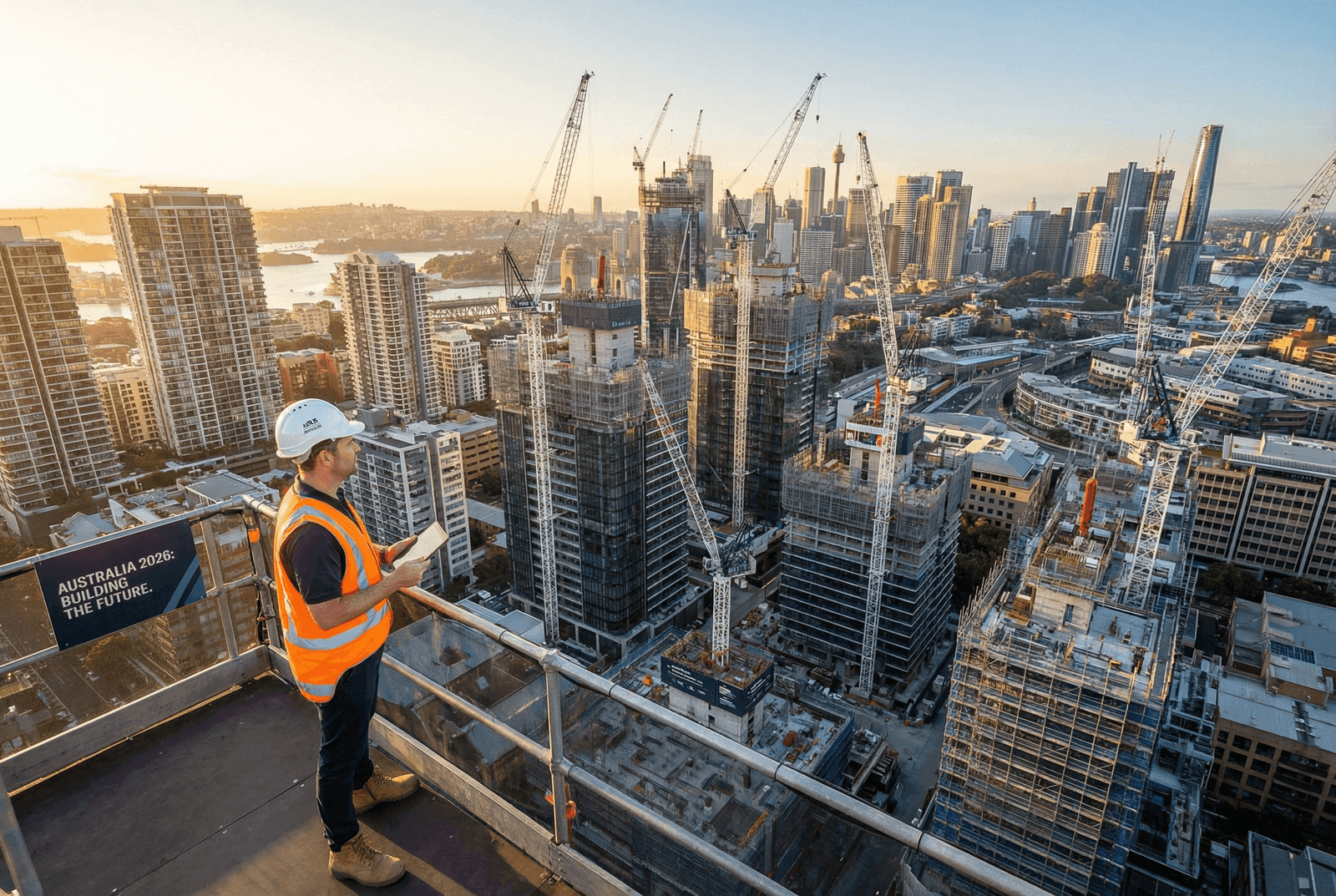
Australian Construction Industry 2026
A comprehensive analysis of Australia's building and construction sector—from the $292 billion market and housing crisis to workforce shortages, regulatory changes, and the technology reshaping how we build.
TL;DR
Australia's $293 billion construction industry faces a 300,000-worker shortfall by 2027 alongside record builder insolvencies and a $242 billion infrastructure pipeline. New NCC 2025 regulations, rising costs, and the housing crisis are reshaping the sector — but demand for qualified workers has never been higher.
Market Outlook for 2026
Australia's construction industry is entering 2026 in a recalibration phase—leaner, more deliberate, and increasingly defined by capacity and discipline over scale and speed. After years of volatility and cost escalation, the sector is finding a new equilibrium with renewed momentum in residential development.
Australian Construction Market Value & Forecast
*Forecast. CAGR 3.31% (2026-2035). Source: Expert Market Research, Oxford Economics
Industry Snapshot
- Total construction work done (Sep 2025): $79.28 billion quarterly
- Building work: Up 6.5% year-on-year; residential up 8.5%
- Dwelling commencements: 48,778 in Sep quarter (+6.6%)
- House approvals: Up 10.1% over two years
- Multi-unit approvals: Up 36.4% over two years
The Housing Crisis: Australia's Building Shortfall
Australia's ambitious target to build 1.2 million homes by mid-2029 is significantly off track. The National Housing Supply and Affordability Council forecasts the country will fall approximately 262,000 homes short—meaning for every five homes needed, only about four will be built.
Housing Target vs Actual Progress
Forecast Total Shortfall
262,000
homes short of 1.2M target by 2029
Rental Vacancy Rate
1.8%
near record lows nationwide
Mortgage Affordability
50%
of median income for new mortgage
No State on Track
No state or territory is currently building enough homes to meet its share of the national target. First-home buyers face savings periods exceeding ten years just for deposits, while rental costs consume 33% of median household income.
Critical Workforce Shortage
Australia's construction sector faces a "perfect storm" with a record $242 billion infrastructure pipeline coinciding with severe labour gaps. Infrastructure Australia projects a 300,000-worker shortfall by 2027—up from approximately 141,000 currently.
Projected Construction Worker Shortfall
Source: Infrastructure Australia, 2025 Infrastructure Market Capacity Report
Universal Trade Shortages
Jobs & Skills Australia
The Only Industry with Universal Shortages
Every construction-specific occupation is listed as in national shortage by Jobs & Skills Australia—making construction the only industry facing universal shortages across all trades.
- 78% of employers expect higher-skilled position shortages in 2026
- 69% anticipate gaps in lower-skilled roles
- 130,000 additional workers needed for housing targets alone
- Regional areas forecast to see shortfalls quadruple by 2027
High Demand = Strong Careers
The persistent shortage means qualified construction workers are in extremely high demand. Those with nationally recognised qualifications and skills in emerging areas like BIM and digital technologies can command premium wages and have their pick of employers. Already have years of hands-on experience? Recognition of Prior Learning (RPL) can fast-track your formal qualification.
Builder Insolvencies Hit Record Levels
Construction insolvencies have reached crisis levels, with 3,595 businesses failing in FY 2024-25— representing 27% of all Australian business failures, the highest of any sector.
Construction Insolvencies by Financial Year
Source: ASIC, AFR, Forward Path Advisory
Key Causes
- Fixed-price contracts during rapid cost escalation
- Rising interest rates increasing holding costs
- Project delays and supply chain disruptions
- Thin profit margins (industry average ~5%)
- Payment delays on large projects
Who's Most Affected
- Small builders (<5 employees) hit hardest
- Victoria and NSW highest numbers
- Restructuring up 7x in 3 years (295 to 2,206)
- Large builders also struggling
- Notable collapses: Porter Davis, Grandeur
Regulatory Changes for 2026
Several significant regulatory changes affect the construction industry in 2026, including the National Construction Code 2025 and enhanced workplace safety requirements for crystalline silica exposure.
Silica Compliance is Mandatory
Non-compliance with silica regulations carries serious penalties including fines, site shutdowns, legal consequences, and potential loss of government tenders. Contractors must have written CS-RCPs before any high-risk crystalline silica work begins. Professionals looking to specialise in safety compliance can gain formal credentials through the Certificate IV in Work Health and Safety (BSB41419).
Construction Costs: 4-6% Escalation Expected
Construction costs are forecast to rise 4-6% across major cities in 2026, with Brisbane and the Gold Coast facing the highest pressure due to Olympic-related infrastructure demands. Energy costs remain the primary driver.
2026 Construction Cost Escalation Forecast by City
Source: Rider Levett Bucknall, Altus Group, WT Partnership
Key Cost Drivers
- Energy: Electricity up 23.6% year-on-year, driving cement, aluminium, and brick costs
- Labour: Trade wages rising 4-5% annually; productivity has halved since 1995
- Completion times: House and apartment builds now take ~40% longer than pre-pandemic
- Local materials: Concrete, plasterboard, bricks elevated due to labour and delivery pressures
- Relief timeline: Analysts don't expect meaningful relief before 2028
With cost pressures intensifying, skilled estimators are in high demand. The Certificate IV in Building Project Support — Estimating (CPC40420) equips professionals with the cost planning and forecasting skills the industry needs.
Technology Reshaping Construction
Digitalisation has become an operational necessity in Australian construction. By 2026, the average firm uses 6.2 different digital technologies—a 20% increase in just one year. Around 30% of firms are already using or trialling AI solutions.
Digital Technology Adoption in Construction
BIM & Digital Twins
Building Information Modelling and Digital Twins enable scenario simulation and risk anticipation before construction begins.
Case study: Brisbane's Cross River Rail used a digital twin modelling 300km² to avert up to 4 months of delays and save millions in costs.
AI & Automation
AI-enhanced planning and cloud-based management platforms are reducing manual tasks, rework, and cost overruns through greater transparency.
30% of firms now using or trialling AI solutions
Modular Construction
Prefabricated homes complete in 10-12 weeks vs 18 months traditional, with 20-30% cost reductions demonstrated in Victoria.
Market growing from <5% to projected 10%+ by 2030
Skills Gap Alert
While digital adoption is rising, 87% of firms report digital-skills shortages, particularly in AI, data analytics, and BIM. Workers with these skills are increasingly valuable and can command higher wages.
State-by-State Construction Outlook
Construction opportunities vary significantly across Australia. Queensland leads with Olympics-driven infrastructure, while southern states enter stabilisation phases with different procurement priorities.
Most stable market with consistent opportunities across construction, engineering, and infrastructure. Brisbane 2032 Olympics preparation driving unprecedented investment.
- $4.4B Olympic venue investment
- 30,000-40,000 workers needed annually
- 5-year pipeline 2x previous 5 years
- New QPP 2026 procurement policy from Jan 2026
Queensland's unique licensing system makes it the ideal state to step into site supervision. Explore the Open Class Site Supervisor (QLD) pathway.
Entering stabilisation phase after a decade of heavy infrastructure investment. Emphasis on value-for-money outcomes and budget discipline.
- Activity ~30% higher than recent years
- Focus on transport and health projects
- Strong but more measured procurement
Moderated tender volume due to budget tightening and sector reforms. Increased emphasis on sustainability, ESG credentials, and social value.
- ~30% higher than recent years expected
- Focus on community services, energy
- Panel-based procurement increasing
South Australia and Tasmania have potential pipelines 4-5x larger than recent years. WA and NT expect only small increases from current levels.
- SA/TAS: Major growth potential
- WA: Stable with mining support
Career Opportunities in Construction
The combination of workforce shortages, a massive infrastructure pipeline, and ongoing housing demand creates exceptional career opportunities for qualified construction workers. The industry employs 1.36 million Australians—9.2% of the total workforce.
Why Construction Careers Are Thriving
High Demand
Industry Statistics
- 1.36 million workers employed
- 9.2% of Australian workforce
- +11,900 jobs added in past year
- 300,000 worker shortfall by 2027
Qualification Pathway
- White Card — Mandatory site access
- CPC40120 — Certificate IV in Building and Construction
- CPC50220 — Diploma of Building and Construction
- Builder's Licence — Run your own business
Not sure which level is right for you? Compare qualifications side by side.
High-Value Skills for 2026
- Building Information Modelling (BIM)
- Digital twin expertise
- Project management & supervision
- Cost estimation & quantity surveying
- Sustainable building practices
- Modular/prefab construction knowledge
Sector Stability
While builder insolvencies have risen, qualified workers remain in high demand. The $242 billion infrastructure pipeline and housing shortage ensure work for years ahead.
Those with formal qualifications and diversified skills across residential, commercial, and infrastructure sectors have the strongest job security.
Frequently Asked Questions
Yes, the Australian construction market is valued at $292.53 billion in 2025 and is forecast to grow at 3.31% CAGR through 2035. Building construction specifically is expected to expand to $130.4 billion in FY2026, representing 9% growth. However, growth is tempered by workforce shortages, cost pressures, and the ongoing housing crisis that's constraining residential supply.
Already working in the industry? You can study while you work — our courses are 100% online, designed for busy professionals on active job sites.
Ready to Build Your Career in Construction?
With 300,000 workers needed and every trade in shortage, there's never been a better time to gain nationally recognised construction qualifications. Study online and flexible with Prepare Training.