QLDVICSATASNTACT
Building
Certificate IV in Building and Construction
CPC40120 - CPC40120 - Nationally recognised building and construction training for builders, site supervisors and construction managers.
The complete 2026 guide to getting your builder's licence in Tasmania. Four sub-classes, no exam required, qualification pathways, realistic costs, CPD obligations, why AMR does not apply until July 2026, and what a $30.68 billion infrastructure pipeline means for licensed builders — all decoded from the legislation into plain language.
Understanding when you need a licence — and when you don't.
Under the Occupational Licensing Act 2005 and the Building Act 2016, you must hold a building services provider licence to carry out building work in Tasmania. The licence is administered by Consumer, Building and Occupational Services (CBOS), part of the Tasmanian Department of Justice.
Tasmania's licensing system covers anyone who manages or carries out building work — whether you are a sole trader contracting directly with homeowners or a builder running a company. The system uses four sub-classes for general construction builders, each tied to the scope and complexity of work you intend to do.
Unlike South Australia (face-to-face technical interview), the ACT (written exam), or Western Australia (exam), Tasmania does not require any exam or interview. Your application is assessed based on your qualifications, documented experience (Statement of Experience), and two referee statements from licensed professionals.
Tasmania uses a clean four-tier structure for general construction builders.
Under the Occupational Licensing (Building Services Work) Determination 2021, Tasmania's builder (general construction) licence has four sub-classes, each defining the scope of work you are authorised to carry out. The qualification and experience requirements increase as the scope expands.
| Sub-Class | Scope of Work | Qualification | Experience Required |
|---|---|---|---|
| Domestic | Residential buildings — houses, townhouses, duplexes, garages, sheds, carports | CPC40120 Certificate IV | 2 years (trade cert) / 4 years (without) |
| Low Rise | Residential + some commercial buildings up to a certain height | CPC40120 Certificate IV | 2 years (trade cert) / 4 years (without) |
| Medium Rise | Multi-storey buildings including medium-rise commercial and residential | CPC50220 Diploma | 2 years (trade cert) / 4 years (without) |
| Open | All building work — no restrictions on type, height, or complexity | CPC60220 Advanced Diploma | 3 years (trade cert) / 6 years (without) |
Source: Occupational Licensing (Building Services Work) Determination 2021, effective 1 January 2022. Check CBOS for current requirements.
If your goal is to build houses, the Domestic sub-class is the most common starting point. It covers all standard residential building work — houses, townhouses, duplexes, and associated structures like garages, sheds, and carports. If you also want to take on light commercial work, consider Low Rise instead — it requires the same qualification and experience.

What you need to study — and how many years on the tools CBOS expects.
The Occupational Licensing (Building Services Work) Determination 2021 prescribes the qualifications and experience required for each sub-class. The qualification ladder is clear: CPC40120 Certificate IV for Domestic and Low Rise, CPC50220 Diploma for Medium Rise, and the CPC60220 Advanced Diploma of Building and Construction for Open.
Experience is measured in two tiers — if you hold a relevant trade certificate (e.g. carpentry, bricklaying), you need fewer years than someone without one. For Domestic, Low Rise, and Medium Rise, it's 2 years with a trade cert or 4 years without. For Open, it's 3 years with a trade cert or 6 years without.
| Sub-Class | With Trade Certificate | Without Trade Certificate | Qualification |
|---|---|---|---|
| Domestic | 2 years | 4 years | CPC40120 Certificate IV |
| Low Rise | 2 years | 4 years | CPC40120 Certificate IV |
| Medium Rise | 2 years | 4 years | CPC50220 Diploma |
| Open | 3 years | 6 years | CPC60220 Advanced Diploma |
Course code: CPC40120 (CPC40120)
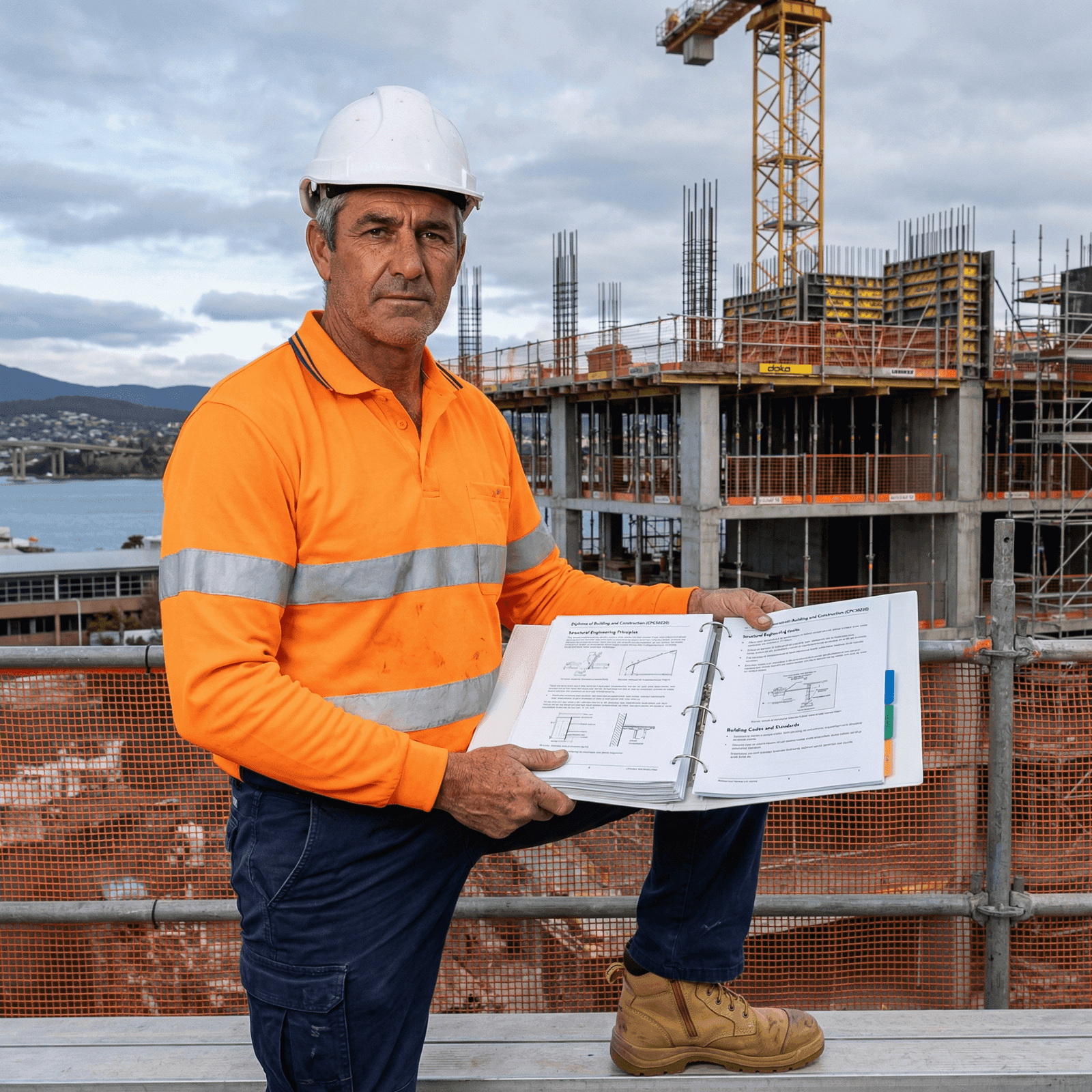
Course code: CPC50220 (CPC50220)
Not sure which qualification you need? Compare qualifications to find the right pathway for your TAS builder's licence. All qualifications are delivered 100% online so you can study while you work.
If you already have extensive construction experience, Recognition of Prior Learning (RPL) can significantly reduce your study time. An RTO assesses your existing skills and knowledge against the qualification's units of competency, allowing you to gain formal credentials based on what you already know and can do.
From qualification to holding your licence — the complete TAS process.
Obtain the CPC40120 Certificate IV (Domestic/Low Rise), CPC50220 Diploma (Medium Rise), or CPC60220 Advanced Diploma (Open). Study 100% online with Prepare Training. RPL is available for experienced tradies.
Accumulate 2 years (with trade cert) or 4 years (without) of documented on-site experience for Domestic, Low Rise, or Medium Rise. Open requires 3 years (with trade cert) or 6 years (without).
Document your building experience with project details including your role, number of storeys, square metres, and dates. This is a critical part of your application — CBOS uses it to assess your practical competence.
Get two referee statements from licensed building professionals who have directly overseen your work. Referees must be able to verify your experience claims and competence.
Apply online through the CBOS system. Include your qualification certificates, Statement of Experience, referee statements, certificate of currency for insurance, and the application fee ($449 for 1 year or $1,206 for 3 years).
Attend a Service Tasmania centre to have your photo taken and identity verified. Your licence will be issued within 21 business days of a complete application.
Tasmania is one of the simpler states when it comes to the assessment process:
Application fees, renewal costs, and why the 3-year option saves money.
| Licence Duration | Fee | Notes |
|---|---|---|
| 1-year licence | ~$449 | Standard annual licence |
| 3-year licence | ~$1,206 | Saves ~$140 vs three 1-year renewals |
Fees are approximate and based on CBOS and Service Tasmania published schedules (2024-25). Always check cbos.tas.gov.au or contact CBOS on 1300 654 499 for current fee amounts.
Three consecutive 1-year renewals cost approximately $1,347 ($449 × 3), while the 3-year licence is approximately $1,206 — a saving of around $140. If you are confident in your career direction, the 3-year option is the better value.
Continuing professional development is mandatory for all licensed builders.
All licensed builders in Tasmania must complete 12 CPD points per year. This is not optional — failure to comply risks licence suspension. CPD ensures builders stay current with evolving building codes, safety standards, and construction practices.
CPD points can be earned through approved training courses, professional development activities, and advanced activities. CBOS publishes a list of approved CPD providers and activities on their website.
12
Points Per Year
Mandatory for all licensed builders
3
Activity Categories
Training, professional, and advanced activities
Annual
Compliance Period
Must be completed each year — no carry-over
Whether you are actively building, between projects, or working under another builder's supervision, your CPD obligations remain. Failure to complete 12 points in any year may result in your licence being suspended by CBOS.
Tasmania is the only state without mandated home warranty insurance — but that's changing.
Licensed builders must provide a certificate of currency for appropriate insurance with their licence application. However, Tasmania is currently the only Australian state without mandated home warranty insurance — meaning homeowners have no insurance safety net if their builder dies, disappears, or becomes insolvent.
This is changing. The Home Warranty Insurance Act 2023 was passed by the Tasmanian Parliament to address this gap. The scheme will apply to domestic building contracts valued over $20,000 and is expected to commence in mid-2025.
$20,000
HWI Threshold
Contracts over $20,000 when scheme commences
2023
Legislation Passed
Home Warranty Insurance Act 2023
Mid-2025
Expected Start
Scheme commencement date TBC
When the Home Warranty Insurance scheme commences, it will protect homeowners if:
Currently, Tasmania is the only Australian state without this consumer protection. Master Builders Tasmania has been a strong advocate for the scheme's introduction.
Regardless of the HWI scheme's status, you must provide a certificate of currency for appropriate insurance (such as public liability and professional indemnity) with your licence application. Contact your insurer to ensure your cover meets CBOS requirements.
Fines of up to $40,400 for individuals and $80,800 for body corporates.
Under Section 22A of the Occupational Licensing Act 2005, it is an offence to carry out building services work without a licence. Penalties are expressed in penalty units — currently $202 per unit in Tasmania.
| Offender | Maximum Penalty | Penalty Units |
|---|---|---|
| Individual | Up to $40,400 | 200 penalty units |
| Body Corporate | Up to $80,800 | 400 penalty units |
Unlike some other states, CBOS cannot order builders to pay compensation or carry out rectification work. If you engage an unlicensed builder and the work is defective, your only recourse is through the courts. This makes checking a builder's licence status before engaging them critical — CBOS provides an online licence search.
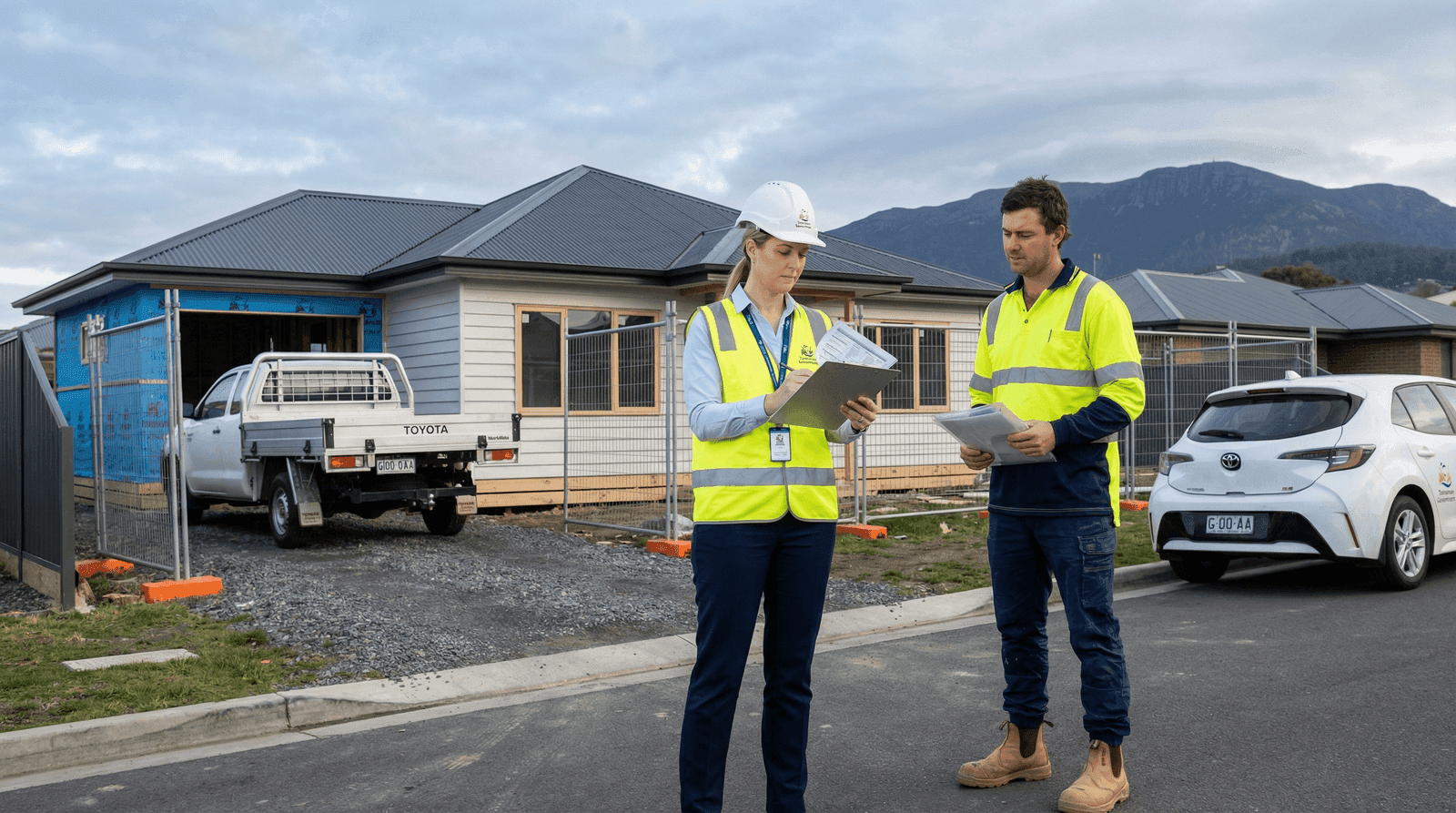
Tasmania is the most restrictive state for interstate builder mobility.
This is the single most important fact for interstate builders considering work in Tasmania: Automatic Mutual Recognition (AMR) does not apply to Builder (General Construction) in Tasmania until 1 July 2026.
While most other states allow interstate builders to work under AMR (also called JobPass) by submitting a free online notification, Tasmania has explicitly excluded general construction builders from the scheme. This makes Tasmania the most restrictive state in Australia for builder mobility.
If you hold an interstate builder's licence and want to work in Tasmania, you must apply through the traditional mutual recognition process under the Mutual Recognition Act 1992 (Cth).
If the AMR exclusion is not extended beyond 1 July 2026, interstate builders may be able to work in Tasmania under AMR:
If you arrive in Tasmania and begin building work relying on AMR, you may be committing an offence under the Occupational Licensing Act 2005. Penalties are up to $40,400 for individuals. Always check the current status of the AMR exclusion with CBOS before planning interstate work in Tasmania.
A $30.68 billion infrastructure pipeline and acute skills shortage.
Despite having Australia's slowest population growth (0.2%), Tasmania's construction sector is booming. The state has a $30.68 billion 10-year infrastructure pipeline with 442 active projects valued over $5 million — up $3.62 billion on the prior year. Building approvals surged 12.8% to a two-year high in September 2025, and the top five builders saw new home starts increase 57.8% in 2024/25.
The energy transition is a major driver — Marinus Link, wind farms, and SunCable are bringing massive investment to the state. Master Builders Tasmania estimates the construction workforce needs to grow by 25% within three years, with up to 40,000 workers needed by 2033. The state has lost roughly 1 in 5 construction workers since 2018.
“Tasmania has suffered from a skilled worker shortage for several years, causing delayed projects across the state.”
— Matthew Pollock, Executive Director, Master Builders Tasmania
“The outlook for new home building in Tasmania is brighter than for the larger mainland states to the north.”
— Stuart Collins, Executive Director, HIA Tasmania
The combination of a massive infrastructure pipeline, acute skills shortage, and impending Home Warranty Insurance creates significant opportunity for licensed builders in Tasmania. Getting licensed now positions you to capitalise on this growth. With the incoming HWI scheme, properly licensed and insured builders will be strongly favoured over unlicensed operators.
Avoid these pitfalls to save time, money, and frustration.
| Mistake | Consequence | Prevention |
|---|---|---|
| Incomplete Statement of Experience | Application delayed or rejected — CBOS can't verify your competence | Include project details with your role, number of storeys, square metres, and dates for every project |
| Poor referee statements | Application rejected — referees must be licensed professionals who directly oversaw your work | Choose referees carefully. They must be licensed builders who can speak specifically to your competence |
| Choosing the wrong sub-class | Licensed for work you don't intend to do, or too narrow for your goals | Match your sub-class to your experience and career direction. Domestic for houses only; Low Rise for houses + light commercial |
| Assuming AMR applies | Working unlicensed — penalties up to $40,400 | AMR is excluded for builders in TAS until 1 July 2026. Apply through traditional mutual recognition |
| Not maintaining CPD | Licence suspension | Complete 12 CPD points every year. Track your points and plan activities in advance |
| Missing insurance certificate of currency | Application returned incomplete | Arrange appropriate insurance and obtain your certificate of currency before applying |
An optional endorsement available to licensed builders in Tasmania.
Tasmania offers a roof drainage endorsement that can be added to your builder's licence. This endorsement authorises you to install, replace, repair, or maintain roof drainage systems (gutters, downpipes, and associated components) as part of your building work.
If you regularly build new homes or carry out renovations that include roof drainage work, this endorsement allows you to handle that work yourself rather than subcontracting it to a licensed plumber.
Contact CBOS on 1300 654 499 to confirm the current requirements and fees for adding a roof drainage endorsement to your licence.
These nationally recognised qualifications meet the licensing requirements discussed in this guide.
CPC40120 - CPC40120 - Nationally recognised building and construction training for builders, site supervisors and construction managers.
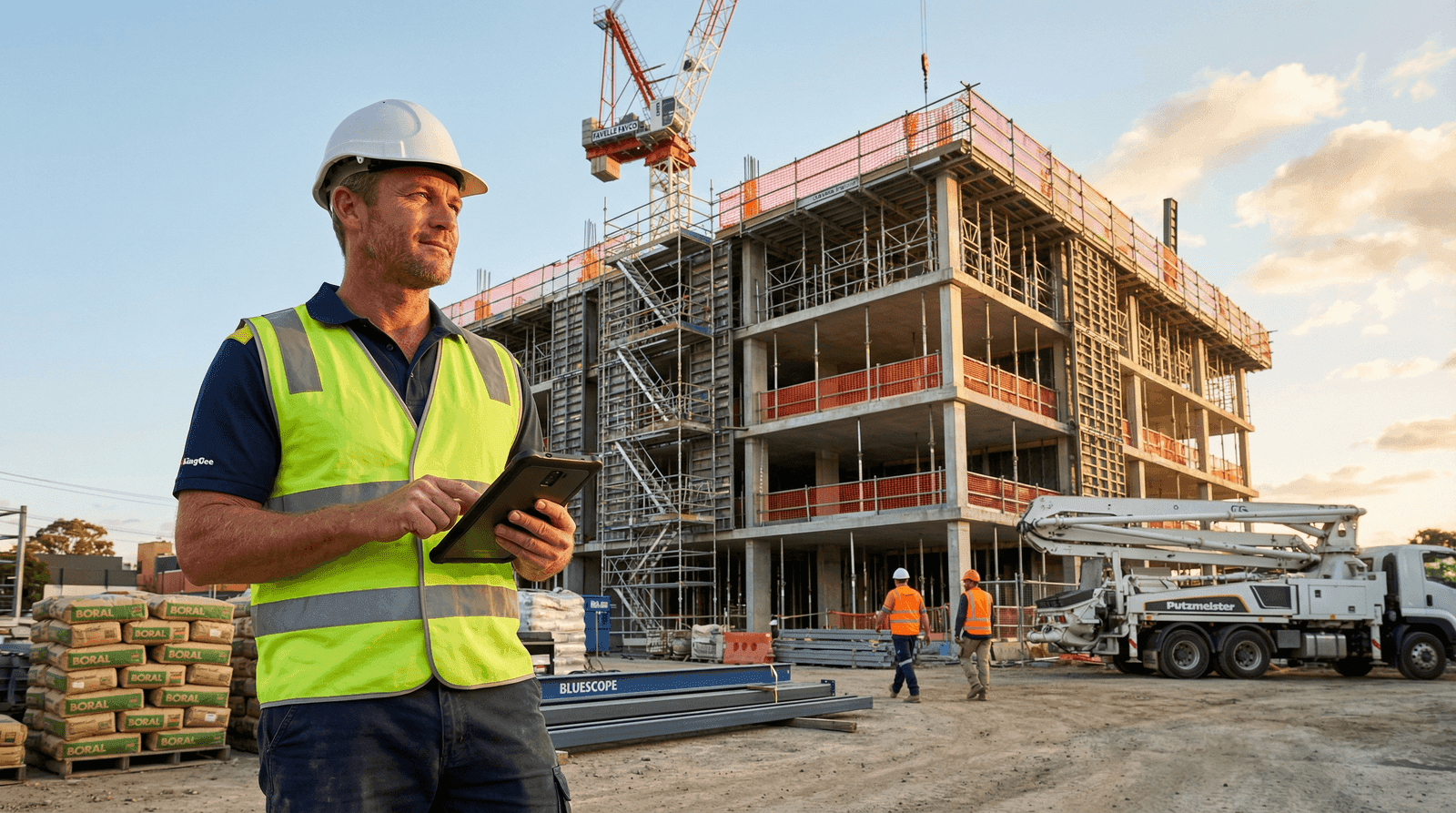
CPC50220 - CPC50220 - Nationally recognised building and construction training for experienced builders, site managers and construction professionals.

CPC60220 - CPC60220 - Advanced building and construction management for experienced professionals working with large and complex projects.
Each regulator sets its own qualification, experience and fee rules. Pick a state to see the full guide.
Not sure where to start? Read the national builders licence guide for a side-by-side summary of every state, or check whether RPL can fast-track your qualification.
Built by Prepare Training (RTO 45384). Use them on the job today, no account needed.
Draft a site-specific Safe Work Method Statement for high risk construction work in minutes. No sign-up.
Open the tool →Work out concrete, brick, timber and plasterboard quantities with waste allowances built in.
Open the tool →Instant per-square-metre build estimates for Sydney, Melbourne, Brisbane, Perth and Adelaide.
Open the tool →A 1-year builder licence costs approximately $449, and a 3-year licence costs approximately $1,206. The 3-year option saves around $140 compared to three consecutive 1-year renewals. Check the CBOS website for current fee amounts.
Prepare Training delivers nationally recognised construction qualifications 100% online. Get your Certificate IV in Building and Construction — the core qualification for Tasmania's Domestic and Low Rise builder licence — and take the first step toward your builder's licence.