QLDVICSATASNTACT
Building
Certificate IV in Building and Construction
CPC40120 - CPC40120 - Nationally recognised building and construction training for builders, site supervisors and construction managers.
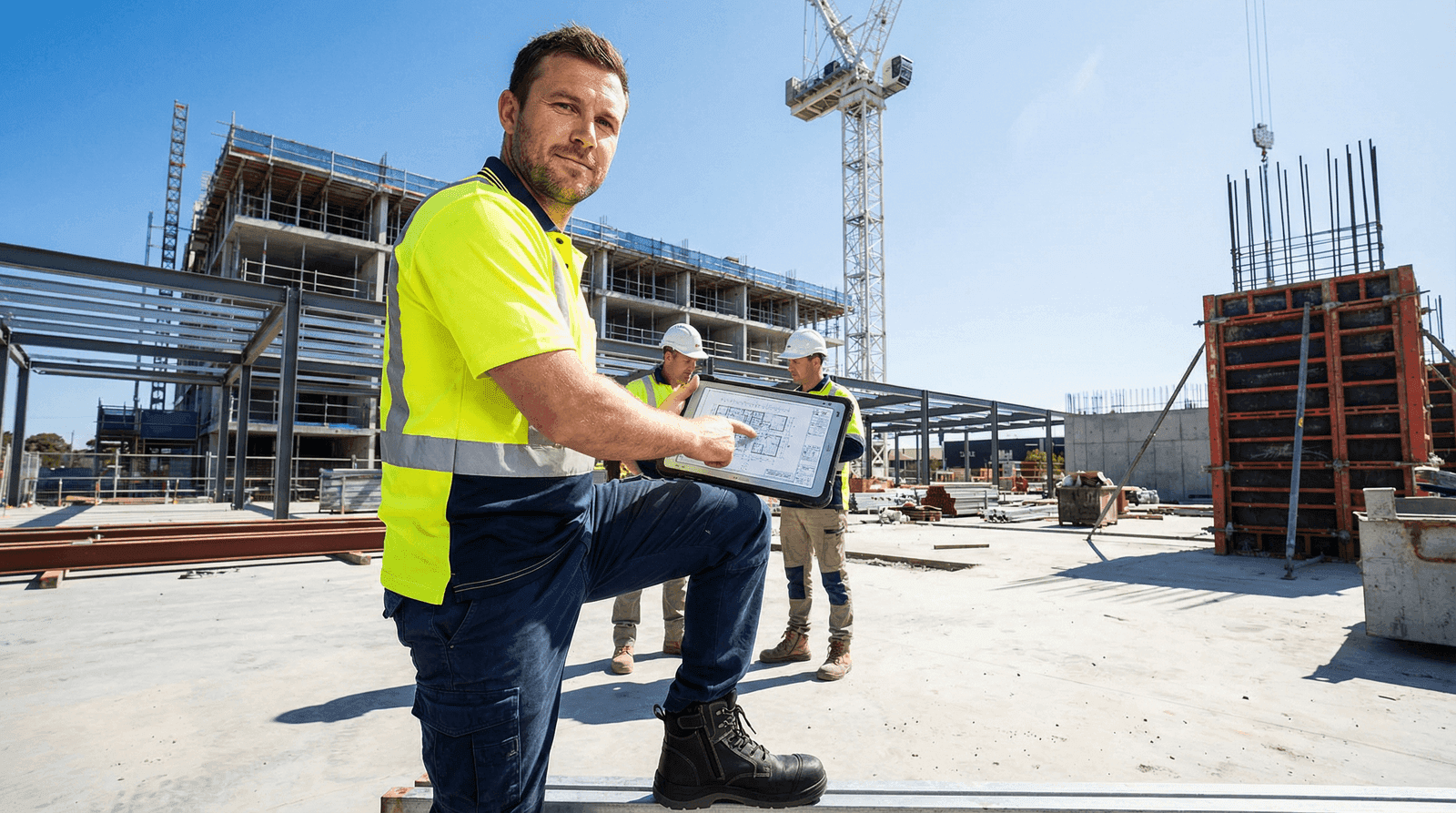
In Victoria, it's called registration, not a licence. This is the complete 2026 guide to becoming a registered domestic or commercial builder through the Building and Plumbing Commission (BPC) — qualifications, experience, exams, fees, and recent reforms all covered.
TL;DR
Victoria calls it registration, not a licence. You need a CPC50220 Diploma (or equivalent), 3 years' experience, and must pass a BPC exam and interview. Two categories — Domestic Builder (Unlimited) and Commercial Builder (Unlimited) — cover residential and commercial work respectively. Registration costs ~$1,011 initially, with mandatory domestic building insurance for residential work.
If you're searching for a "builders licence" in Victoria, here's the first thing to know: Victoria doesn't issue builders licences. Instead, you apply for building practitioner registration through the Building and Plumbing Commission (BPC), which replaced the Victorian Building Authority (VBA) on 1 July 2025.
This isn't just a naming difference — the registration system, the regulator, and the assessment process are all distinct from NSW's licensing model or Queensland's QBCC system. Registration applies to individuals, not companies. If you want your company named as the builder on permits, the company must be separately registered with at least one director holding individual registration.
Performing building work without registration can result in fines exceeding $46,000 for individuals and up to $480,000 for companies if done knowingly or recklessly. You must be registered before entering any domestic building contract worth more than $10,000, or carrying out reblocking, restumping, demolition, or home removal at any value.
For building actual buildings — houses, apartments, commercial structures — you need one of these two primary registrations. They serve fundamentally different markets.
DB-U Registration
CB-U Registration
Class 2 apartment buildings sit in an overlap zone — they can be built under either a Domestic Builder or Commercial Builder registration depending on the contract type. If you work across both residential houses and apartment developments, you may eventually want both registrations.
There are also limited commercial builder classes for builders stepping up from domestic:
| Limited Class | Height Limit | Excavation Limit | Qualification |
|---|---|---|---|
| CB – Low-Rise | Up to 15m | Up to 3m depth | CPC50220 Diploma + specific units |
| CB – Medium-Rise | Up to 25m | Up to 8m depth | CPC60220 Advanced Diploma |
Your registration type determines which National Construction Code (NCC) building classes you can work on. Here's a visual breakdown of which classes fall under each registration.
Class 2 buildings (apartments) can be built under a domestic building contract or a commercial contract. A Domestic Builder (Unlimited) can manage the residential aspects, while a Commercial Builder handles the commercial contracting. In practice, which registration you use depends on the contract structure and whether the work falls under the Domestic Building Contracts Act 1995.
This is where Victoria differs from what you might expect. There's a prescribed qualification for each class — but there's also an equivalency pathway most people don't know about.
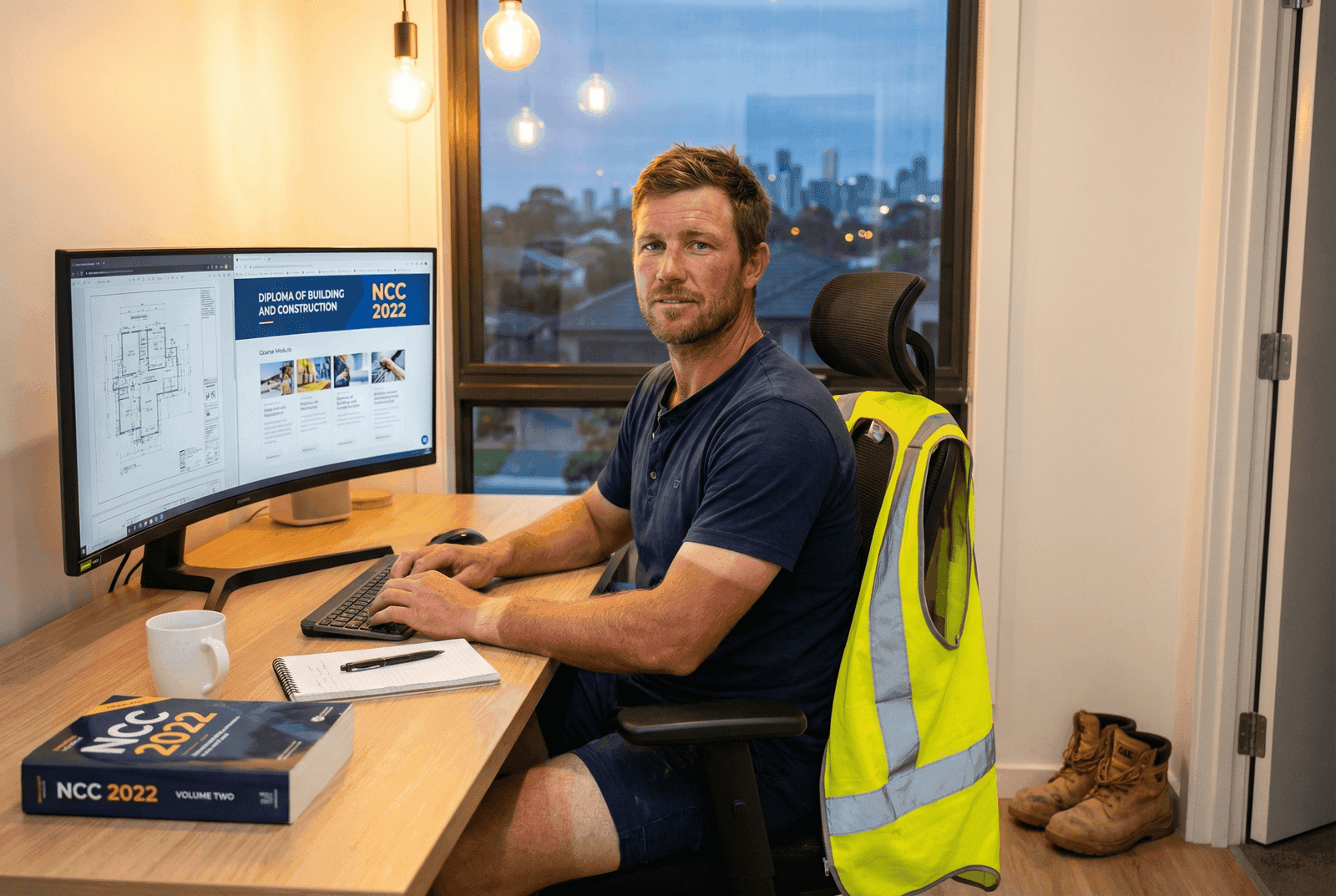
Under the Building Act 1993, Section 171, the BPC can register applicants with equivalent qualifications. The HIA confirms that many DB-U applicants hold a CPC40120 Certificate IV in Building and Construction and demonstrate equivalent skills through BPC exams and assessments.
View Diploma Course Details →Delivered 100% online — you can study while you work and gain your qualification without leaving the tools.
| Registration Class | Prescribed Qualification | Alternative Pathway |
|---|---|---|
| DB-U (Domestic Unlimited) | CPC50220 Diploma or Bachelor degree | CPC40120 Cert IV + equivalency assessment |
| CB-U (Commercial Unlimited) | Bachelor degree or CPC60220 Advanced Diploma | Contact BPC for equivalent pathways |
| CB Low-Rise | CPC50220 Diploma + 2 specific units | Contact BPC for equivalent pathways |
| CB Medium-Rise | CPC60220 Advanced Diploma | Contact BPC for equivalent pathways |
For Commercial Builder (Unlimited) registration, the Advanced Diploma of Building and Construction (CPC60220) is the primary VET pathway. If you have extensive building experience, RPL can help you gain formal credentials faster. Compare qualifications to find the right pathway for your registration goals.
A qualification alone is never enough. You must demonstrate practical, well-rounded experience in managing building projects — not just trade work. The BPC is looking for evidence that you can run a job from start to finish.
Applies to DB-U, CB-U, CB Low-Rise, and CB Medium-Rise. Must be within the 7 years before applying.
Applies to limited commercial builder classes (fit-out, waterproofing, steel erection, etc.).
For Commercial Builder (Unlimited), your experience must specifically include construction of buildings higher than 25 metres. For CB Medium-Rise, it must include buildings up to 25 metres with excavations up to 8 metres deep. This is non-negotiable — the BPC will verify this during assessment.
The registration process in Victoria involves more assessment than most states. Here's the complete pathway from preparation to registration.
Obtain the prescribed qualification for your chosen class — or a qualification the BPC accepts as equivalent. Study with an accredited RTO and ensure your units align with BPC requirements.
Document at least 3 work history projects showing your role in managing building work. Include permits, plans, photos, contracts, and correspondence. This is where most applications succeed or fail.
Find at least one referee registered in the same or higher class. They must complete and sign the official Technical Referee Form for your specific registration class. Use the correct form — the wrong form causes delays.
Log in to the BPC portal, complete the application form, upload your evidence portfolio and technical referee reports, and pay the registration fee.
Complete a proctored online exam with multiple-choice questions and plan-based exercises. You need 70% or higher in both components. Exams are held weekly via the Janison platform.
A 1-3 hour face-to-face interview with a BPC assessor. They'll review your 3 submitted projects, ask about your on-site processes, and test knowledge of legislation, contracts, codes, and standards.
Once approved, obtain your domestic building insurance (if applicable), and you're legally authorised to carry out building work in Victoria. Registration is renewed every 5 years.
The exam is the most misunderstood part of the process. It's not a knowledge test you can cram for — it's a practical assessment of your ability to read plans, apply codes, and make construction decisions.
Pass mark: 70% minimum
Pass mark: 70% minimum
Duration: 1-3 hours
The BPC provides a free "Building Exam How to Guide" with practice plan-marking exercises. Complete the onboarding for the Janison proctoring software at least 3 days before your exam. Failing either component means losing your fees and needing to reapply — preparation is not optional.
Here's the complete breakdown of what you'll pay — registration fees, ongoing annual fees, and the insurance you're legally required to hold.
| Registration Class | Registration Fee | Annual Fee | 5-Year Renewal |
|---|---|---|---|
| Domestic Builder (Unlimited) | $1,011.40 | $505.70 | $1,112.50 |
| Commercial Builder (Unlimited) | $809.10 | $404.50 | $964.60 |
Source: VBA/BPC Fee Schedule 2025. All fees are GST-exempt.
Mandatory for all domestic building work valued at more than $16,000. Since 1 July 2025, all DBI policies are managed directly by the BPC.
Separate from DBI, implied warranties under the Domestic Building Contracts Act 1995 transfer to new owners for up to 10 years from completion. These cover workmanship, materials, and compliance — they apply regardless of insurance.
Victoria's building industry went through its biggest regulatory shakeup in decades. If you're applying now, this is the landscape you're entering.
The BPC can now require builders to meet minimum financial standards to maintain registration. This is a direct response to the Porter Davis collapse and other high-profile builder insolvencies. Registration is no longer just about qualifications and experience — you must also demonstrate financial viability.
If you hold building registration or licensing in another state, you may be able to work in Victoria through Automatic Mutual Recognition (AMR) without obtaining separate VIC registration.
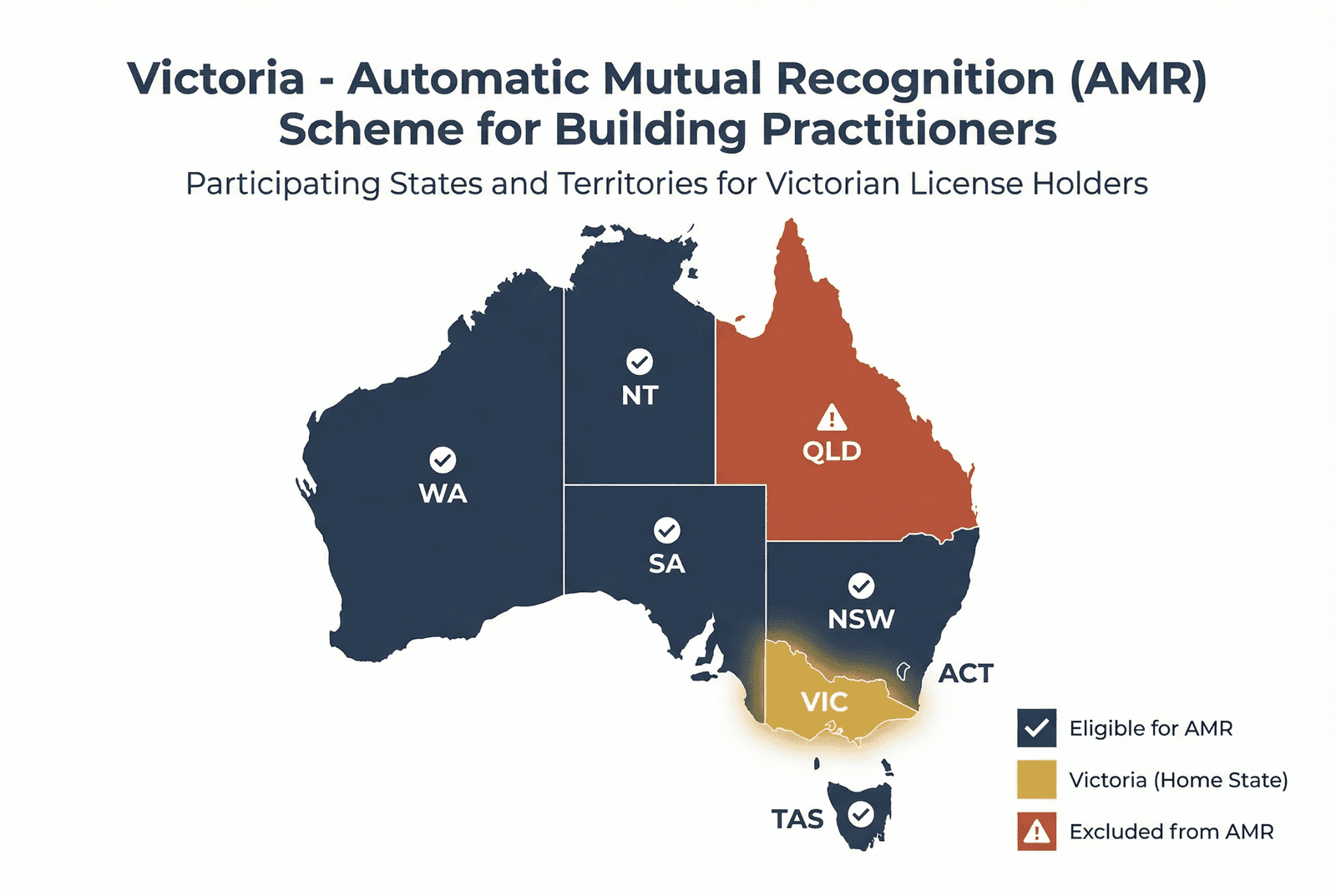
Complete an online notification form via the BPC Portal before commencing work. There is currently a fee exemption for AMR notifications as a transitional measure.
Queensland and New Zealand registrations are currently ineligible for AMR in Victoria. Builders from these jurisdictions must apply through the traditional Mutual Recognition pathway, which requires a separate application to the BPC.
Learn from others' mistakes. These are the most frequent reasons applications stall or get rejected.
| Mistake | What Happens | How to Avoid It |
|---|---|---|
| Weak evidence portfolio | Application rejected — you must demonstrate project management, not just trade work | Document 3+ projects showing your involvement from permits through to handover. Include photos, contracts, plans, and correspondence. |
| Wrong qualification | Must restart with the correct pathway, delaying application by months | Confirm your target registration class with the BPC before enrolling. A Cert III in Carpentry qualifies for limited classes only, not DB-U. |
| Failing the exam | Lose your fees and must reapply from scratch | Complete the BPC's free practice exercises. Install proctoring software 3+ days early. Study NCC, contracts, and OH&S legislation. |
| Wrong technical referee form | Application delayed while the correct form is obtained and completed | Download the exact form for your registration class from the BPC website. There are separate forms for each class. |
| No insurance before starting work | Fines exceeding $46,000. Work may be legally invalid. | Obtain DBI before accepting any deposit or payment for domestic work over $16,000. |
These nationally recognised qualifications meet the licensing requirements discussed in this guide.
CPC40120 - CPC40120 - Nationally recognised building and construction training for builders, site supervisors and construction managers.
CPC50220 - CPC50220 - Nationally recognised building and construction training for experienced builders, site managers and construction professionals.
CPC60220 - CPC60220 - Advanced building and construction management for experienced professionals working with large and complex projects.
Each regulator sets its own qualification, experience and fee rules. Pick a state to see the full guide.
Not sure where to start? Read the national builders licence guide for a side-by-side summary of every state, or check whether RPL can fast-track your qualification.
Built by Prepare Training (RTO 45384). Use them on the job today, no account needed.
Draft a site-specific Safe Work Method Statement for high risk construction work in minutes. No sign-up.
Open the tool →Work out concrete, brick, timber and plasterboard quantities with waste allowances built in.
Open the tool →Instant per-square-metre build estimates for Sydney, Melbourne, Brisbane, Perth and Adelaide.
Open the tool →Start with the right qualification. Whether you're pursuing the Diploma pathway for Domestic Builder (Unlimited) or the Advanced Diploma for Commercial Builder registration, Prepare Training delivers nationally recognised qualifications 100% online.