Construction Manager
$117k–$296k
Average salary in Perth. Oversee entire construction projects from planning to handover.
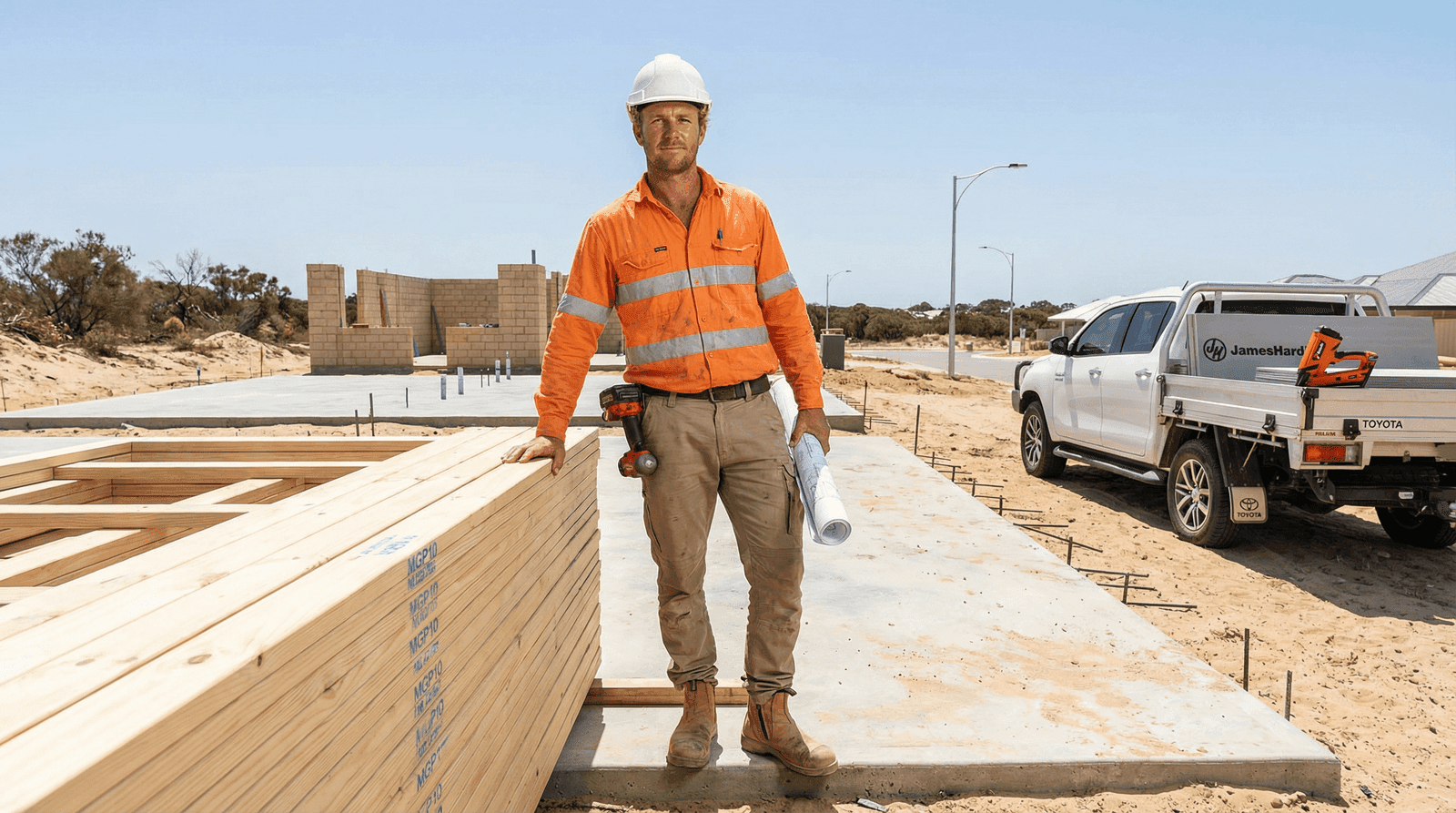
The complete 2026 guide to WA builder registration. Five pathways, the trade experience truth, realistic costs, and the career opportunities waiting on the other side — all decoded from the bureaucratic jargon into plain language.
In Western Australia, what most people call a "builder's licence" is officially known as builder's registration. The Building Services Board is the registration authority under the Building Services (Registration) Act 2011 and the Building Services (Registration) Regulations 2011, supported by Building and Energy, a division of the Department of Local Government, Industry Regulation and Safety (LGIRS). Registration as a building contractor is required to carry out "builder work": building work that needs a building permit, is valued at $20,000 or more ($50,000 or more for a Class 10a building such as a private garage, shed or carport), and is in the Board's prescribed area of the State.
WA uses a two-tier registration system. To operate as a builder who contracts directly with clients, you need contractor registration, and an individual contractor must also hold practitioner registration. Partnerships and companies need at least one registered building practitioner as their nominated supervisor.
Source: Building and Energy, Builders' registration and Building Services (Registration) Regulations 2011 r. 13 (accessed October 2026).
The individual registration. This confirms your personal qualifications and experience to supervise building work.
The business registration. This allows an individual, partnership or company to trade as a builder.
The Building Services Board offers five distinct pathways (called 'Sets') to Building Practitioner registration. Each has different qualification and experience requirements. This is the information no other guide lays out clearly — until now.
| Set | Qualification | Experience | Best For |
|---|---|---|---|
| Set 1 | CPC50220 Diploma of Building and Construction (Building); CPC50210 with six prescribed units; or an equivalent the Board determines | 7 years carrying out or supervising building work | Tradespeople with 7+ years on the tools who complete the Diploma |
| Set 2 | Registered architect (or RAIA Member Level 1 or 2), Professional Engineer (MIEAust or FIEAust), or AusIMM Fellow or Member | 5 years supervising building construction | Architects and engineers crossing into building |
| Set 3 | Australian Institute of Building membership (Member or Fellow) | 5 years carrying out, supervising or managing building construction | AIB members with substantial construction experience |
| Set 4 | Board examinations, or the Diploma (Building) through RPL based on experience only | 5 years supervising or managing building construction | Experienced supervisors and foremen without the Diploma |
| Set 5 | Board examinations, or the Diploma (Building) through RPL based on experience only | 7 years carrying out building work in WA outside the Board’s prescribed area | Builders in regional or remote WA entering the prescribed area |
Source: Building and Energy, Apply for building practitioner registration and Building Services (Registration) Regulations 2011 r. 16 (accessed October 2026).
The CPC50220 Diploma of Building and Construction (Building) is the qualification named for Set 1. It isn't the only route: Sets 2 and 3 use professional membership, and Sets 4 and 5 accept the Board's examinations or the Diploma through RPL.
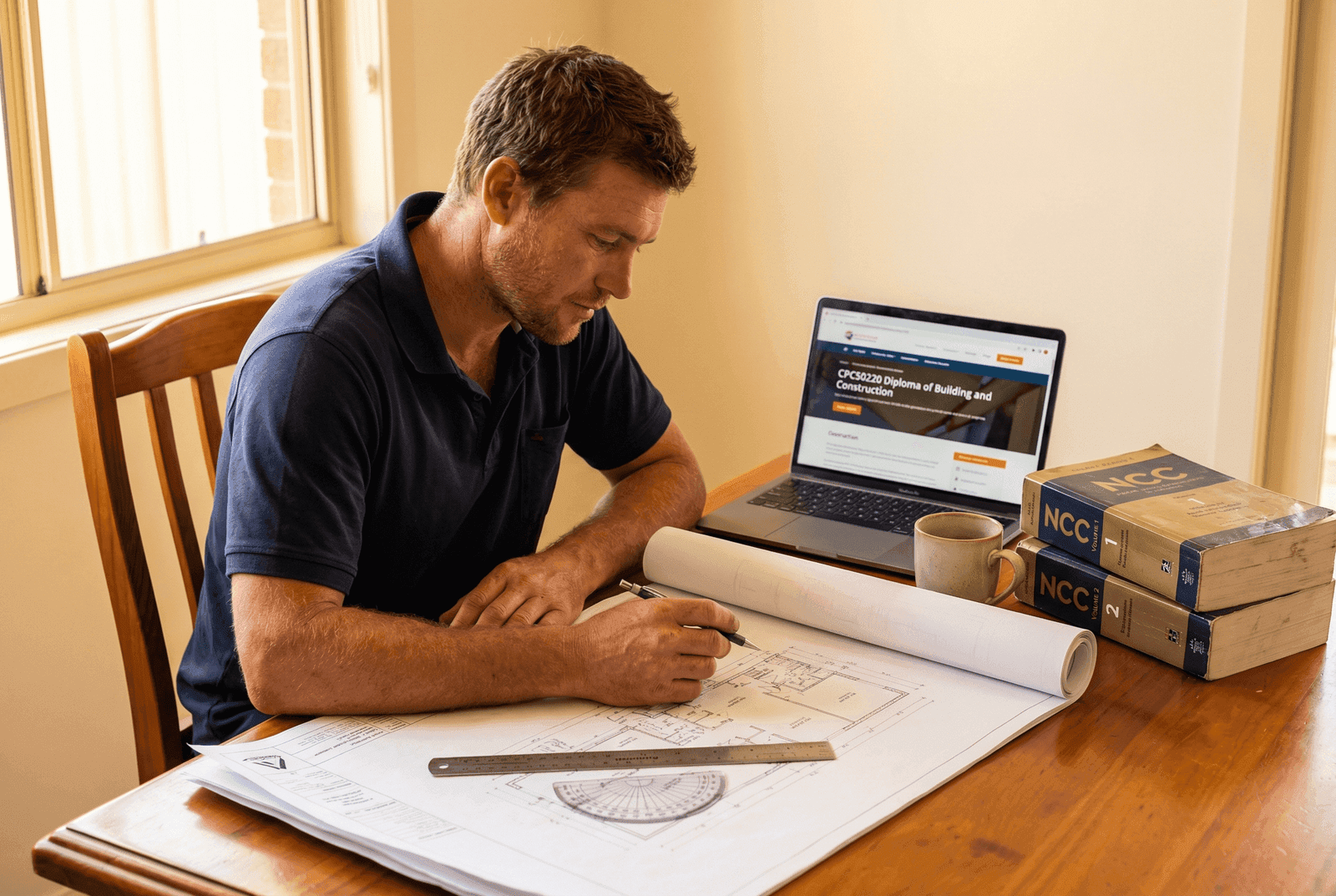
Course Details
The older CPC50210 Diploma is still accepted for Set 1 if it includes the six units the Regulations list, but the CPC50220 is the current nationally recognised qualification and the Regulations prescribe no extra units for it. If you're starting fresh, enrol in the CPC50220.
Source: Building Services (Registration) Regulations 2011 r. 16 and the Building Services Board's Equivalent qualification (set 1) policy (accessed October 2026).
If you already have extensive construction experience, an RTO can assess your skills and knowledge against the Diploma units. A Diploma gained this way can support Set 1, and under Sets 4 and 5 the Board accepts the Diploma (Building) obtained through RPL based on experience only.
The Building Services Board runs its own assessment for candidates without the Diploma. This is available under Sets 4 and 5 — but it's not an easy shortcut.
This is where most confusion lives. The Building Services Board defines very specific types of experience, and they are not interchangeable across pathways. Understanding these definitions is critical to choosing the right Set.
| Experience Type | Definition | Typical Roles | Counts For |
|---|---|---|---|
| Carrying out building work | Performing building work as an apprentice or tradesperson on the tools | Apprentice, qualified carpenter, bricklayer, concreter | Sets 1, 3 and 5 |
| Supervising building work | Directing the work of others with authority to accept or reject their work | Leading hand, foreman, site supervisor | Sets 1, 2, 3, 4 |
| Managing building construction | Coordinating trades and materials for the whole of a building project | Construction manager, project manager, building manager | Sets 3, 4 |
Source: Building and Energy, Documenting your experience (accessed October 2026).
The Board explicitly excludes these activities from qualifying experience:
The Board's experience assessment policy contains a rule most applicants don't know about: a full-time professional site supervisor or site manager working for a registered building contractor is generally expected to be responsible for a minimum of five average building projects (an average residential build) at one time. Supervision or management experience below that minimum will be discounted, while large, complex builds count as several average builds. The Board can depart from the policy in a particular case. Keep this in mind when documenting your experience.
Source: Building Services Board policy, Building practitioner experience assessments: professional rate of intensity (accessed October 2026).
You may have heard that holding a trade can 'halve the time' to get your builder's licence. The truth is more nuanced — and understanding the nuance is what separates a successful application from a wasted one.
Your apprenticeship counts. The Board explicitly defines "carrying out building work" as including work performed as an apprentice or tradesperson.
Only supervisory/management time counts. Those 5 years must be in supervising or managing building construction — not carrying out trade work.
There is no blanket "halving" provision for tradespeople. What exists is a genuine reduction from 7 to 5 years under Set 4, but it requires you to have transitioned from the tools into a supervisory or management role. If you're still on the tools, Set 1 is your pathway — and the good news is your apprenticeship years are already counting toward that 7-year requirement. A carpenter who started their apprenticeship at 18 could meet the experience requirement by 25 and be a registered builder before 28.
Here's what the journey typically looks like for a tradesperson working toward full builder registration via the most common route (Set 1).
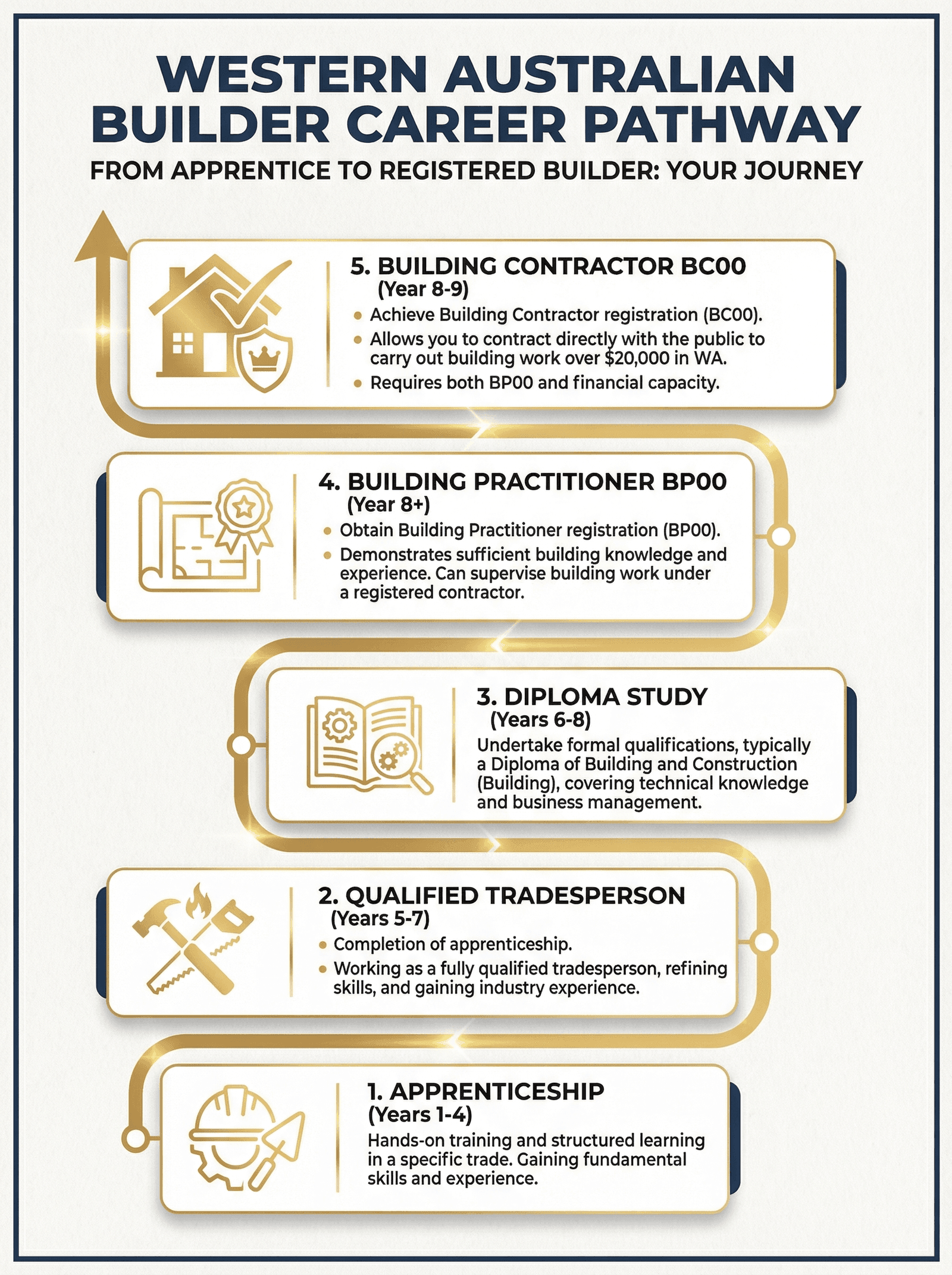
Complete a Certificate III in a building trade (e.g., CPC30220 Carpentry). This time counts as "carrying out building work" toward your 7-year requirement.
Work as a qualified tradesperson on building sites. Consider transitioning to a leading hand or foreman role. Begin the Certificate IV in Building and Construction as a stepping stone.
Enrol in the CPC50220 Diploma of Building and Construction. Many providers run part-time or block delivery (e.g., 4 days per month over 16 months) so you can study while you work.
Apply under Set 1 with your Diploma and 7 years of experience. Building and Energy says applications typically take 4 to 6 weeks and it aims to decide complete applications within 50 business days. Once approved, you're registered for 3 years.
Apply for contractor registration, showing financial capacity (the Board generally expects access to at least $50,000 in cash or cash equivalent). You can then contract for permit work valued at $20,000 or more as a sole trader, partnership or company.
Here's the cost picture from qualification through to contractor registration. Registration fees are from Building and Energy's 2026-27 schedule, in effect from 1 July 2026.
| Cost Item | Amount | Notes |
|---|---|---|
| CPC50220 Diploma course fee | Ask the provider | Set by each training provider. Prepare Training doesn't list course fees on the website, so send us an enquiry for yours. |
| Board examination fees | $245 per unit (metro) | 5 assessments in total; $74 per unit in regional areas |
| Practitioner application fee | $290 | Non-refundable |
| Practitioner registration (3 years) | $843 | Building practitioner registration |
| Contractor application fee | $290 to $479 | Individual $290; partnership or company $479 (non-refundable) |
| Contractor registration (3 years) | $564 to $3,880 | Individual $564; partnership $1,820; company $3,880 |
| Police check | Varies | Must be dated within the past 3 months and show the same name as your identification |
Source: Building and Energy fees, 2026-27 (from 1 July 2026, wa.gov.au, accessed October 2026). Building and Energy says these fees are exclusive of GST, and fees are reviewed each year, usually changing on 1 July. Always check the official fees page for current amounts.
These totals cover Building and Energy's registration and application fees only. They don't include your qualification, Board exam fees, a police check, public liability insurance, or home indemnity insurance, which the Home Building Contracts Act 1991 requires a builder to take out before accepting payment or starting residential building work valued over $20,000.
Builder registration isn't just a piece of paper — it's a launchpad. WA's construction industry employs over 155,000 workers, built 22,602 homes in 2024-25 (the highest in 8 years), and has a $208 billion 10-year civil construction pipeline (CCF WA and Oxford Economics, WA Civil Infrastructure 10 Year Outlook).
$117k–$296k
Average salary in Perth. Oversee entire construction projects from planning to handover.
~$108k
Average salary in Perth. Manage day-to-day construction operations and trade coordination.
Practitioner and contractor registration, with the financial capacity the Board expects (generally at least $50,000 in cash or cash equivalent). Operate as a sole trader, partnership or company and contract directly with clients for residential and commercial work.
Build your own developments instead of hiring a registered builder. Significant cost savings and complete control over project quality and timelines.
Automatic Mutual Recognition (AMR) can let you work in other participating states and territories under your WA registration, after notifying the local regulator and subject to its rules. Work follows opportunity.
Provide expert advisory services for building inspections, dispute resolution, project oversight, and compliance consulting.
Salary figures are indicative estimates based on industry data. Actual earnings vary by experience, project type, location, and business model.
The Building Services Board is experiencing high application volumes. Avoid these mistakes to prevent costly delays or outright rejection.
| Mistake | Consequence | Prevention |
|---|---|---|
| Assuming trade time counts for Set 4 | Application refused — Set 4 requires supervisory/management experience only | If you’re still on the tools, apply under Set 1 instead (7 years carrying out OR supervising) |
| Poor experience documentation | Delays, requests for additional info, or refusal | All experience must be verified by a credible, independent person — not a relative, co-worker, or subordinate |
| Treating Board exams as an easy shortcut | Failed exams, wasted fees, significant delays | The Board says about 55% pass Exam 1 first time; prepare thoroughly or weigh up RPL or the Diploma instead |
| Not meeting the "rate of intensity" threshold | Claimed supervision or management experience discounted | Record how many projects you ran at once; the Board generally expects a full-time site supervisor to run at least five average residential builds at a time |
| Expecting a joint application to finish together | The contractor application can’t be finalised until the practitioner registration is approved | Lodging both together is allowed; make sure the practitioner application is complete so it doesn’t hold up the contractor one |
| Ignoring financial capacity requirements | Contractor application refused | The Board generally expects access to at least $50,000 in cash or cash equivalent and a quick ratio of at least 1:1 |
It depends on your pathway. Set 1 asks for the CPC50220 Diploma plus the equivalent of 7 years full-time carrying out or supervising building work. Set 4 asks for 5 years supervising or managing building construction, plus the Board examinations or the Diploma through RPL based on experience only. Building and Energy says applications typically take 4 to 6 weeks to process and it aims to decide complete applications within 50 business days. Counting an apprenticeship, the realistic path from first day on the tools to registration is around 8 to 9 years.
These nationally recognised qualifications meet the licensing requirements discussed in this guide.
CPC50220 - CPC50220 - Explore course content, online coursework and assessment requirements. Check any intended licensing pathway with the relevant regulator.
CPC40120 - CPC40120 - Explore course content, online coursework and assessment requirements. Check any intended licensing pathway with the relevant regulator.
Each regulator sets its own qualification, experience and fee rules. Pick a state to see the full guide.
Not sure where to start? Read the national builders licence guide for a side-by-side summary of every state, or check whether RPL can fast-track your qualification.
Built by Prepare Training (RTO 45384). Use them on the job today, no account needed.
Draft a site-specific Safe Work Method Statement for high risk construction work in minutes. No sign-up.
Open the tool →Work out concrete, brick, timber and plasterboard quantities with waste allowances built in.
Open the tool →Instant per-square-metre build estimates for Sydney, Melbourne, Brisbane, Perth and Adelaide.
Open the tool →Prepare Training delivers nationally recognised construction qualifications 100% online, including RPL. The CPC50220 Diploma of Building and Construction is one recognised pathway to WA building practitioner registration (Set 1), alongside the Board's other sets, and the Board also asks for 5 to 7 years of relevant experience.