How to Start a Tradie Business in Australia
Everything you need to know about how to start a tradie business in Australia. From getting the right qualifications and licence, to registering your ABN, arranging insurance, setting your prices, and landing your first clients — this is the complete playbook for tradies going out on their own.
Is Starting a Tradie Business Right for You?
Going from employee to business owner is the single biggest career shift most tradies make. You already know the tools and the trade — but running a business means you are now responsible for quoting, invoicing, compliance, safety, tax, marketing, and client relationships on top of the actual work.
The good news? Australia's construction industry is booming. There are more than 400,000 construction businesses operating nationally, and demand for skilled tradies consistently outstrips supply. If you can deliver quality work, manage your money, and keep customers happy, there has never been a better time to go out on your own.
Signs You're Ready
- You have 2+ years of industry experience
- You understand your trade inside and out
- You can manage your own time and schedule
- You have savings to cover 3-6 months of expenses
- You're comfortable speaking with clients directly
- You're willing to learn the business side
Ask Yourself First
- ?Do I have enough contacts to generate initial work?
- ?Can I handle irregular income in the early months?
- ?Am I prepared to work on the business, not just in it?
- ?Do I have the qualifications my state requires?
- ?Have I spoken to an accountant about my structure?
Get Your Qualifications and Licence
This is where most generic "start a tradie business" guides fall short. Banks will tell you to "check your local regulations" and move on. But for anyone in building and construction, your qualifications and licence are not just a box to tick — they determine what work you can legally take on, what value of projects you can manage, and whether you can operate as a head contractor.
In most Australian states, if you want to contract for or supervise building work valued over $5,000 (including GST, labour, and materials), you need a builder's licence. The specific licence classes, qualification requirements, and experience thresholds vary by state — but the common thread is that you need a nationally recognised qualification.
Operating Without a Licence
Performing licensable building work without the correct licence is an offence in every Australian state and territory. Penalties range from $11,000 to over $110,000 depending on the jurisdiction, and can include imprisonment. Your insurance may also be voided if you are working outside the scope of your licence. Always verify your licence requirements with your state regulator before taking on work.
Which Licence Do You Need?
Builder's Licence Requirements by State
| State | Regulator | Min. Qualification | Experience | Threshold |
|---|---|---|---|---|
| NSW | NSW Fair Trading | Cert IV Building | 2 years | $5,000 |
| QLD | QBCC | Cert IV Building | 2-4 years | $3,300 |
| VIC | VBA | Cert IV Building | 3 years | $10,000 |
| WA | Building Commission | Diploma | 3 years | $20,000 |
| SA | CBS | Cert IV Building | 3 years | $12,000 |
| TAS | CBOS | Cert IV Building | 2 years | $5,000 |
| ACT | Access Canberra | Cert IV Building | 2 years | $12,000 |
| NT | NT Building Advisory | Cert IV Building | 2 years | $12,000 |
Already Have Experience but No Formal Qualification?
If you have been working in the industry for years but never completed a formal qualification, you do not necessarily need to start from scratch. Recognition of Prior Learning (RPL) allows experienced tradies to have their skills and knowledge formally assessed against qualification standards. Many tradies achieve their Certificate IV in Building and Construction through RPL in a matter of weeks rather than months.
The Qualification Pathway
The most common pathway for tradies starting a building business is the Certificate IV in Building and Construction (CPC40120). This is the minimum qualification for a builder's licence in most states and covers critical competencies including:
Cert IV Building
Entry-level builder's licence in most states. Covers planning, estimating, legal obligations, and site management.
View course details →Diploma of Building
Required for medium-rise work and higher licence classes. Unlocks larger projects and contract values.
View course details →Cert IV Estimating
Specialist estimating and project support. Ideal for tradies who want to master quoting and costing.
View course details →Set Up Your Business Structure
Your business structure affects everything from how much tax you pay to whether your personal assets are protected if something goes wrong on a job. Getting this right from the start saves significant pain later.
Sole Trader vs Company
Business Structure Comparison
| Factor | Sole Trader | Company (Pty Ltd) |
|---|---|---|
| Setup cost | Free (ABN only) | $500-$1,200 (ASIC + legal) |
| Annual compliance | ~$2,400/year | ~$5,800/year |
| Tax rate | Personal rates (19-45%) | Flat 25% (base rate) |
| Liability | Unlimited personal liability | Limited to company assets |
| Complexity | Simple — one tax return | Company return + personal return |
| Profit flexibility | All profit taxed immediately | Retain and reinvest at 25% |
| Best for | Starting out, income <$120k | Established, income >$120k |
Start Simple, Scale Later
There is nothing wrong with starting as a sole trader and converting to a company later when your income justifies the extra compliance costs. Many successful construction businesses started this way. The key is to get proper accounting advice before you make the switch — restructuring has tax implications.
Register Your ABN
Your Australian Business Number (ABN) is the foundation of your business identity. You need it to invoice clients, register for GST, and operate legally. Registration is free through the Australian Business Register (ABR) and, if approved, you receive your 11-digit number immediately.
ABN Registration Process
Confirm Your Business Structure
Decide whether you are registering as a sole trader, partnership, company, or trust. Most tradies start as sole traders.
Gather Your Details
You will need your Tax File Number (TFN), proof of identity, details of your business activity, and an expected start date.
Apply Online Through the ABR
Visit abr.gov.au and complete the application. It is free and takes around 10-15 minutes. Approved applications receive an ABN immediately.
Register a Business Name (Optional)
If you are not trading under your own name, register a business name through ASIC. This costs approximately $39 for 1 year or $92 for 3 years.
Register for GST (If Required)
If your annual turnover is or will be over $75,000, register for GST at the same time as your ABN. You can also register voluntarily below this threshold.

Get Your Insurance Sorted
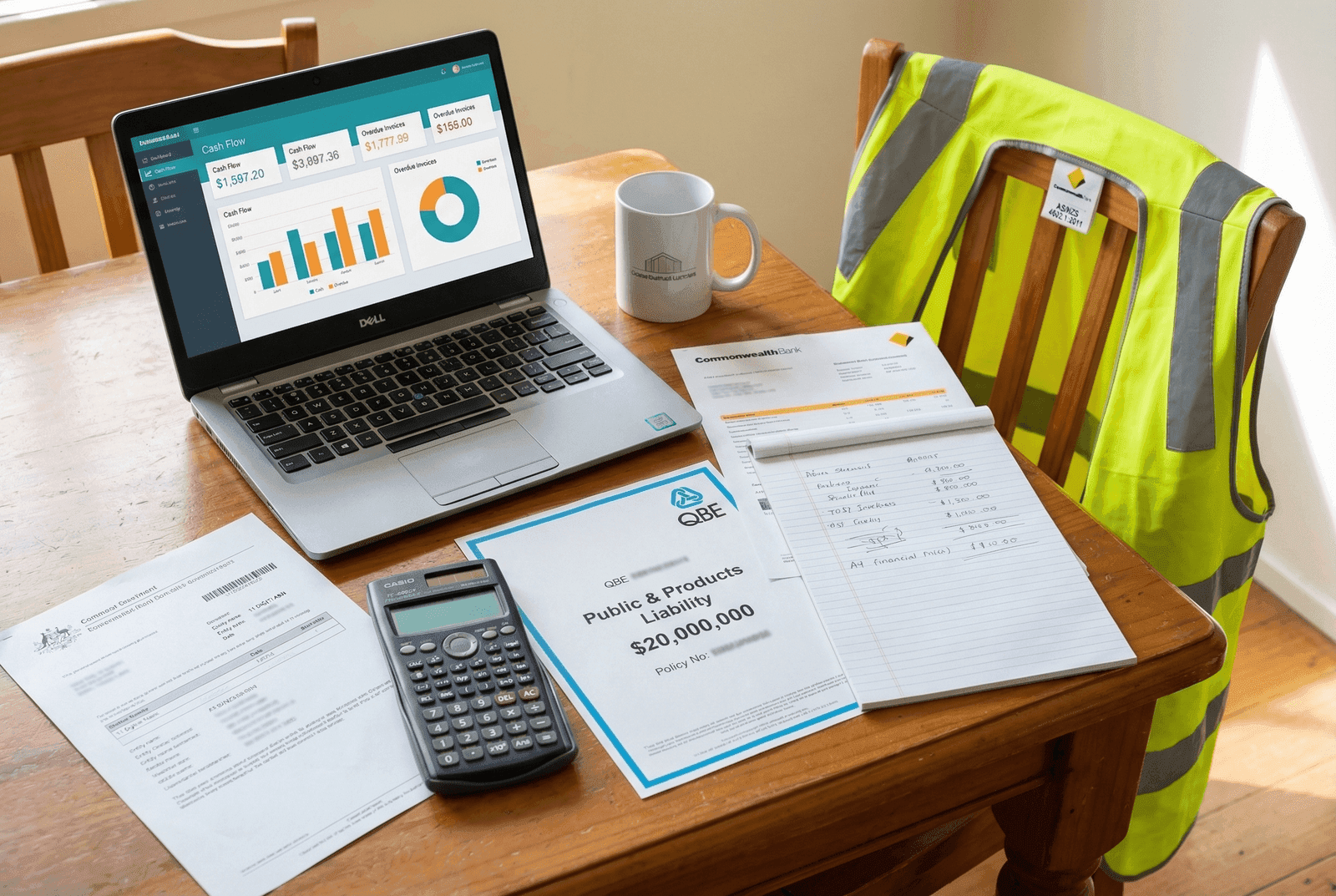
Insurance is not optional for tradies — it is a legal requirement for many trades and a practical necessity for all. One uninsured incident can destroy your business and personal finances.
Public Liability
Public liability insurance protects you if a third party — a client, passer-by, or another contractor — claims your work caused them injury or property damage. It covers legal costs and compensation payouts. Most tradies carry $5M to $20M in coverage.
For building and construction tradies, public liability is typically a requirement for obtaining and maintaining your builder's licence. Many commercial clients and head contractors will also require proof of public liability before allowing you on site.
Professional Indemnity
Professional indemnity (PI) insurance covers you if a client claims your advice, design, or professional service caused them financial loss. This is increasingly important for builders who provide design input, project management, or consulting services.
PI insurance is already mandatory for building practitioners in QLD, VIC, NT, and WA. From July 2026, it will also be mandatory for registered building practitioners in NSW.
Workers' Compensation
If you hire employees — even one casual worker — workers' compensation insurance is legally required in all Australian states and territories. Be aware that as a sole trader or subcontractor, you are typically not covered by workers' comp yourself. Consider personal accident and illness insurance to protect your own income.
Insurance Requirements by Trade
| Insurance Type | Who Needs It | Typical Cost | Coverage |
|---|---|---|---|
| Public Liability | All tradies (often mandatory) | $800-$2,500/yr | $5M-$20M |
| Professional Indemnity | Building practitioners (state-dependent) | $1,000-$3,000/yr | $1M-$5M |
| Workers' Comp | Any tradie with employees | Varies by state & payroll | Injury/illness at work |
| Personal Accident | Sole traders (recommended) | $500-$1,500/yr | Your own injury/illness |
| Tool & Equipment | All tradies (recommended) | $300-$800/yr | Theft, damage, loss |
| Motor Vehicle | Work vehicles (mandatory) | $1,200-$3,000/yr | Accident, theft, third party |
Sole Traders: You're Not Covered
A common trap for new tradie business owners — if you are a sole trader or subcontractor, standard workers' compensation does not cover you in most states. If you are injured and cannot work, you have no income. Personal accident and illness cover is strongly recommended. The cost is typically $500-$1,500 per year — a fraction of what you would lose from even a short period off work.
Set Your Pricing
Pricing is where many new tradie businesses get it wrong. Charge too little and you will burn out working long hours for slim margins. Charge too much before you have a reputation and you will struggle to win work. The key is calculating your true costs first — then adding a fair profit margin on top.
Hourly Rate vs Fixed Price
Hourly Rate
Best for: Repairs, maintenance, and jobs where scope is unclear.
- Client carries the time risk
- Simple to calculate and invoice
- Common for smaller/reactive jobs
- Can feel open-ended to clients
- Typical range: $60-$120/hour
Fixed Price
Best for: New builds, renovations, installations with clear scope.
- You carry the risk — but keep the upside
- Clients prefer knowing the cost upfront
- Higher profit potential on efficient jobs
- Requires accurate estimating skills
- Professional — builds client confidence
How to Quote a Job
Accurate quoting separates profitable tradies from those who are busy but broke. Whether you are quoting hourly or fixed price, you need to account for every cost before you add your margin. For detailed guidance on estimating construction projects, see our construction cost estimation guide.
Quoting Process
Site Visit and Scope
Always inspect the site before quoting. Document the scope of work clearly — what is included, what is excluded, and any assumptions you are making.
Calculate Material Costs
List every material needed and get current supplier prices. Add 5-10% for waste and contingency. Lock in prices where possible.
Estimate Labour Hours
Be realistic about how long each task will take. Include setup, travel, and cleanup time. Multiply by your hourly cost (not your charge-out rate).
Add Overheads and Margin
Add your overhead allocation (insurance, vehicle, phone, admin) and your profit margin (20-50%). This is your charge-out cost, not your wage.
Present Professionally
Use a clear, professional quote template. Include your ABN, licence number, scope description, total price, payment terms, and validity period.
The 2% to 5% Rule for Marketing Budget
Allocate 2% to 5% of your gross revenue to marketing. For a sole trader earning $150,000 per year, that is roughly $250-$625 per month. This covers your Google Business Profile, a basic website, and occasional paid advertising. The tradies who invest consistently in marketing are the ones with full schedules.
Find Your First Clients
The best marketing in the world will not help if you do not have a plan to convert interest into paying work. Here is how to build a client pipeline from scratch — without relying on referrals alone.

Leverage Your Network
Tell everyone you know that you are going out on your own. Former colleagues, builders you have worked for, friends, and family. Word of mouth is still the number one source of work for new tradies.
Google Business Profile
Set up and optimise your free Google Business Profile. This is how local customers find tradies near them. Add photos of your work, list your services, and actively request reviews from happy clients.
Trade Platforms
Register on platforms like hipages, ServiceSeeking, and Airtasker. These connect you directly with customers looking for tradies. Competition is strong, so quality photos and reviews matter.
Simple Website
Build a basic one-page website with your services, service area, licence number, insurance details, and contact information. This gives you credibility when clients search your business name.
Social Media Presence
Before-and-after photos on Instagram and Facebook build your portfolio and reach. Post consistently — even once or twice a week is enough. Use natural light and clean job-site shots.
Builder and Subbie Networks
If you are a specialist trade (electrical, plumbing, tiling), build relationships with head contractors and builders. Reliable subbies who turn up on time and deliver quality are always in demand.
The Qualification Advantage
Competitive Edge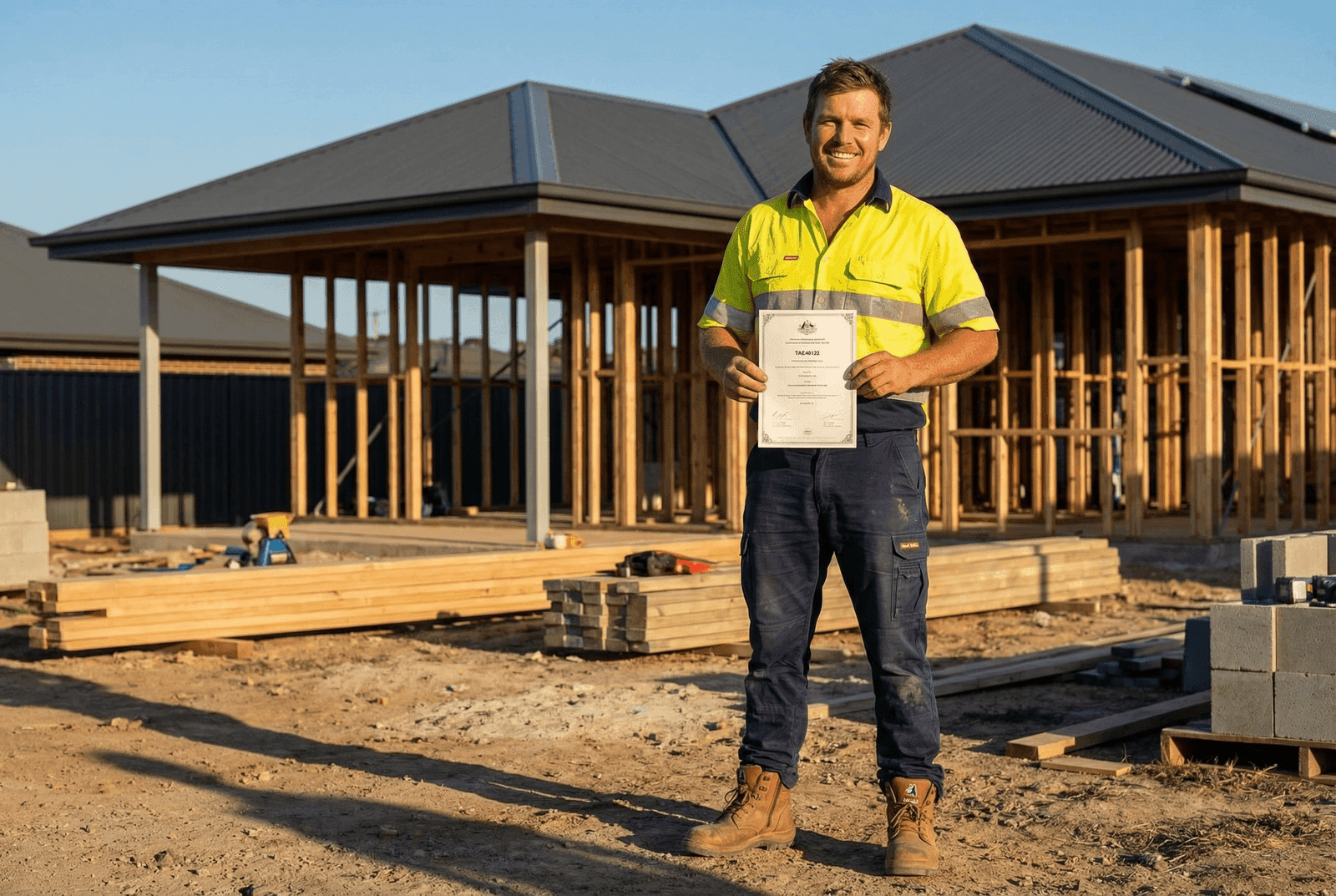
Having the right qualifications is not just about legal compliance — it is a genuine competitive advantage. Clients increasingly check whether tradies are licensed, and commercial clients almost always require it.
A Certificate IV in Building and Construction or Diploma of Building and Construction signals that you have formally verified knowledge in planning, estimating, legal requirements, and project management — not just hands-on skills. This opens doors to higher-value projects and clients who are willing to pay more for qualified professionals.
Financial Basics for Tradies
Getting your finances right from day one is the difference between a business that thrives and one that folds within two years. Here is what every new tradie business owner needs to know.
GST, BAS and Tax
Once your annual turnover hits $75,000, GST registration is mandatory. You must register within 21 days. Once registered, you add 10% GST to every invoice, lodge a Business Activity Statement (BAS) each quarter, and can claim back the GST you have paid on business purchases (called input tax credits).
The most common mistake new tradies make with GST is treating it as income. The GST you collect belongs to the ATO — set it aside immediately. A good rule of thumb is to transfer 10% of every payment you receive into a separate "tax" bank account so you always have BAS money ready.
Cash Flow Management
Cash flow kills more tradie businesses than lack of work. You can be fully booked and still go broke if clients pay late, materials cost more than quoted, or you have not set aside money for tax. Here are the fundamentals:
Cash Flow Rules
- Invoice immediately — not next week, today
- Set clear payment terms (7-14 days)
- Require deposits on large jobs (20-50%)
- Use progress payments for projects over $10k
- Chase late payments within 48 hours
- Keep 3 months of expenses in reserve
Tax Set-Aside Guide
Set aside from every payment received:
- 10% — GST (goes to ATO quarterly)
- 25-30% — Income tax (estimate based on your expected bracket)
- 11.5% — Super guarantee (compulsory for employees; recommended for yourself)
That means roughly 45-50% of revenue is spoken for before you pay yourself or cover expenses. Understanding this from day one prevents nasty surprises.
Growing Your Tradie Business
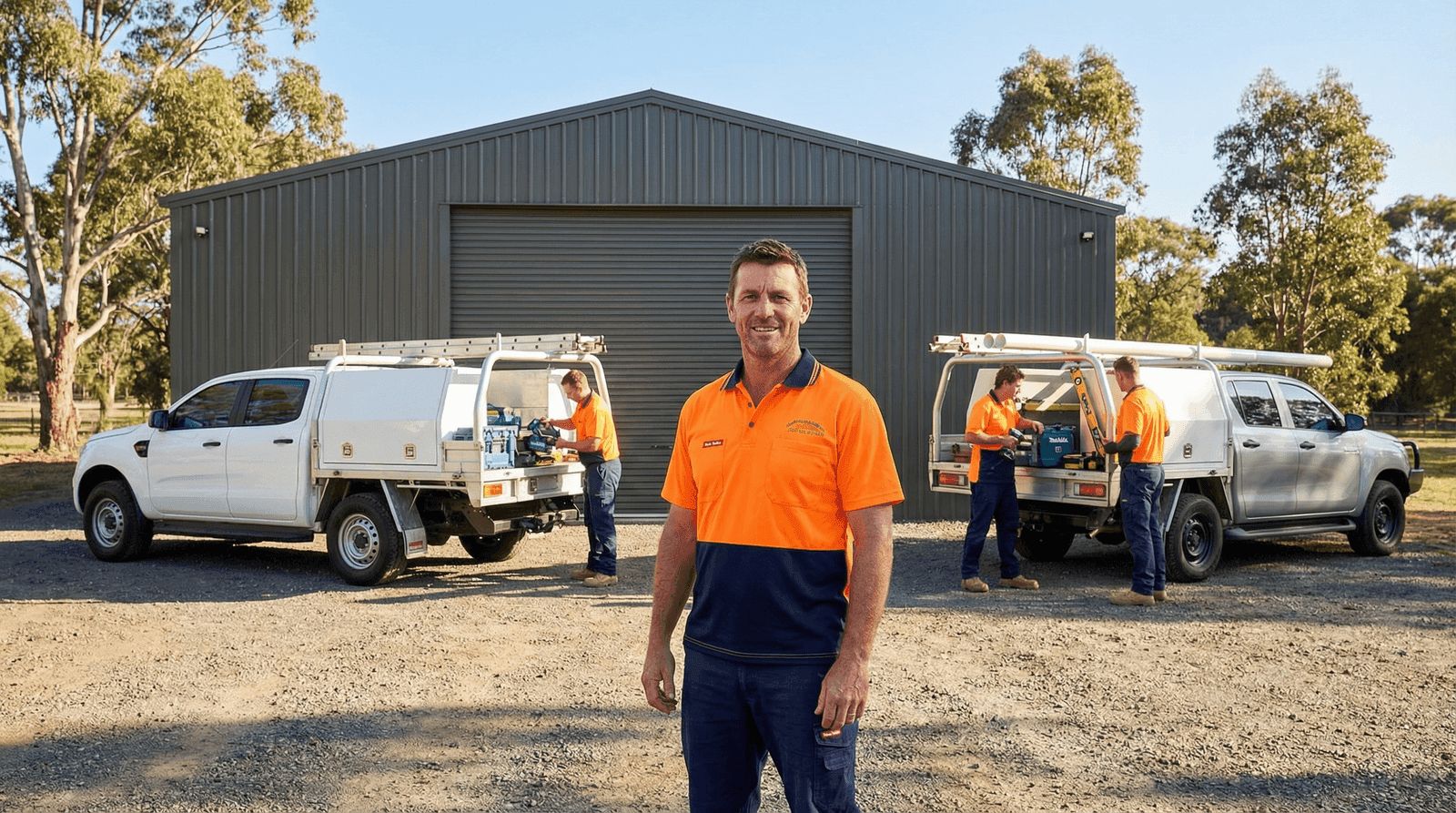
Once you have a steady pipeline of work and your finances are under control, it is natural to think about growth. But scaling a tradie business is not as simple as taking on more work — it requires systems, the right team, and often higher qualifications.
Build your reputation, refine your pricing, and develop efficient systems for quoting and invoicing.
Hire an apprentice or labourer. You need workers' comp, payroll systems, and WHS procedures.
Multiple employees or subbies. Consider upgrading to a Diploma for higher-class licence and bigger projects.
Company structure, dedicated admin support, project management systems, and potentially multiple crews.
Qualification Upgrades Unlock Growth
As your business grows, your qualification requirements often grow with it. A Certificate IV gets you started, but a Diploma of Building and Construction unlocks medium-rise work, higher licence classes, and larger contract values. Understanding construction cost estimation and contract administration also become critical as project values increase. Read our construction contract administration guide for a practical breakdown of contract types, progress claims, and state-by-state requirements.
Curious about earning potential at different career stages? Our construction salaries guide breaks down what builders, site supervisors, estimators, and project managers earn across Australia.
Common Mistakes to Avoid
After working with thousands of tradies through our training programmes, we see the same mistakes repeated. Avoiding these will put you ahead of most new tradie business owners from day one.
Underpricing to Win Work
Racing to the bottom on price attracts budget clients, creates razor-thin margins, and leads to burnout. Compete on quality and reliability instead. Clients who choose the cheapest quote are rarely the best clients.
Not Separating Business and Personal
Mixing business and personal bank accounts makes bookkeeping a nightmare, increases accounting costs, and makes you more likely to miss tax obligations. Set up a dedicated business account from day one.
Relying Only on Referrals
Word of mouth is great — but it is not a strategy. Smart tradies treat referrals as a bonus and maintain multiple lead sources: Google, trade platforms, social media, and builder networks.
Skipping Insurance
One client claim, one site injury, or one stolen toolbox can cripple an uninsured business. Public liability, tool cover, and personal accident insurance are non-negotiable costs of doing business.
Scaling Too Fast
Hiring before your systems and pipeline can support the extra cost is a common killer. Make sure you have consistent revenue, proper accounting, and documented processes before taking on employees.
Ignoring the Paperwork
Late BAS, missed tax deadlines, and poor record keeping add up to fines, interest, and stress. Set aside time every week — even just 30 minutes — to keep your books current.
The Biggest Risk: Operating Without a Licence
It bears repeating — performing licensable work without the correct licence is the single biggest risk a new tradie business can take. Beyond fines and potential imprisonment, unlicensed work voids your insurance, invalidates any warranties you provide, and destroys your reputation. If you are unsure about your licensing requirements, check our builder's licence requirements by state page or speak to your state regulator.
Frequently Asked Questions
Starting costs vary by trade but typically range from $2,000 to $15,000. This includes ABN registration (free), business name registration (~$39 for 1 year), insurance ($1,000-$3,000/year for public liability), tools and equipment (varies widely), vehicle setup, and marketing materials. Building-related trades may also need to factor in licence application fees ($200-$1,500 depending on state) and qualification costs.
Ready to Get Qualified and Start Your Own Business?
The right qualification is the foundation of a successful tradie business. Whether you need a Certificate IV for your builder's licence or a Diploma for larger projects, Prepare Training delivers nationally recognised qualifications 100% online. Speak to an advisor about your pathway.