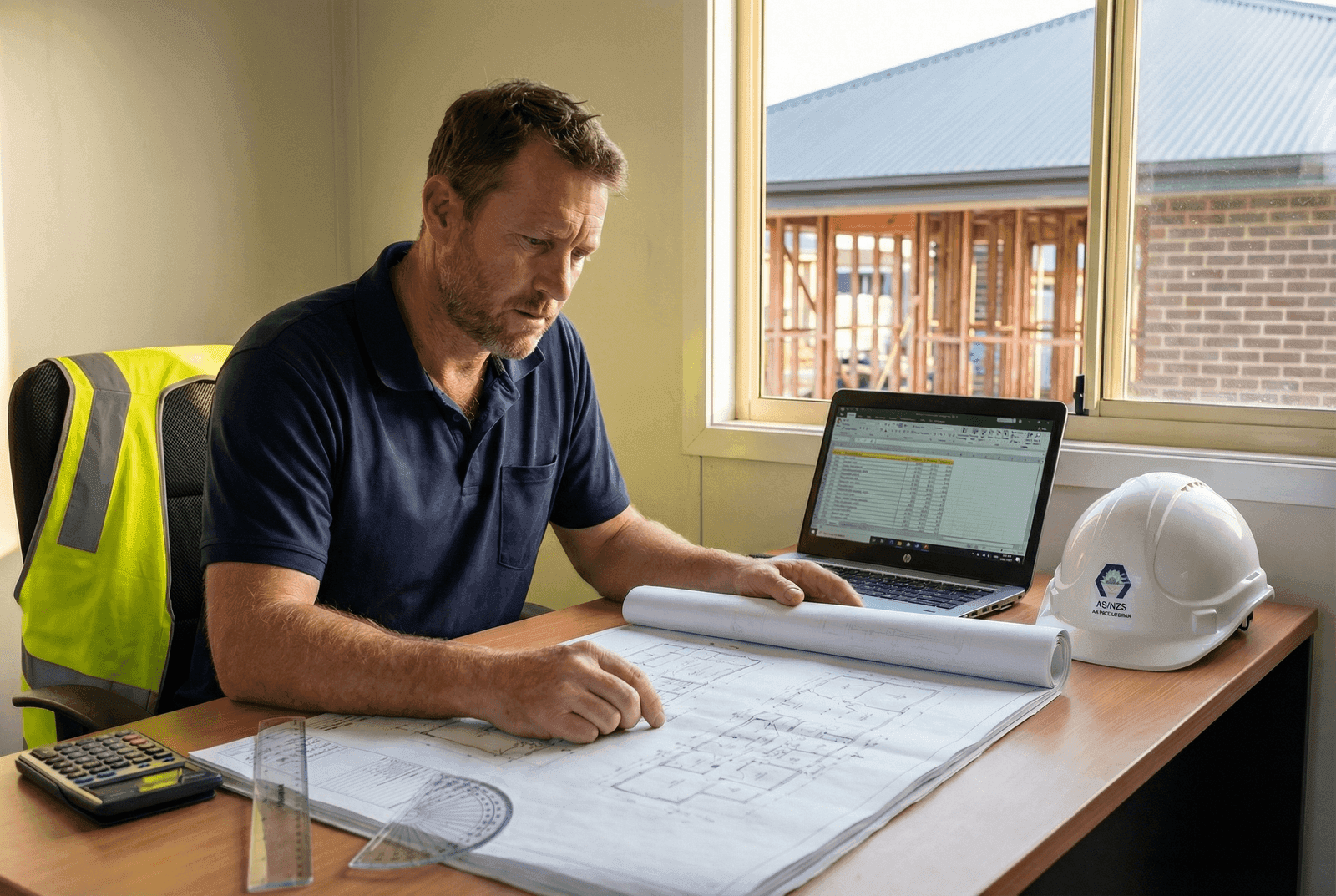
Construction Cost Estimation
The complete guide to estimating construction costs in Australia. Learn quantity takeoff methods, current building costs per square metre, how to build unit rates, and the overhead and profit margins that keep your business sustainable.
TL;DR
Construction costs in Australia are 30.8% above pre-COVID levels with 5.3% annual escalation. This guide covers quantity takeoff methods, current building costs per square metre by city, unit rate build-ups, waste allowances, and the overhead and profit margins that keep builders viable.
What is Construction Cost Estimation?
Construction cost estimation is the process of forecasting the total cost of a building or construction project. It involves measuring quantities from drawings, applying prices for materials and labour, and adding appropriate allowances for overhead, profit, and risk.
Accurate estimation is fundamental to construction success — it determines project viability, enables competitive tendering, and provides the baseline for budget control throughout the project.
Why Estimation Matters
- Determines if a project is financially viable
- Enables competitive bids that win work profitably
- Provides baseline for tracking actual vs planned costs
- Identifies cost risks early for mitigation
- Builds client confidence and trust
- Enables accurate cash flow planning
Competency Standards
In Australia, cost estimation is covered by national competency unit:
CPCCBC4004 — Identify and produce estimated costs for building and construction projects
This unit is part of the Certificate IV in Building and Construction and the specialist Certificate IV in Building Project Support (Estimator). Already pricing jobs? You can have that experience assessed through RPL.
Types of Estimates and When to Use Them
Estimate accuracy improves as project design develops. Understanding which estimate type suits each project stage prevents both over-engineering early estimates and under-preparing for tenders.
Order of Magnitude
Rough budget for feasibility. Based on historical data and $/m² rates.
Preliminary
Compare design options. Uses elemental cost analysis.
Detailed
Refined budget with quantity takeoffs from developed drawings.
Definitive
Competitive pricing from complete documentation.
Control
Track actual costs. Manage variations and progress claims.
Match Effort to Stage
Don't waste time preparing detailed estimates for concept-stage projects — the design will change. Conversely, never submit a tender based on $/m² rates alone. Match your estimation effort to the information available.
How to Do a Quantity Takeoff
Quantity takeoff is the process of measuring and listing all materials, labour, and resources needed for a project from construction drawings. It's the foundation of accurate cost estimation.
Quantity Takeoff Process
Step by Step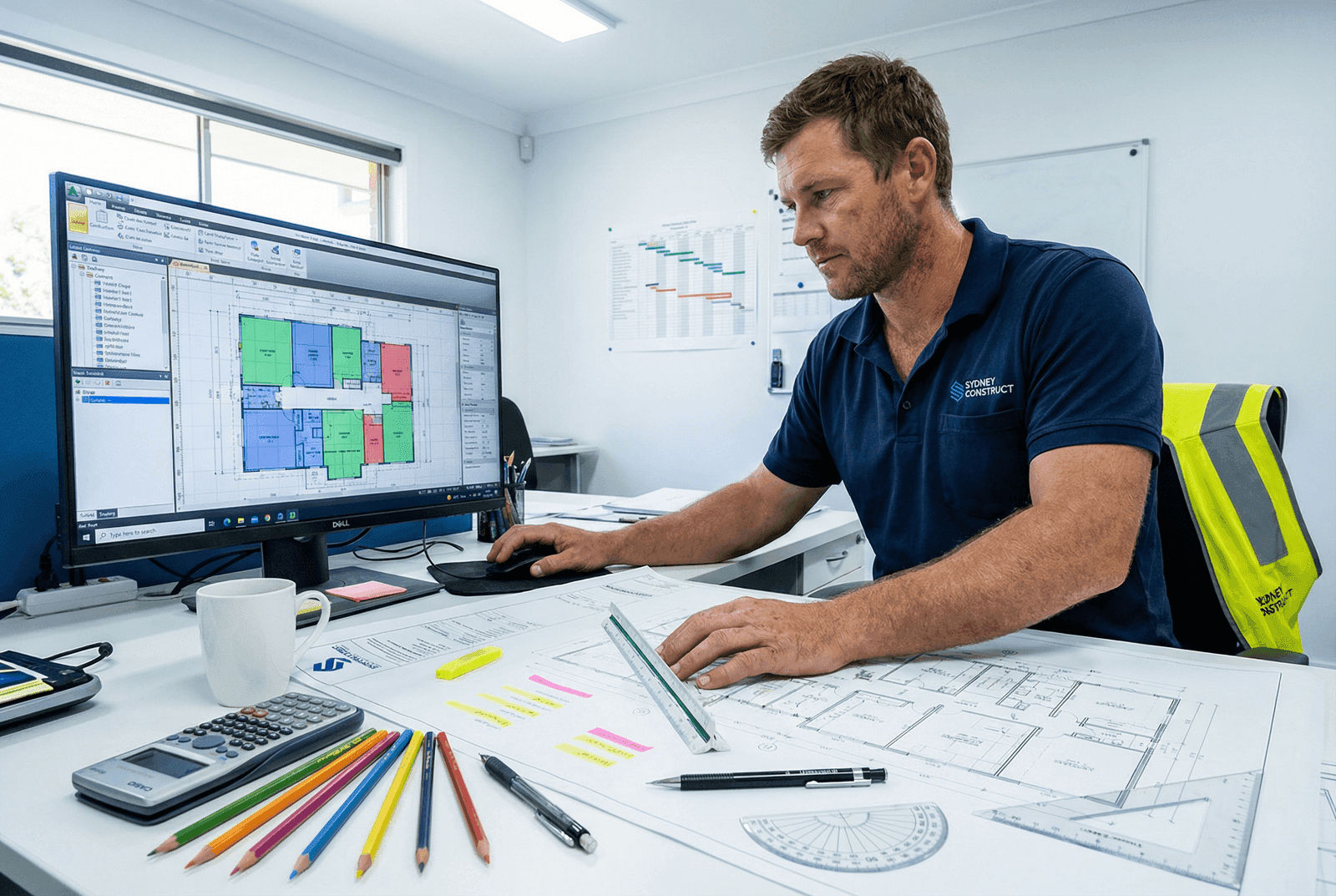
Manual vs Digital Takeoff
Manual: Using scale rulers, calculators, and coloured pencils on printed drawings. Time-intensive but develops fundamental understanding.
Digital: Import PDFs or CAD files into software like PlanSwift or Buildsoft. Click to measure areas, lengths, and volumes. Up to 10x faster for large projects.
Review All Drawings
Familiarise yourself with the full drawing set — plans, elevations, sections, details, and specifications.
Organise by Trade
Work systematically through each trade: excavation, concrete, framing, roofing, finishes, services, etc.
Measure Quantities
Record quantities using appropriate units: m² for areas, m for linear, m³ for volume, No. for items.
Add Waste Allowances
Apply appropriate waste factors (2-15% depending on material) to net quantities.
Apply Unit Rates
Multiply quantities by unit rates including labour, materials, and plant costs.
Check and Verify
Cross-check totals, verify against $/m² benchmarks, review for omissions.
Current Building Costs in Australia
Construction costs are currently 30.8% above pre-COVID levels. These indicative rates help with preliminary budgeting — always obtain current quotes for specific projects.
Residential Construction ($/m²)
| City | Basic | Mid-Range | High Spec |
|---|---|---|---|
| Sydney | $1,630 | $3,500 | $6,010 |
| Melbourne | $1,620 | $3,100 | $4,720 |
| Brisbane | $1,570 | $2,400 | $3,310 |
| Perth | $1,360 | $2,200 | $3,000 |
| Adelaide | $1,430 | $2,400 | $3,410 |
Commercial Construction ($/m²)
| Building Type | Low Range | High Range |
|---|---|---|
| Office Buildings | $2,500 | $5,500 |
| Retail Spaces | $1,800 | $4,800 |
| Industrial/Warehouse | $1,300 | $3,800 |
| Healthcare Facilities | $3,000 | $6,500 |
Sources: Koste, Matrix Estimating, Rawlinsons (2025). Rates are indicative only and exclude land, professional fees, and external works.
Building Up Unit Rates
A unit rate is the cost per standardised unit of measurement — per square metre, per linear metre, per item. Understanding how unit rates are built up helps you price accurately and identify where costs can be controlled.
(Labour + Materials + Plant) × (1 + Overhead%) × (1 + Profit%)Labour
- Base wages and on-costs
- Super, WorkCover, leave provisions
- Productivity allowances
Materials
- Supply cost (inc. GST handling)
- Delivery to site
- Waste allowance
Plant & Equipment
- Hire rates (wet or dry)
- Operating costs (fuel, maintenance)
- Mobilisation/demobilisation
- Site establishment and offices
- Site management and supervision
- Temporary services (power, water, fencing)
- Scaffolding and temporary works
- Cleaning and rubbish removal
- Insurance and bonds
- Safety and compliance costs
- Quality control and testing
Preliminaries typically run 10-15% of direct costs for residential, higher for commercial projects.
Standard Waste Allowances
Waste allowances account for material losses during transport, handling, cutting, and installation. Apply these percentages on top of net quantities from your takeoff.
| Material | Wastage % |
|---|---|
| Cement | 2-5% |
| Sand | 5-12% |
| Concrete/Aggregate | 5-10% |
| Reinforcement Steel | 2-5% |
| Structural Steel | 10-15% |
| Bricks/Blocks | 2-5% |
| Material | Wastage % |
|---|---|
| Tiles | 4-10% |
| Plywood/Timber | 5-10% |
| Plasterboard | 5-10% |
| Stone | 10-15% |
| Paint | 2-5% |
| Insulation | 3-5% |
Track Your Own Data
These are industry averages — your actual waste rates depend on crew skill, design complexity, and material handling. Track ordered vs installed quantities on your projects to build accurate, project-specific waste factors.
Overhead, Profit, and Contingency
These additions transform a cost estimate into a sustainable price. Get them wrong and you'll either lose money on every job or lose jobs to competitors.
Overhead
Costs of running your business not charged to specific projects:
- Office rent and administration
- Vehicles and general equipment
- Insurance, legal, accounting
- Marketing and business development
Typically 8-15% of direct costs
Profit Margin
Your return on investment and reward for taking risk. Industry average is thin:
Many aim for 10-15%, but actual margins often end up lower due to variations, rework, and price increases.
Contingency
Allowance for unforeseen costs and risks. Decreases as design definition improves:
- Early design: 25-30%
- Developed design: 15-20%
- Tender stage: 5-10%
- Construction: 3-5%
Renovations typically need higher contingency than new builds.
Profit Margin ≠ Mark-Up
A 10% mark-up does not equal a 10% profit margin. Mark-up is added to costs; margin is calculated from selling price. A 10% mark-up yields roughly 9% margin, and that's before any cost overruns eat into your returns.
Cost Escalation Forecast (2025-2026)
Construction costs continue to rise, though at a slower pace than the 2022-2023 spike. For projects spanning multiple years, escalation allowances are essential.
| City | 2025 Escalation | 2026 Forecast |
|---|---|---|
| Brisbane | 7.0% | 6.0% |
| Gold Coast | 6.5% | 5.5% |
| Perth | 5.5% | 5.0% |
| Melbourne | 5.0% | 4.5% |
| Sydney | 4.6% | 4.8% |
| Adelaide | 4.5% | 4.5% |
| Canberra | 3.0% | 3.5% |
Source: WT Partnership Market Conditions Report (2025)
Key Cost Drivers
- Energy costs: Electricity up 23.6% over past year, affecting cement, aluminium, and bricks
- Labour: Trade wages rising 4-5% annually; productivity has halved since 1995
- Materials: Concrete, bricks, and plasterboard rising; steel and diesel subdued
- Outlook: Relief unlikely before 2028 according to industry analysts
Estimating Software for Australian Builders
Digital estimation tools dramatically improve speed and accuracy. Here are the main options available in Australia.
PlanSwift
Used by 6,500+ Australian companies
- Point-and-click takeoff from PDFs/CAD
- Drag-and-drop assemblies with labour + materials
- Excel integration
- Local AU/NZ support
- Learn in under 14 days
Buildsoft Cubit
Australian-made, 40+ years in industry
- Intelligent single-click space takeoff
- 3D visualisation
- AI estimating features
- Quote and tender management (Cubit Select)
- Local development and support
CostX (iTWO)
Enterprise solution for larger projects
- BIM integration and 5D modelling
- Advanced revision comparison
- Team collaboration features
- Quantity surveyor focused
- Higher learning curve
Start with Spreadsheets
For smaller builders, spreadsheet-based systems using Excel with Rawlinsons Construction Cost Guide ($450/year) remain a cost-effective starting point. You can always upgrade to dedicated software as your business grows.
Common Estimation Mistakes to Avoid
These errors cost builders money and reputation. Recognising them helps you implement checking procedures and produce more reliable estimates.
Quantity Errors
- Missing items: Forgetting to include obvious items like flashings, sealants, or fixings
- Double counting: Measuring the same area twice when using different drawings
- Scale errors: Reading wrong scale or not verifying scale on drawings
- No waste allowance: Pricing net quantities without waste factors
Pricing Errors
- Outdated rates: Using last year's prices in a 5%+ escalation market
- Forgetting on-costs: Using base wages without super, WorkCover, leave
- Ignoring site conditions: Standard rates for difficult access or remote sites
- No escalation: Fixed pricing on long-duration projects
Margin Errors
- Inadequate overhead: Not recovering true cost of running the business
- Racing to the bottom: Cutting margin to win jobs, then losing money
- No contingency: Zero allowance for unforeseen issues
- Confusing mark-up and margin: Thinking 10% mark-up = 10% profit
Check Before Submitting
Before submitting any estimate: verify totals against $/m² benchmarks, have another person review the takeoff, confirm all items from the specification are included, and check that overhead, profit, and contingency are appropriate for the risk.
Career Pathways: Becoming a Construction Estimator
Construction estimation is a valued skill that can lead to dedicated estimator roles or enhance your capabilities as a builder or project manager.
Estimator Career Overview
Industry Data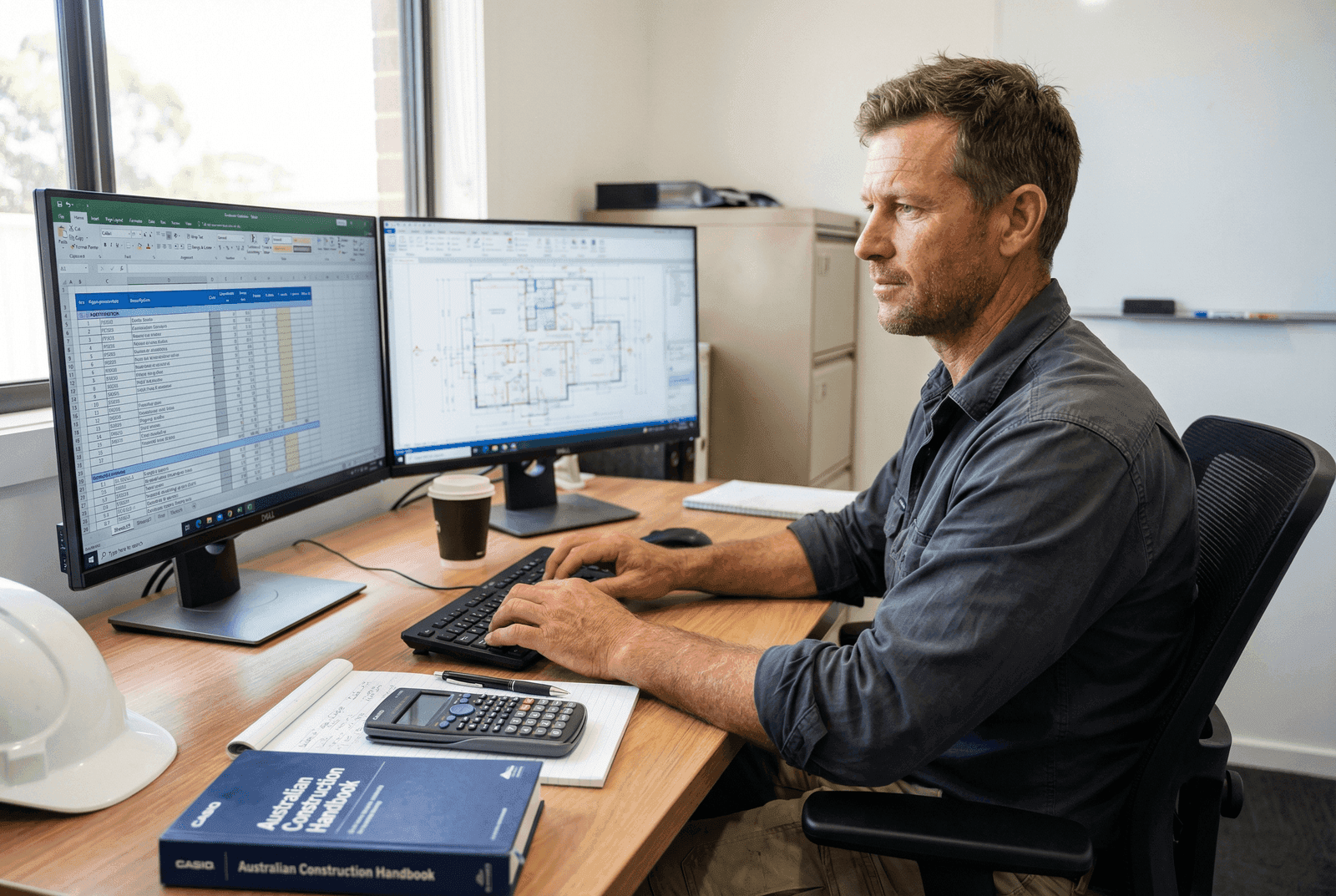
Industry Statistics
- ~7,000 estimators employed in Australia
- $73k-$99k average salary range
- 87% work full-time (avg 42 hrs/week)
- Mining/resources pay highest ($135k avg)
Qualification Pathway
- CPCCBC4004 — Core estimation competency
- CPCCBC4003 — Contract administration guide (sibling unit)
- CPC40120 — Cert IV Building & Construction
- Cert IV Building Project Support (Estimator) — Specialist estimation pathway
- Free construction cost calculator for instant per-square-metre estimates in five capital cities
- CPC50220 — Diploma for advanced roles
- QS degree — For quantity surveying career
Estimator vs Quantity Surveyor
Estimators focus on pre-construction cost estimation, typically working for builders on residential and smaller commercial projects. Understanding estimation is also valuable for anyone pursuing a builder's licence.
Quantity Surveyors are degree-qualified professionals (often AIQS members) who manage costs throughout the entire project lifecycle. QS services cost 1-2% of project value but can prevent 10-30% budget overruns. Consider engaging a QS for projects over $1M.
Not sure which qualification suits your career goals? Compare qualifications or learn how to study while you work.
Free Tools for Builders and Site Supervisors
Built by Prepare Training (RTO 45384). Use them on the job today, no account needed.
- Free SWMS generator
Draft a site-specific Safe Work Method Statement for high risk construction work in minutes. No sign-up.
Open the tool → - Free building materials calculator
Work out concrete, brick, timber and plasterboard quantities with waste allowances built in.
Open the tool → - Free construction cost calculator
Instant per-square-metre build estimates for Sydney, Melbourne, Brisbane, Perth and Adelaide.
Open the tool →
Already pricing jobs on site?
Frequently Asked Questions
Multiply the gross floor area of the building by the appropriate cost per square metre rate for your location and specification level. In 2025, residential costs range from $1,360/m² (basic, Perth) to $6,010/m² (high-spec, Sydney). Always add contingency (10-15%) and professional fees on top. These rates are indicative—obtain current quotes for your specific project.
Ready to Master Construction Estimation?
Cost estimation (CPCCBC4004) is a core competency in the Certificate IV and Diploma of Building and Construction. Study online at your own pace and gain the financial skills that keep construction businesses profitable.