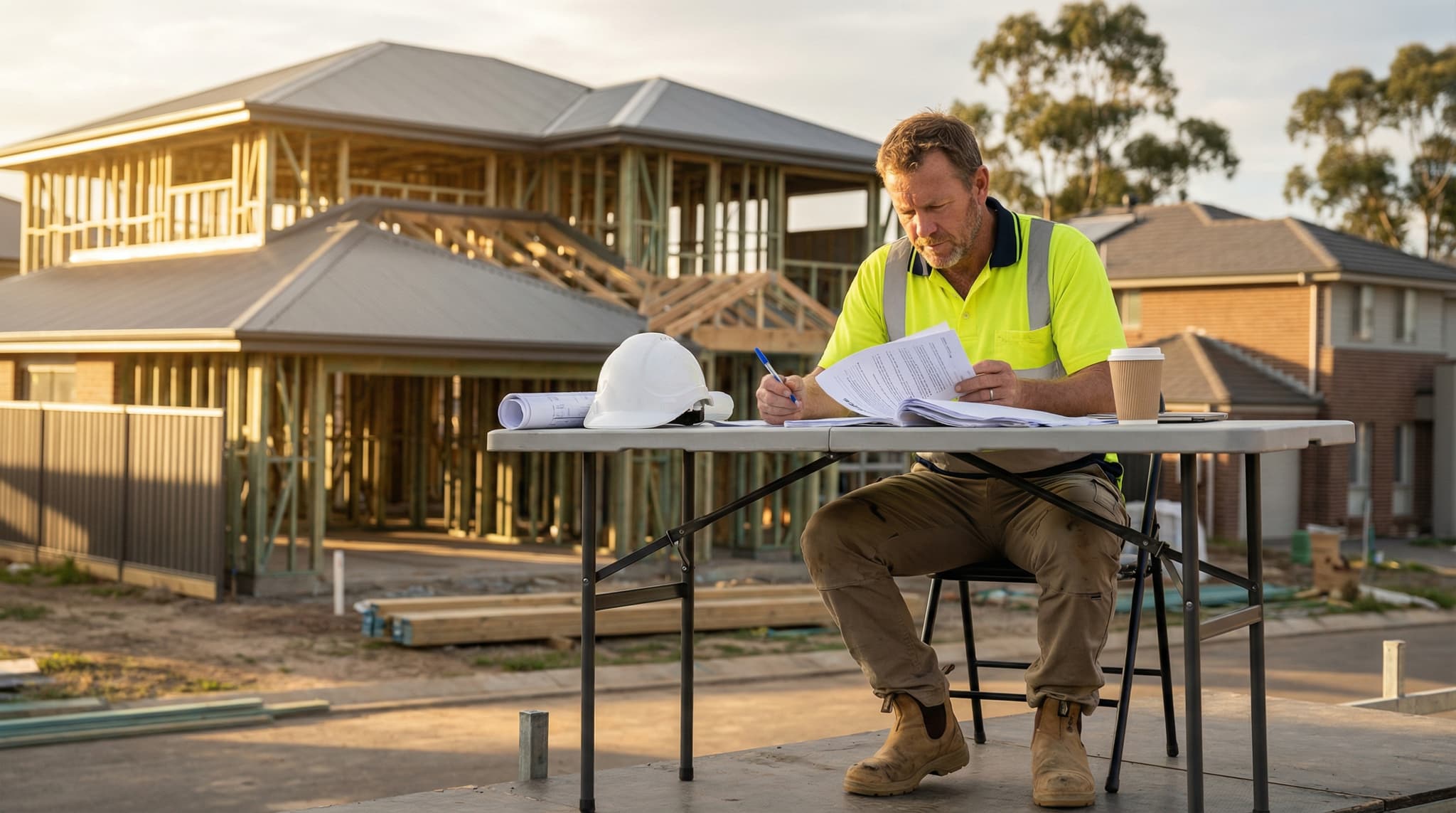
How to Select, Prepare and Administer a Construction
Contract in Australia
A practical guide to the skills taught in CPCCBC4003 — from choosing the right contract type to managing progress claims, variations, and disputes across all eight states and territories.
What Is CPCCBC4003?
The nationally recognised unit that teaches you how to handle construction contracts from start to finish.
Important Notice
CPCCBC4003 “Select, prepare and administer a construction contract” is a unit of competency within the CPC Construction, Plumbing and Services Training Package. It covers the practical skills builders, estimators, and site managers need to choose the right contract for a project, prepare all the documentation, and administer the contract through to completion — including handling progress claims, managing variations, and navigating disputes.
The unit applies to both residential (NCC Class 1 and 10, maximum two storeys) and commercial (Class 2 to 9, Type C constructions) building work. It's a core skill set for anyone working in contract administration, project management, or site supervision.
What You'll Learn in CPCCBC4003
- Select the appropriate contract type for residential and commercial projects
- Prepare contract documentation including schedules, specifications, and plans
- Administer progress claims and payment schedules
- Manage variations with proper written documentation
- Navigate dispute resolution processes
- Understand Australian Standards AS 2124 and AS 4000
- Identify causes of breach of contract
Where CPCCBC4003 Fits
This unit is an elective in the CPC40320 Certificate IV in Building Project Support (Contract Administrator) and the CPC40320 Certificate IV in Building Project Support (Estimator). It also appears in several building and construction qualifications where contract knowledge is essential.
Types of Construction Contracts in Australia
Choosing the right contract type is one of the first decisions you'll make — and one of the most consequential.
Each contract type allocates risk differently between the principal (project owner) and the contractor. CPCCBC4003 teaches you to assess project characteristics — scope clarity, budget certainty, timeframe, and complexity — and match them to the contract structure that best protects both parties.
Also called: Fixed price contract
The contractor agrees to complete the defined scope of work for a single, agreed price. This is the most common contract type for residential building and well-defined commercial projects.
Risk allocation: The contractor bears the cost overrun risk. If materials cost more than expected, the contractor absorbs it.
Best for: Projects with a well-defined scope, complete plans and specifications, and stable market conditions.
Watch out: Changes to scope require formal variations — and each variation is a potential dispute if not documented properly.
Choosing the Right Contract
Australian Standard Form Contracts
You don't need to draft a contract from scratch. Standard form contracts provide pre-drafted frameworks used across the industry.
CPCCBC4003 specifically requires knowledge of Australian Standards AS 2124 and AS 4000. But several other standard forms are widely used depending on the project type and scale. Understanding the differences is essential for selecting the right framework.

Standard Form Contracts Comparison
| Contract | Year | Best For | Risk Balance | Key Feature |
|---|---|---|---|---|
| AS 2124 | 1992 | Large infrastructure, highly tailorable | Favours principal | Often so heavily modified it becomes unrecognisable |
| AS 4000 | 1997 | Commercial building < $500M | More balanced (favours contractor) | Detailed claims and variations framework |
| AS 4902 | 2000 | Design and construct projects | Balanced | Comprehensive design liability provisions |
| HIA | Updated regularly | Residential building (HIA members) | Favours builder | Consumer-focused with state-specific versions |
| MBA | Updated regularly | Residential building (MBA members) | Favours builder | Industry association standard for members |
| ABIC MW | 2008 | Small residential projects | Balanced | Architect-administered, simpler format |
AS 4000:2025 — A Major Update
The updated AS 4000:2025, published in June 2025, replaces mandatory arbitration with flexible dispute resolution options including Dispute Avoidance Boards (DABs). DABs are standing, project-embedded panels that resolve disputes in real time. They've already been used on 119 Australian projects worth over $75 billion — without a single dispute escalating to formal proceedings.
What Must Be in a Construction Contract
Every state has legislation dictating what a written construction contract must contain — and the thresholds that trigger those requirements.
The exact requirements vary by state, but most jurisdictions mandate these elements for residential building work above a specified value threshold. Missing any of these can result in fines, void arbitration clauses, or loss of the ability to enforce payment.
- Builder's name, licence or registration number, and ABN
- Owner's name and address
- Description of work with plans and specifications
- Contract price (fixed price, or cost-plus with prescribed disclosure)
- Progress payment schedule with stages and amounts
- Start and completion dates
- Variation procedures
- Dispute resolution provisions
- Cooling-off period details
- Insurance certificates
- Statutory warranties statement
State-by-State Contract Thresholds
| State | Written Contract Required | Max Deposit | Cooling-Off | Key Legislation |
|---|---|---|---|---|
| NSW | $5,000 (basic) / $20,000 (comprehensive) | 10% | 5 business days | Home Building Act 1989 |
| VIC | $10,000 (major domestic) | Regulated | 5 business days | Domestic Building Contracts Act 1995 |
| QLD | $3,300 incl. GST | 5% (over $20K) | 5 business days | QBCC Act 1991 |
| SA | $20,000 (from Nov 2025) | 5% | 5 business days | Building Work Contractors Act 1995 |
| WA | $7,500 | 6.5% | 5 business days | Home Building Contracts Act 1991 |
| TAS | $20,000 | Not specified | 5 business days | Residential Building Work Contracts Act 2016 |
| ACT | No legislated threshold | Not legislated | Not legislated | Construction Occupations (Licensing) Act 2004 |
| NT | $12,000 | 5% | Not specified | Building Act 1993 |
Penalties for Non-Compliance
The Contract Administration Lifecycle
Contract administration isn't a one-off task — it's a discipline that runs from day one through to the defects liability period.
CPCCBC4003 structures contract administration as a lifecycle with distinct phases. Each phase has its own documentation, compliance requirements, and risk points. Understanding this flow is what separates competent contract administrators from those who end up in disputes.

Contract Administration Process
Select the Contract
Assess project scope, risk profile, and client requirements. Choose the contract type (lump sum, cost-plus, etc.) and standard form (AS 4000, HIA, MBA) that best fits.
Prepare the Documentation
Assemble the contract package: general conditions, special conditions, plans, specifications, schedules, insurance certificates, and statutory notices. Verify compliance with state legislation.
Administer During Construction
Process progress claims, manage variations with written approvals, monitor compliance with contract terms, maintain the project register, and handle correspondence between parties.
Practical Completion
Issue the practical completion certificate when work is substantially complete. Document any minor defects for rectification. Initiate retention release schedule.
Defects Liability Period
Monitor and manage defect rectification during the warranty period (typically 12 months for general work, 6 years for structural under home warranty). Release final retention on satisfactory completion.
Progress Claims and Security of Payment
Progress claims are how contractors get paid. Security of Payment legislation is what ensures it actually happens.
A progress claim is a formal request for payment submitted for work completed over a specific period. Unlike a standard invoice, it's tied to contractual milestones and has legal standing under both your contract and state Security of Payment (SOP) legislation.
SOP legislation exists in every Australian state and territory. In NSW alone, $745.2 million in claims were processed through the SOP Act in 2024, from 1,057 applications — with claimants achieving a 73.9% success rate. That's double the success rate of court proceedings.
Security of Payment Timeframes by State
| State | Payment Response | Adjudication Window | SOP Model | Claim Window |
|---|---|---|---|---|
| NSW | 10 business days | 10 business days | East Coast | 12 months |
| VIC | 10 business days | 10 business days | East Coast | 3 months |
| QLD | 15 business days | 20–30 business days | East Coast | 6 months |
| SA | 15 business days | 10 business days | East Coast | 6 months |
| WA | 15 business days | 20 business days | East Coast (since Aug 2022) | 6 months |
| TAS | 10–20 business days | 10 business days | East Coast | 12 months |
| ACT | 10 business days | After 5 BD notice | East Coast | 12 months |
| NT | 10 business days | 90 calendar days | West Coast (only remaining) | Not time-limited |
WA Changed Models in 2022
Payment Claim Documentation Must Be Exact
Managing Variations Without Losing Money
Unrecovered variations account for 5–8% of total contract value. Proper documentation is the difference between getting paid and writing it off.
A variation is any change to the original scope of work defined in the contract. They're inevitable — site conditions change, clients change their minds, regulations change. What matters is how you document and administer them. Under CPCCBC4003, you learn the systematic process that protects your position.

The Variation Process Under AS 4000
Under AS 4000, the superintendent issues a written direction for the variation. The contractor then provides a cost and time assessment. Once the superintendent assesses and approves the variation, it becomes part of the contract. Under HIA and MBA residential contracts, a “written statement” setting out the reason and cost is legally required before work commences.
Case Study: Kaloriziko v Calibre (2025)
In this landmark NSW case, a developer disputed 9 previously approved variations worth $270,000 after already paying $689,922. The developer argued that “on account only” language in the progress payment clause allowed revisiting variation approvals.
The court disagreed. Justice Stevenson held that once a variation is formally directed and assessed, it becomes binding and irrevocable. “On account only” applies to progress claims, not variation approvals. The builder was awarded $2.1 million.
Lesson for contract administrators: Written variation approvals create permanent commitments. Get them right the first time — there's no going back.
Variations Must Be in Writing — No Exceptions
Dispute Resolution: From Negotiation to Litigation
Construction disputes consume 2.6% of total project costs in Australia — an estimated $6.45 billion annually. Knowing your resolution options saves time and money.
The average resolution period for construction disputes in Australia is approximately 15 months through traditional channels. But SOPA adjudication resolves payment disputes in roughly 28 days. Understanding the full spectrum of options — and when to use each — is a core CPCCBC4003 competency.
Dispute Avoidance Boards Under AS 4000:2025
The updated AS 4000:2025 introduces Dispute Avoidance Boards (DABs) — standing panels embedded in the project that resolve disputes in real time before they escalate. DABs have been used on 119 Australian projects worth over $75 billion without a single dispute escalating to formal proceedings. This is the future of construction dispute management.
Recent Legislative Changes (2022–2026)
Construction contract law in Australia has shifted significantly. These are the changes every builder and contract administrator needs to know.
Common Mistakes That Cost Builders Thousands
Poor contract administration costs Australian builders $25,000–$150,000 per project. These are the mistakes that cause it.
1. No written variation approval before starting work
This is the number one cause of payment disputes. Under all state legislation, variations must be in writing and signed by both parties before work commences. Verbal agreements are unenforceable.
2. Missing SOP payment claim deadlines
Statutory timeframes are strict — 10 to 20 business days depending on your state. Late payment claims are void. Set calendar reminders for every deadline.
3. Relying on verbal agreements despite “entire agreement” clauses
Most standard form contracts include an “entire agreement” clause that supersedes all prior oral discussions. Courts consistently reject verbal evidence that contradicts written terms.
4. Not knowing which state's SOP regime applies
The applicable legislation is determined by the project location, not your business registration. Building in Queensland from your NSW office? Queensland law applies.
5. Exceeding deposit limits
Each state caps the deposit amount: NSW at 10%, Queensland at 5% for contracts over $20,000, WA at 6.5%. Exceeding these is an offence, not just bad practice.
6. Submitting inadequate payment claim documentation
As the MWB v Devcon (2024) case confirmed, a spreadsheet is not a payment claim. Your claims must meet the strict technical requirements of your state's SOP legislation.
7. Using cost-plus contracts for residential work in Queensland
The QBCC specifically advises against this because cost-plus contracts limit the protections available under the Queensland Home Warranty Scheme.
8. Assuming “on account” preserves the right to revisit variations
The Kaloriziko v Calibre (2025) decision definitively rejected this. Once a variation is formally directed and assessed, it's irrevocable. There is no going back.
Career Pathways in Contract Administration
Contract administration is one of the highest-paying office-based roles in the construction industry — and demand is strong.

Contract Administrator Salary Ranges (2025)
| Role | Average Salary | Range | Source |
|---|---|---|---|
| Contract Administrator | $116,000 | $88,000 – $140,000 | Hays / Seek |
| Junior Contract Administrator | $75,000 | $65,000 – $95,000 | Seek / Indeed |
| Senior Contract Administrator | $135,000 | $120,000 – $160,000+ | Hays |
| Construction Administrator | $58,000 | $51,250 – $65,000 | Indeed |
According to Jobs and Skills Australia, contract administrators earn above the national average weekly wage — $1,660 per week compared to the national average of $1,460. It's classified as a “very large” occupation, and construction employment grew 0.9% over the year to November 2025.
Qualification Pathway
The entry point is the CPC40320 Certificate IV in Building Project Support (Contract Administrator), which includes CPCCBC4003 as an elective unit. From there, you can progress to the CPC50220 Diploma of Building and Construction for broader project management responsibilities.
If you already have construction experience, you may be eligible for RPL. Read our Recognition of Prior Learning (RPL) to fast-track your qualification. And if you're interested in the numbers side of construction, the construction cost estimation guide covers the sibling unit CPCCBC4004 — another elective in the same qualification.
Already Working in Construction?
Frequently Asked Questions
Common questions about construction contracts, CPCCBC4003, and contract administration in Australia.
Ready to Master Construction Contract Administration?
The CPC40320 Certificate IV in Building Project Support (Contract Administrator) includes CPCCBC4003 and everything you need to manage construction contracts professionally. 100% online, study at your own pace.