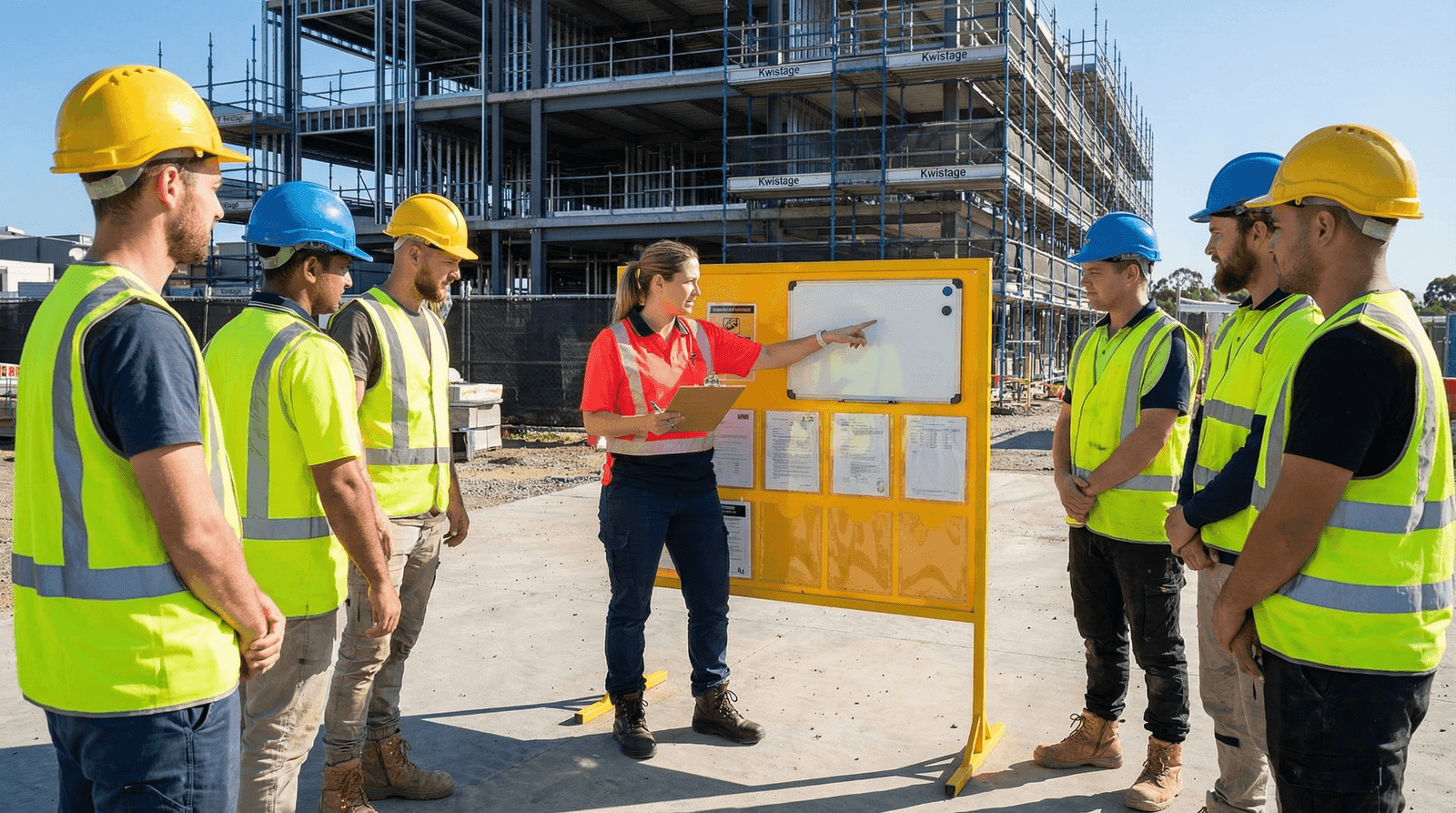
What Does a WHS Advisor Do? Career Guide
A WHS Advisor is one of Australia's most in-demand safety roles, with the HSE job market growing 22.3% in 2025. This guide covers salary, qualifications, day-to-day duties, and the career pathway from entry-level WHS Officer to Head of Safety.
What Is a WHS Advisor?
A WHS Advisor (Work Health and Safety Advisor) is a qualified professional responsible for ensuring workplaces meet their legal obligations under the Work Health and Safety Act 2011. Operating across every industry in Australia, WHS Advisors provide expert guidance on hazard identification, risk management, incident investigation, and regulatory compliance.
Unlike purely compliance-focused roles, a WHS Advisor works at the intersection of legislation, operations, and organisational culture. They don't just enforce rules — they shape safety strategy, train teams, and drive continuous improvement in how organisations protect their people.
The model WHS laws, developed by Safe Work Australia in 2011 and adopted by all Australian jurisdictions except Victoria (which maintains its own OHS Act), place a duty of care on PCBUs (Persons Conducting a Business or Undertaking) to ensure worker safety “so far as is reasonably practicable.” WHS Advisors are the professionals who help organisations meet this duty.
Why WHS Matters
WHS Advisor Duties & Responsibilities
A WHS Advisor's workload balances strategic planning with hands-on safety management. Here's what a typical week looks like.
Daily Tasks
Risk & Compliance
- Conduct workplace inspections and hazard assessments
- Develop and review Safe Work Method Statements (SWMS)
- Maintain WHS risk registers, SDS and chemical registers
- Monitor compliance with WHS Act 2011 and regulations
- Prepare for and support regulator audits
People & Culture
- Deliver toolbox talks and safety inductions
- Investigate incidents, injuries, and near-misses
- Advise management on safety strategy and legislation
- Coordinate return-to-work and injury management
- Champion psychosocial safety and wellbeing programs
WHS Advisor vs WHS Officer vs WHS Manager
| Aspect | WHS Officer | WHS Advisor | WHS Manager |
|---|---|---|---|
| Focus | Operational compliance | Strategic advisory | Leadership & governance |
| Scope | Single site or team | Multiple sites or division | Organisation-wide |
| Key Tasks | Inspections, reports, registers | Audits, policy, risk frameworks | Budgets, strategy, board reports |
| Min. Qualification | Cert IV in WHS | Cert IV in WHS | Diploma of WHS |
| Typical Salary | $85K–$100K | $95K–$135K | $130K–$180K+ |
| Experience | 0–3 years | 3–7 years | 7+ years |
Practical Tip
WHS Advisor Salary in Australia
WHS Advisor salaries range from $91,000 at entry level to $135,000+ for experienced professionals, with construction and mining paying significant premiums.
Salary by Role Level
Source: Robert Half, Talent.com, Zenergy Group, SEEK 2025\u201326
| Role | Salary Range | Typical Qualification |
|---|---|---|
| WHS Officer (Entry) | $85,000–$100,000 | Cert IV in WHS |
| WHS Advisor | $95,000–$135,000 | Cert IV in WHS |
| Senior WHS Advisor | $120,000–$145,000 | Diploma of WHS |
| WHS Coordinator | $100,000–$130,000 | Cert IV / Diploma |
| WHS Manager | $130,000–$180,000 | Diploma of WHS |
| Head of Safety / Director | $180,000–$280,000+ | Diploma + experience |
Salary by State
Source: Jooble, Talent.com, SEEK average annual salary data 2025–26
Salary by Industry
| Industry | WHS Advisor Range | Premium |
|---|---|---|
| Mining & Resources | $120,000–$160,000+ | +30–50% |
| Construction | $110,000–$145,000 | +15–30% |
| Oil & Gas / Energy | $115,000–$155,000 | +20–40% |
| Government | $95,000–$125,000 | At market |
| Manufacturing | $90,000–$120,000 | At market |
| Healthcare | $88,000–$115,000 | −5–10% |
| Retail & Services | $80,000–$105,000 | −10–20% |
For a deeper look at how WHS salaries compare within the construction sector, see our construction salaries in Australia guide, which breaks down pay by role and qualification level.
WHS Qualifications
Two nationally recognised qualifications form the backbone of WHS career progression in Australia. Both are delivered 100% online by Prepare Training (RTO 45384).
Certificate IV in WHS
BSB41419 | 6–12 months
- Entry-level WHS qualification
- Covers risk assessment & hazard identification
- Incident investigation fundamentals
- WHS legislation & compliance frameworks
- Workplace consultation & communication
- Opens doors to WHS Officer & Advisor roles
Diploma of WHS
BSB51319 | 12–18 months
- Advanced WHS management qualification
- Strategic risk management & WHS systems
- Leading WHS audits & compliance programs
- Interpreting complex legislation
- Managing psychosocial hazards
- Pathway to WHS Manager & Head of Safety
Which Qualification Do You Need?
Diploma Entry Requirements

Career Pathway in WHS
The WHS career pathway offers clear progression from entry-level roles to executive leadership, with each step unlocking higher responsibilities and salary.
WHS Career Progression
Health & Safety Representative (HSR)
The starting point for many. Complete the 5-day HSR course to represent your team on safety matters. No formal qualification required. Typical salary: $70,000–$85,000.
WHS Officer / Safety Officer
Your first dedicated WHS role. Requires a Certificate IV in WHS (BSB41419). Responsible for site inspections, incident reporting, and maintaining safety registers. Typical salary: $85,000–$100,000.
WHS Advisor / WHS Coordinator
A mid-level role providing expert safety guidance across sites or divisions. Requires Cert IV in WHS plus 3–5 years of experience. Conducts audits, develops policy, and advises management. Typical salary: $95,000–$135,000.
WHS Manager / Senior WHS Advisor
Leads the WHS function across an organisation. Requires Diploma of WHS (BSB51319) plus 5–7 years of experience. Manages budgets, safety systems, and reports to executive leadership. Typical salary: $130,000–$180,000.
Head of Safety / WHS Director
The executive safety leadership role. Requires Diploma plus significant management experience. Sets organisation-wide safety strategy, manages large teams, and reports to the board. Typical salary: $180,000–$280,000+.
Alternative Pathways
WHS in Construction
Construction is one of the highest-risk industries in Australia and one of the best-paying sectors for WHS professionals.
Construction accounts for a disproportionate share of Australia's workplace fatalities and serious injuries. Falls from height, vehicle incidents, being struck by moving objects, and exposure to hazardous substances are the leading risks. This elevated risk profile means construction firms pay significant salary premiums for qualified WHS professionals.

What Makes Construction WHS Different?
Higher Risk
- Working at heights and confined spaces
- Heavy plant, cranes, and mobile equipment
- Excavation and demolition hazards
- Hazardous substances (asbestos, silica dust)
- Electrical risks and live services
Higher Complexity
- SWMS required for all high-risk construction work
- Principal contractor WHS management plans
- Subcontractor prequalification and management
- Construction induction (White Card) requirements
- State-specific variations (QBCC, NSW Fair Trading)
A WHS Advisor in construction earns $110,000–$145,000 — 15–30% above the general market rate. At Tier 1 contractors in Sydney and Melbourne, senior WHS roles can exceed $200,000. For context on the broader construction salary landscape, see our Australian construction industry outlook.
Construction WHS Tip
Skills & Traits for WHS Professionals
Technical qualifications get you in the door. These skills and traits determine how far you go.
Technical Skills
- Risk assessment & hazard analysis
- Incident investigation (ICAM, TapRoot)
- WHS legislation interpretation
- Safety management systems (ISO 45001)
- Data analysis & reporting
Interpersonal Skills
- Clear communication (written & verbal)
- Influence without authority
- Training & facilitation
- Conflict resolution
- Cross-cultural competence
Personal Traits
- Attention to detail
- Ethical integrity & courage
- Resilience under pressure
- Continuous learning mindset
- Empathy & people focus

The Soft Skills Premium
Job Market & Demand
The WHS profession is experiencing sustained growth driven by legislation, infrastructure investment, and a cultural shift toward proactive safety.
Growth Drivers
Legislative & Regulatory
- Psychosocial safety regulations (all states)
- Industrial manslaughter laws expanding
- Silica dust exposure limits tightened
- ESG reporting requirements increasing
- Industrial relations reforms adding compliance
Economic & Industry
- $242 billion infrastructure pipeline
- Renewable energy and transmission builds
- Housing crisis driving construction demand
- Brisbane 2032 Olympics program
- Defence infrastructure expansion

The outlook for WHS professionals is overwhelmingly positive. With an ageing safety workforce, expanding regulatory obligations, and Australia's largest-ever infrastructure pipeline, the supply-demand imbalance is expected to push salaries higher and create abundant career opportunities for qualified professionals.
Getting Ahead of Demand
Got years of site safety experience?
Frequently Asked Questions
Answers to the most common questions about WHS Advisor careers in Australia.
The minimum qualification for most WHS Advisor roles in Australia is the Certificate IV in Work Health and Safety (BSB41419). For senior or management-level positions, the Diploma of Work Health and Safety (BSB51319) is typically required. Both qualifications are nationally recognised and can be completed 100% online through Prepare Training (RTO 45384).
Ready to Start Your WHS Career?
Whether you're entering the WHS profession or advancing to management, our team can help you find the right qualification. Get honest, no-pressure advice on the Certificate IV or Diploma of WHS — with 100% online, flexible study.