• Courses
  • Study Pathways
  • About
  • FAQ
  • Blog
  • Tools
  • Contact
  • Enquire Now
  • Courses
  • Study Pathways
  • About
  • FAQ
  • Blog
  • Tools
  • Contact
Enquire Now
Prepare Training

Nationally recognised building and construction qualifications delivered 100% online.

RTO 45384

Qualifications

BuildingCertificate IV in BuildingCertificate IV NSW/WADiploma of BuildingDiploma of Building NSW/WAAdvanced DiplomaWork Health & SafetyCertificate IV in WHSDiploma of WHSProject SupportEstimatorContract AdministratorSupervisionLow-Rise Site SupervisorOpen Class Site SupervisorView All Courses

Resources

BlogLicence GuidesTools & CalculatorsRecognition of Prior LearningCourse ComparisonFAQs

Get in Touch

1300 142 181hello@prepare.com.au
15/1 Newspaper Pl
Maroochydore QLD 4558
Enquire Now

© 2026 Prepare Training. RTO 45384. All rights reserved.

Privacy PolicyTerms of Service
Australian builder on a residential construction site with timber frame house under construction — NCC building classes guide
NCC Classification Guide

Building Classes in Australia: Complete Guide to NCC Classification

Understanding building classes is essential for anyone in the Australian construction industry. This guide covers all 10 classes under the National Construction Code—from residential houses to commercial buildings and everything in between.

View All ClassesStart with Class 1
  1. Home
  2. Blog
  3. Building Classes in Australia
10
Main Classes
17
Sub-Classifications
3
NCC Volumes
1988
First BCA Published

In This Guide

  1. What Are Building Classes?
  2. Quick Reference Table
  3. Class 1 – Residential Houses
  4. Class 2 – Apartment Buildings
  5. Class 3 – Residential for Unrelated Persons
  6. Class 4 – Dwelling in Non-Residential Building
  7. Class 5-8 – Commercial & Industrial
  8. Class 9 – Public Buildings
  9. Class 10 – Non-Habitable Structures
  10. Mixed-Use Buildings
  11. How Classification is Determined
  12. Building Classes & Builder Licensing
  13. Frequently Asked Questions
The Basics

What Are Building Classes?

Building classes are the classification system used in Australia's National Construction Code (NCC) to categorise buildings based on their intended use and function. Every building in Australia is assigned a class from 1 to 10, which determines which specific NCC requirements apply.

The NCC—administered by the Australian Building Codes Board (ABCB)—is Australia's primary set of technical design and construction provisions. It establishes minimum requirements for safety, health, amenity, accessibility, and sustainability.

Why Classification Matters

  • Determines fire safety requirements
  • Sets accessibility obligations
  • Defines structural requirements
  • Affects building approval process
  • Impacts construction costs
  • Relates to builder licensing

NCC Volume Coverage

  • Volume One: Class 2-9 buildings
  • Volume Two: Class 1 and 10 buildings
  • Volume Three: Plumbing (all classes)
  • Housing Provisions: Companion to Volumes

Classification information is located in Section A6 of the Governing Requirements.

At a Glance

Quick Reference: All Building Classes

Use this table as a quick reference for all 17 building classifications under the NCC. Click any class for detailed information.

ClassDescriptionExamplesNCC Volume
1aSingle dwelling or attached dwellingsDetached house, townhouse, row house, duplexVol 2
1bSmall boarding house/hostelGuest house <300m² with <12 people, holiday rentals (4+ dwellings)Vol 2
2Apartment buildingsFlats, units, apartments with 2+ sole-occupancy unitsVol 1
3Residential for unrelated personsHostels, backpackers, hotels (residential), workers' quartersVol 1
4Dwelling within non-residentialCaretaker's residence in warehouse, manager's flat above shopVol 1
5Office buildingsLaw offices, accountants, government agencies, architect officesVol 1
6Retail and service buildingsShops, restaurants, cafés, hairdressers, shopping centresVol 1
7aCar parksPublic and private car parks, parking stationsVol 1
7bWarehouses and storageWarehouses, wholesale storage, distribution centresVol 1
8Industrial/factoryFactories, workshops, laboratories, abattoirsVol 1
9aHealthcare buildingsHospitals, day surgery clinics, nursing homesVol 1
9bAssembly buildingsSchools, universities, theatres, churches, nightclubsVol 1
9cResidential care buildingsAged care facilities where 10%+ need physical assistanceVol 1
10aNon-habitable buildingsSheds, carports, private garages, barns, gazebosVol 2
10bStructuresFences, masts, antennas, retaining walls, swimming poolsVol 2
10cPrivate bushfire sheltersStandalone bushfire shelter associated with Class 1a buildingVol 2

Source: Australian Building Codes Board (ABCB), NCC 2022. State and territory variations may apply.

Residential

Class 1 – Residential Houses

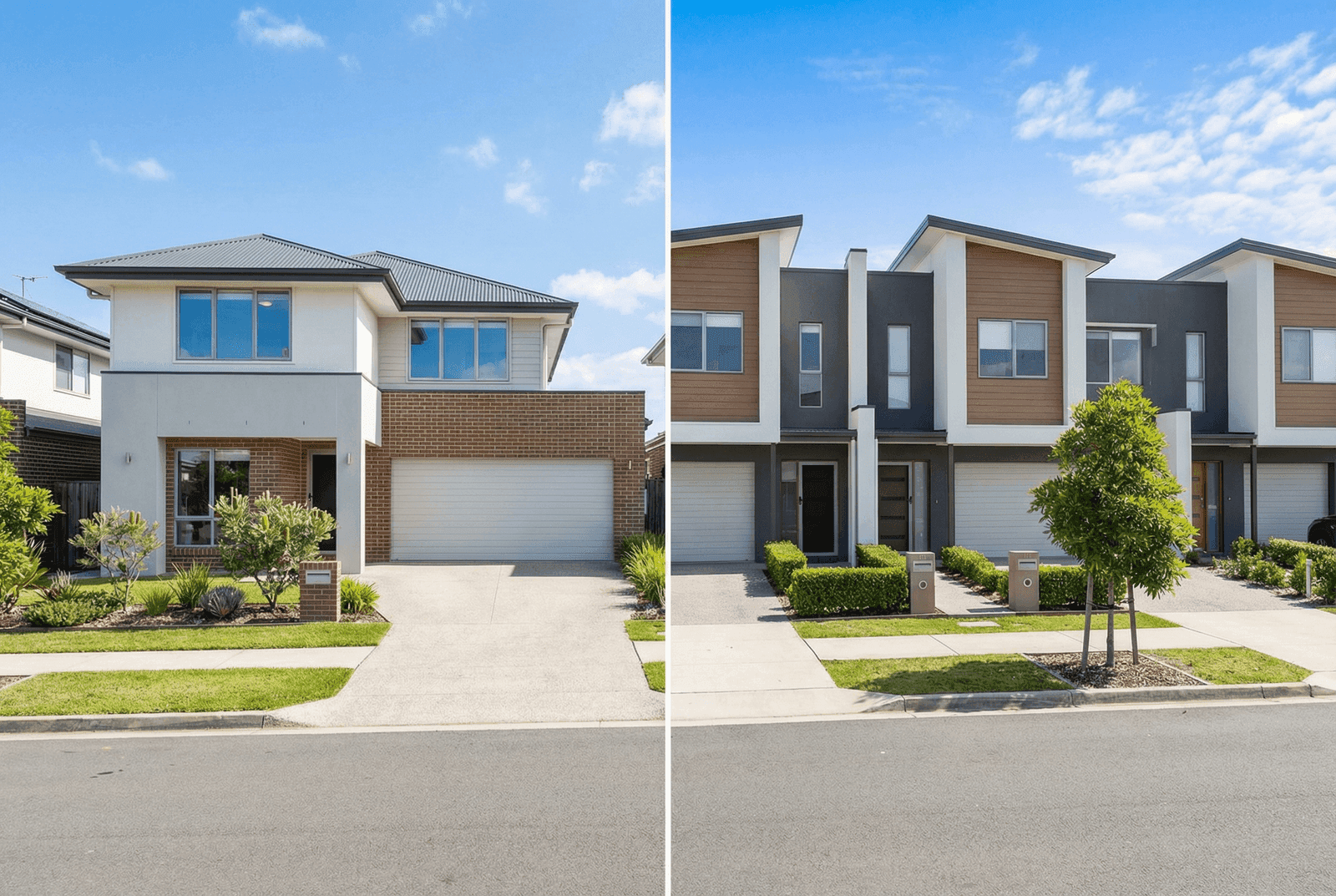
Class 1 buildings are houses. They're typically standalone single dwellings of a domestic or residential nature. These buildings can also be horizontally attached to other Class 1 buildings (like townhouses), provided they're separated by fire-resisting and sound-insulating walls.

Class 1a

A single dwelling being a detached house, or one of a group of attached dwellings.

Examples:
  • Detached house
  • Townhouse
  • Row house
  • Terrace house
  • Duplex (when separated)

Class 1b

Boarding house, guest house, or hostel with specific limitations.
Requirements:
  • Floor area less than 300m²
  • Ordinarily fewer than 12 people
  • OR: 4+ dwellings on one allotment for short-term holiday accommodation
⚠️

Key Restriction

Class 1 buildings cannot be located above or below any other dwelling or any other class of building—except for a private garage. If dwellings are stacked vertically, the building becomes Class 2.

Class 1 Examples

Volume Two
Australian residential buildings — detached house with brick and render facade alongside contemporary townhouse row in suburban setting

Common Features

  • Single family occupation
  • Direct ground floor access (not stacked)
  • Fire separation walls for attached dwellings
  • Covered by NCC Volume Two
Multi-Residential

Class 2 – Apartment Buildings

Class 2 buildings are apartment buildings containing two or more sole-occupancy units (SOUs). These are multi-unit residential buildings where people live above and below each other—the key distinction from Class 1.

What is a Sole Occupancy Unit (SOU)?

A sole-occupancy unit is a part of a building for occupation by an owner, lessee, or tenant to the exclusion of others. In Class 2 buildings, each apartment is an SOU. The key factor is exclusivity of use—not how many people occupy it.

Class 2 Examples

  • Apartment buildings
  • Residential flats
  • Units
  • Single-storey attached dwellings with common space below (e.g., shared basement carpark)

Key Characteristics

  • Dwellings stacked vertically
  • Each unit is a separate SOU
  • Common areas (corridors, lifts, lobbies)
  • Covered by NCC Volume One
Know the Difference

Class 3 – Residential Buildings for Unrelated Persons

Class 3 buildings are residential buildings (other than Class 1, 2, or Class 4) that provide a common place of long-term or transient living for unrelated people. Understanding the difference between Class 2 and Class 3 is crucial.

Class 2 – Apartments
  • Separate dwellings (SOUs)
  • Each unit self-contained
  • Individual ownership/lease
  • Private kitchens/bathrooms
  • Example: Apartment block
Class 3 – Communal Accommodation
  • Communal living arrangement
  • Shared facilities common
  • Unrelated occupants
  • May share kitchens/bathrooms
  • Example: Backpackers hostel

Class 3 Examples

  • Boarding houses
  • Guest houses
  • Hostels
  • Backpackers
  • Hotels (residential parts)
  • Motels (residential parts)
  • Workers' quarters
  • Dormitory accommodation
  • Residential schools (not Class 9)
  • Detention centres (residential)
  • Care facilities (not Class 9)
💡

Class 1b vs Class 3

If a boarding house or hostel exceeds the Class 1b limits (floor area 300m² or more, OR 12+ people ordinarily), it becomes Class 3. The Class 1b limits are the threshold between the two classifications.
Special Case

Class 4 – Dwelling Within Non-Residential Building

A Class 4 part of a building is a sole dwelling or residence within a building of a non-residential nature. This is not a standalone building class—it's always a "part of" another building.

Examples

  • Caretaker's residence in a storage facility
  • Manager's apartment above a shop
  • Caretaker's flat in an office building
  • Security guard quarters in a warehouse

Key Restrictions

  • Can only be in Class 5-9 buildings
  • Cannot be in Class 1, 2, or 3 buildings
  • Maximum one Class 4 part per building
  • Must be sole dwelling (only residence in building)
Commercial & Industrial

Class 5-8 – Commercial and Industrial Buildings

Classes 5 through 8 cover commercial, retail, storage, and industrial buildings. All are covered by NCC Volume One.

5

Office Buildings

Buildings used for professional or commercial purposes (not involving storage, display, or sale of goods).

Examples:

Law offices, accountants, government agencies, architects, medical practices (where treatment doesn't render patients unconscious)

6

Retail & Service

Places for sale of retail goods or supply of services direct to the public.

Examples:

Shops, restaurants, cafés, hairdressers, shopping centres, showrooms, funeral parlours, service stations

7a

Car Parks

Buildings used for parking vehicles.

Examples:

Multi-storey car parks, parking stations, basement car parks

7b

Warehouses & Storage

Buildings for storing goods or displaying goods for wholesale.

Examples:

Warehouses, distribution centres, wholesale storage, trade suppliers

8

Industrial / Factory

Buildings where a process or handicraft is carried out for trade, sale, or gain.

Examples:

Factories, workshops, mechanic workshops, laboratories (general), abattoirs, food processing

💡

Service Station Classification

Service stations are Class 6 (for fuel sales and car servicing). However, buildings solely for panel beating, auto electrical, or tyre replacement are Class 8as they involve manufacturing/processing work.
Public Buildings

Class 9 – Public Buildings

Class 9 buildings are buildings of a public nature with three important sub-classifications based on their specific use: healthcare, assembly, and residential care.

9a

Healthcare Buildings

Buildings where occupants or patients undergo medical treatment and may need physical assistance to evacuate.

  • Hospitals (public and private)
  • Day surgery clinics
  • Clinics where treatment renders patients unconscious
  • Laboratories within healthcare buildings
9b

Assembly Buildings

Buildings where people gather for social, theatrical, political, religious, or civil purposes.

  • Schools and universities
  • Childcare centres and pre-schools
  • Theatres and cinemas
  • Churches and places of worship
  • Nightclubs and sporting facilities
9c

Residential Care Buildings

A place of residence where 10% or more of residents need physical assistance in daily activities and to evacuate.

  • Aged care facilities
  • Residential care with personal care services
  • Excludes hospitals (which are 9a)

Note: A general medical practitioner's office is typically Class 5. However, if any treatment administered leaves patients unconscious or non-ambulatory (requiring supervised medical care on-site), it becomes Class 9a.

Structures

Class 10 – Non-Habitable Buildings and Structures

Class 10 covers non-habitable buildings and structures. These are typically ancillary to the main building on a property. They're covered by NCC Volume Two.

Class 10a – Non-Habitable Buildings

  • Sheds
  • Carports
  • Private garages
  • Barns
  • Patios and gazebos

Class 10b – Structures

  • Fences
  • Masts and antennas
  • Retaining walls
  • Free-standing walls
  • Swimming pools

Class 10c – Private Bushfire Shelters

A structure associated with, but not attached to, a Class 1a building. Designed for emergency bushfire refuge.

What is a Private Garage?

The NCC defines a private garage as either:

  • A garage associated with a Class 1 building, OR
  • A single storey containing not more than 3 vehicle spaces within a building, OR
  • Any separate single storey garage associated with another building containing no more than 3 vehicles
⚠️

Converting Class 10 to Residential

You cannot convert a Class 10a building (like a shed or garage) into a dwelling (Class 1a) without building approval. This requires a Change of Classification application and the building must meet all Class 1a requirements including fire safety, amenity, and structural standards.
Complex Classifications

Mixed-Use Buildings and Multiple Classifications

Buildings can have mixed uses and therefore mixed (or multiple) classifications. The NCC requires each part of a building to be classified according to its purpose.
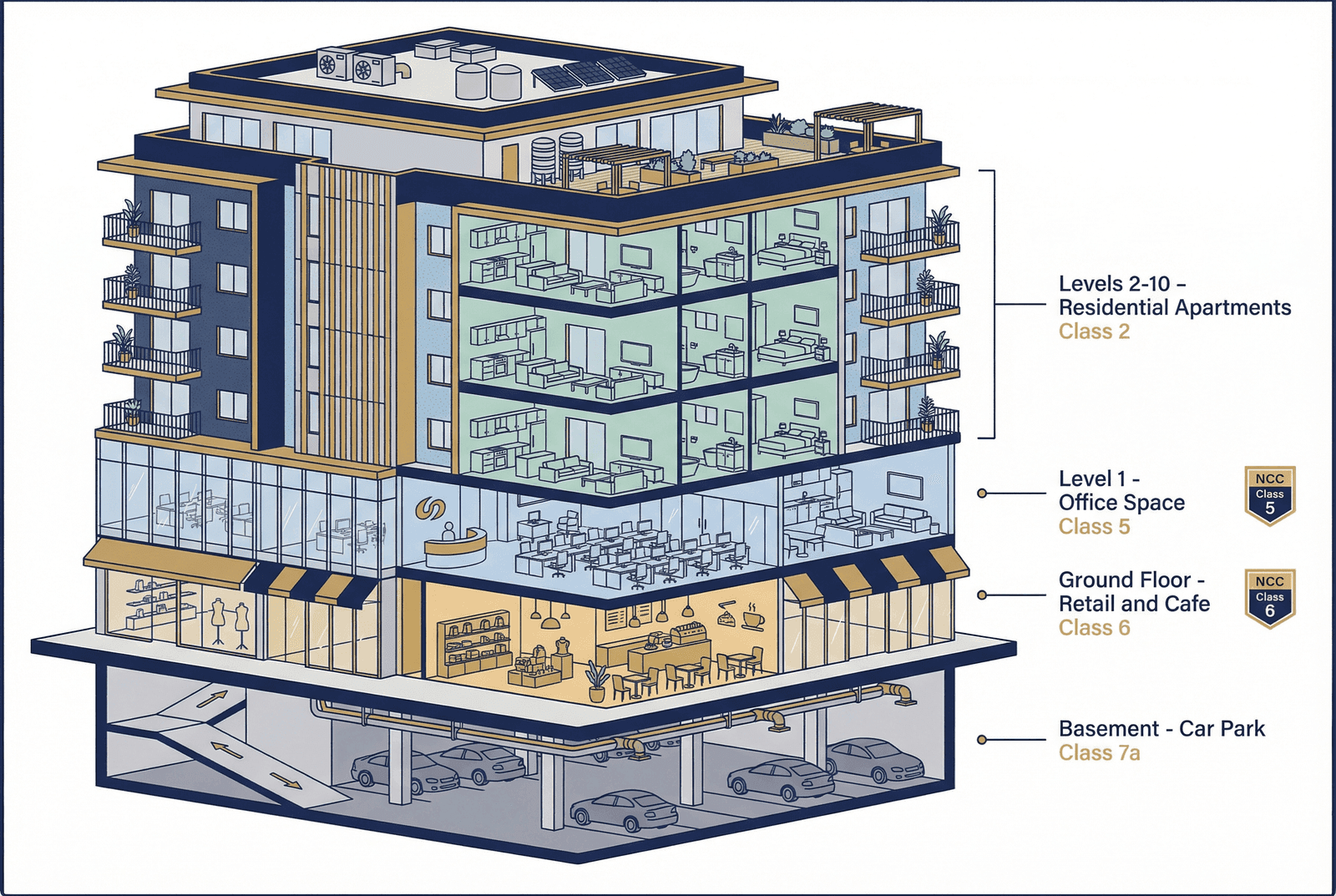
Example: Mixed-Use Development

Multiple Classes
Isometric cutaway of mixed-use building showing NCC classes — basement car park (Class 7a), ground floor retail and cafe (Class 6), office space (Class 5), residential apartments (Class 2)

Typical Mixed-Use Example

  • Basement: Car park (Class 7a)
  • Ground floor: Retail shops, cafés (Class 6)
  • Level 1: Office space (Class 5)
  • Levels 2-10: Residential apartments (Class 2)

Each part must comply with requirements for its specific classification.

The 10% Rule

If a part of a building has a different purpose but occupies less than 10% of the floor area of that storey, it may adopt the classification of the major use.

Example: An 8% office area in a warehouse can be classified as Class 7b.

Multiple Classifications

A building (or part) designed for multiple purposes can have more than one classification simultaneously. For example, a building designed for retail, storage, or office use may be classified as Class 5/6/7.

Process

How Building Classification is Determined

The appropriate authority—typically a registered building certifier or building surveyor—is responsible for determining the building classification. This is a critical step in the building approval process.

Key Principles

  • Classification is based on intended use
  • Each part of a building must be classified separately
  • If unclear, classify as the class it most closely resembles
  • State/territory variations may apply

Finding Existing Classification

Most existing buildings have been subject to building approval. To find the classification of an existing building:

  • Check building approval documentation
  • Contact your local council
  • Engage a registered building surveyor
💡

Change of Use

Changing a building's use may require a change of classification. This typically requires building approval from a certifier, and the building must meet all requirements for the new classification—even if some requirements are similar to the current use.
Career Relevance

Building Classes & Builder Licensing

Understanding building classes is essential for anyone pursuing a career in construction. Builder licensing categories often align with building classes, determining what work you can legally undertake.

Qualifications by Building Class

Career Pathway
Building professional reviewing architectural plans at desk with Certificate IV in Building and Diploma of Building and Construction certificates on wall

Typical Qualification Requirements

  • Certificate IV in Building (CPCBC40120): Class 1, 10, and Class 2-9 Type C constructions
  • Diploma of Building (CPCBC50220): Higher-rise and more complex buildings
  • Advanced Diploma (CPCBC60220): Project management for major commercial projects

Requirements vary by state. Check with your state building authority for specific licence categories.

View Certificate IV →View Diploma →Compare All Qualifications →

Why This Matters for Your Licence

Your builder's licence typically specifies which building classes you can work on. Understanding the NCC classification system helps you identify your scope of work and plan your career progression. Higher qualifications generally allow work on more complex building classes. Read our complete builder's licence guide to learn more.

Already have industry experience? You may be able to fast-track your qualification through Recognition of Prior Learning (RPL).

Common Questions

Frequently Asked Questions

Australia's National Construction Code (NCC) classifies buildings into 10 main classes (Class 1-10) based on their use. These include residential buildings (Class 1-4), commercial buildings (Class 5-8), public buildings (Class 9), and non-habitable structures (Class 10). Some classes have sub-classifications like Class 1a, 1b, 7a, 7b, 9a, 9b, 9c, 10a, 10b, and 10c.

Disclaimer: This information is general in nature and based on the National Construction Code 2022. Building classification can be complex and may be affected by state and territory variations. For specific advice on your project, consult a registered building certifier or surveyor, or contact your local council. Building regulations change periodically—always verify current requirements with your state or territory building authority before commencing any building work.

Our qualifications are designed so you can study while you work — 100% online, at your own pace.

BUILDING CLASSES

Ready to Advance Your Building Career?

Understanding building classes is essential for anyone working in construction. Our nationally recognised qualifications cover NCC requirements and prepare you for a successful career as a licensed builder or site supervisor.